On this page (6)
Gladly is good at people-first service. One thread per customer across voice, chat, email and SMS, agents who see the whole history, strong phone tooling. For large retail contact centres, it does the job well.
The gaps show up when an online store wants AI to do the work instead of talking about it. Ask most support AI to change a size on a paid order, cancel before dispatch or deal with a lost parcel, and it replies politely, then passes the job to a person. That’s usually when brands start looking elsewhere.
This guide covers the 7 Gladly alternatives that eCommerce teams weigh most when they want AI support. Each one suits a different kind of operation. The right choice depends on one question: do you want AI that chats with customers, or AI that resolves the problem inside your store?
Gladly alternatives compared
| Tool | Best for | Executes store actions or chat only | Logistics automation depth | Product recommendations / sales |
|---|---|---|---|---|
| Minami | Stores that want logistics issues resolved by AI end to end | Executes actions itself | Full: order edits, cancellations, address changes, delivery incidents, courier claims, returns and exchanges | Yes, in chat and inside exchanges, with in-chat checkout |
| Gorgias | Shopify teams keeping agents in an inbox | AI handles some flows; agents act from the sidebar | Medium: returns and tracking via AI, edits mostly by agents | Separate Shopping Assistant |
| Richpanel | DTC teams wanting a helpdesk with AI actions | AI performs order and subscription updates | Medium: order and subscription changes, self-service portal | Not a focus |
| Kustomer | Large multi-brand contact centres | AI assists agents and automates workflows | Depends on custom setup | Not a focus |
| Intercom Fin | Knowledge-heavy support on any helpdesk | Mostly conversational; actions via configured connectors | Low to medium, depends on setup | Fin for sales |
| Zendesk | Big support orgs needing governance | Conversational AI plus Action Builder | Low out of the box, Shopify via apps | Not a focus |
| Freshdesk | General ticketing on a budget | Conversational AI | Low, Shopify via apps | Not a focus |
Why eCommerce brands look for a Gladly alternative for AI support
Gladly is designed around people. Each customer gets one lifelong conversation, and the platform’s job is to make the agent in that conversation fast, informed and personal. Even its AI is pitched as a single assistant that talks to shoppers before and after they buy.
That’s the issue for an online store. Most of a store’s support queue isn’t a conversation problem. It’s a logistics problem: an order that needs a different size, an address typed wrong, a parcel stuck at a depot, a return that should be an exchange. A conversational layer can explain the policy. It can’t make the change, so the ticket still ends with an agent opening Shopify and the carrier portal.
Brands searching for a Gladly AI alternative usually want the reverse: AI that goes into the store, takes the action and closes the case, with people only seeing the true exceptions. Some also want that same AI to recommend products while it’s helping, so support starts adding revenue instead of only costing it.
7 Gladly alternatives for AI-first support
1. Minami AI
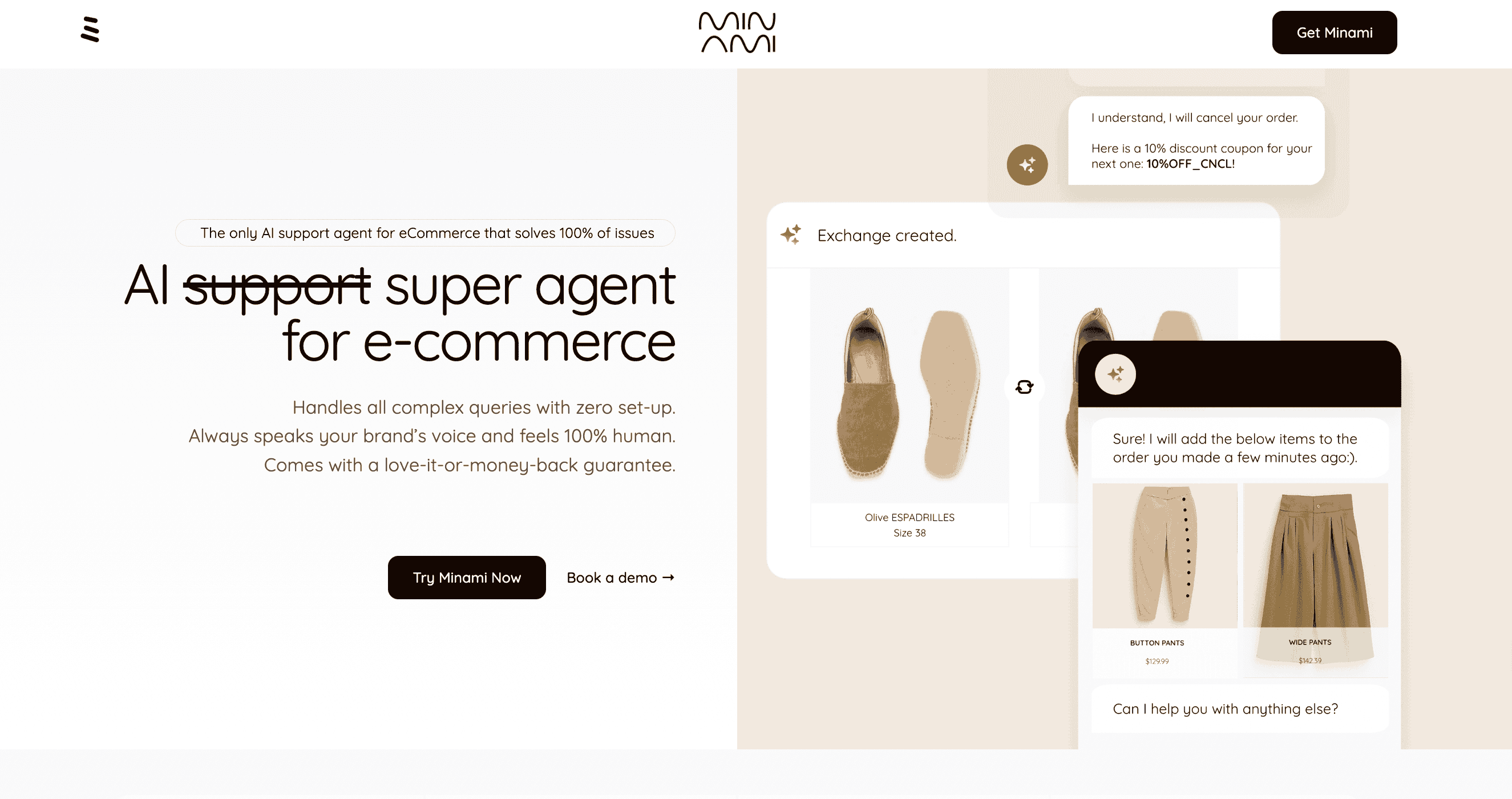
Best for: online stores that want every logistics issue, from order edits to delivery incidents, resolved by AI inside the store, plus product recommendations that lift sales.
Minami isn’t a chatbot sitting on top of your helpdesk. It’s an AI agent that executes. When a customer asks to swap a size, Minami edits the paid order in Shopify. When a parcel is late or damaged, it deals with the courier and files the claim. Minami’s own positioning is that it solves up to 100% of support issues, and its whole design is aimed at resolving an online store’s logistics problems without a human in the loop.
What it executes inside your store
- Order edits: adds items to paid orders or removes them before fulfilment.
- Cancellations: cancels eligible orders before they ship, offering an alternative first.
- Address changes: updates delivery details before dispatch.
- Delivery incidents: handles lost, damaged and delayed parcels; Minami says it resolves 90% of these without a human.
- Courier work: manages over 80% of carrier communication and pursues claims (Minami’s figure).
- Returns and exchanges: applies your policy and steers customers toward an exchange.
- WISMO: sends tracking updates before the customer asks.
Product recommendations and sales
Minami also sells. It answers product questions and recommends items during the conversation, and inside an exchange it can suggest any product in your store with instant checkout in the chat. Adding a forgotten item to a paid order becomes an upsell without a new checkout. You can read more on its shopping experience page.
Setup and pricing
No flows to build. You share your policies, install the Shopify app or a tag, and exceptions reach your team with full context. Set-up costs nothing and pricing is custom (contact sales).
Pros and cons
- Pros: executes real logistics actions in Shopify and with carriers rather than just replying; covers the full post-purchase journey; recommends products and turns exchanges into sales; no configuration work.
- Cons: built for email and store chat rather than voice; eCommerce-only, so it’s not for SaaS support.
Our take: if what you want from AI is fewer tickets, not better-worded replies, this is the one. It was designed to take the logistics work itself off your team, and it sells while it’s at it.
- Talks directly with carriers to change addresses, reroute parcels and open delivery incidents, then executes the change in the store or CMS end to end.
2. Gorgias

Best for: Shopify brands that want agents in a store-aware inbox, with AI covering part of the queue.
Gorgias is an eCommerce helpdesk first. Its strength is putting Shopify order data next to every ticket so agents can refund, edit or look up orders without switching tabs. Its AI Agent handles flows like returns and tracking, and a separate Shopping Assistant works on pre-sales. For the details, see our breakdown of Gorgias AI Agent pricing.
What it executes
Agents can act on orders from the sidebar; the AI resolves set flows and escalates the rest. Much of the order editing still happens by hand, by a person.
Pricing
Starter $40/mo (monthly only, 50 tickets and 30 automated interactions); Basic $90/mo, or $77/mo billed annually (300 tickets); Pro $550/mo, or $471/mo annually; Advanced $1,430/mo, or $1,227/mo annually. Beyond the included volume, extra tickets cost $0.36 to $0.40 each and AI Agent automated interactions $1.50 each.
Pros and cons
- Pros: deepest Shopify inbox on the list, 254 integrations, dedicated pre-sales assistant.
- Cons: the AI is a layer on an agent tool, so complex order changes usually land with people.
Our take: a good home for teams that want humans doing the order work with better tools. If you want the AI to do it, look at the top of the list.
3. Richpanel

Best for: DTC teams that want a helpdesk where AI can update orders and subscriptions.
Richpanel is a multichannel inbox (email, chat, social, SMS, WhatsApp, phone) whose AI can carry out order and subscription changes. A self-service portal lets shoppers track, return or cancel without writing in.
What it executes
Order and subscription updates through AI, plus portal-based self-service. Delivery incidents and courier follow-up are less of a focus.
Pricing
Helpdesk: Free ($0, 3 seats), Starter $29 per user/mo, Pro $99 per user/mo. AI and self-service plans are priced by order volume: Free (up to 50 orders/mo), Starter $50/mo, Pro $600/mo, with lower annual rates.
Pros and cons
- Pros: real AI order actions, wide channel coverage, migration help for switchers.
- Cons: still built around a seat-based agent inbox; limited on carrier-side logistics and sales.
Our take: a capable middle ground between a classic helpdesk and an executing agent.
4. Kustomer

Best for: large, multi-brand contact centres that like Gladly’s customer-centred approach.
Kustomer is the nearest relative to Gladly here. It’s built around the customer record, with a timeline of every interaction and custom objects for orders, and it scales to as many as 300 brands. AI agents and assistants handle routing, workflows, knowledge and search.
What it executes
Workflow automation and AI assistance for agents. Store actions depend on how you configure custom objects and integrations, which often means an implementation project.
Pricing
Custom / not published. Kustomer quotes each team after a short questionnaire; voice, SMS and WhatsApp are pay as you go.
Pros and cons
- Pros: strong omnichannel and voice, flexible data model, built for scale.
- Cons: automation of order logistics needs custom work; not eCommerce-specific.
Our take: right if you’re replacing Gladly like-for-like. It won’t, by itself, turn support into an AI that fixes orders.
5. Intercom Fin
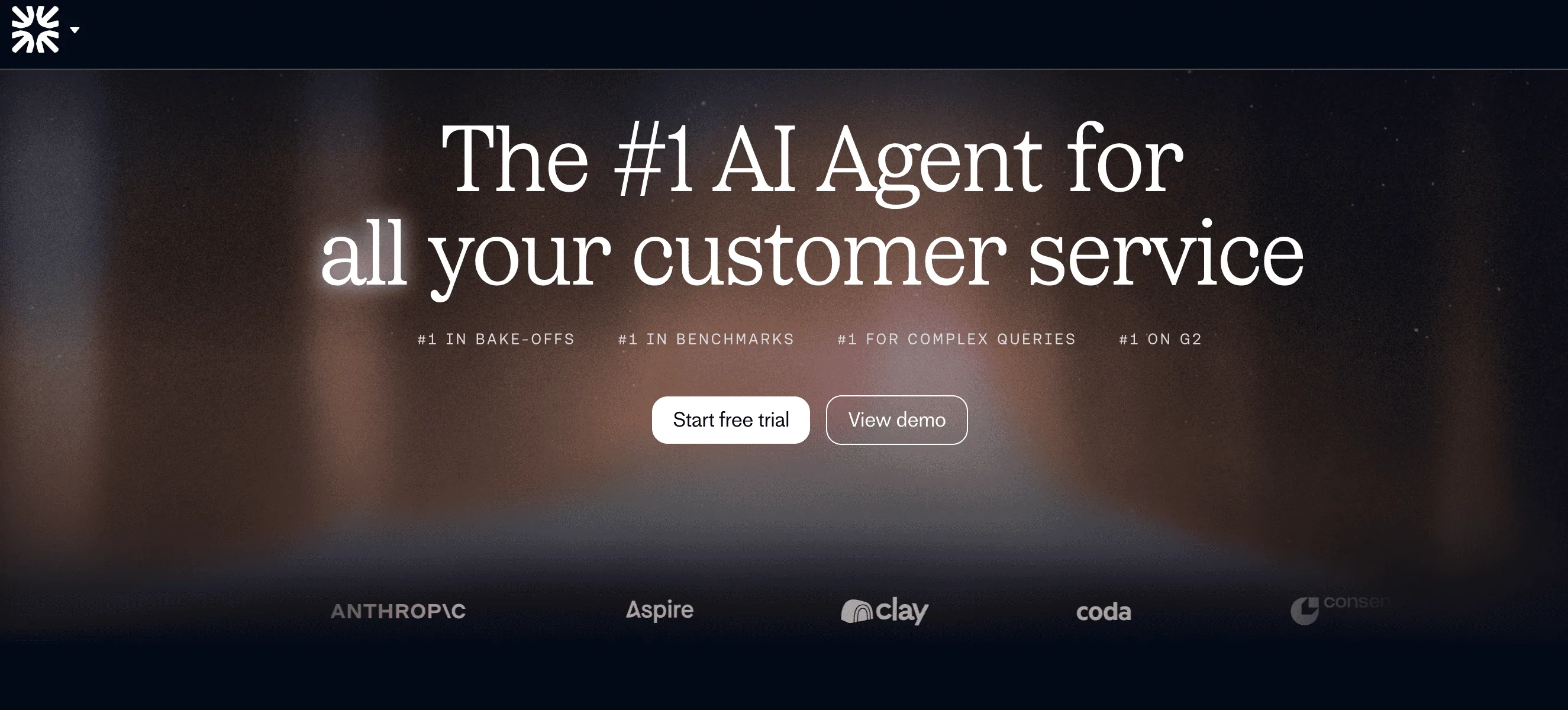
Best for: teams with knowledge-heavy questions that want a strong conversational AI on any helpdesk.
Fin is Intercom’s AI agent, available inside Intercom or on top of another helpdesk. It’s excellent at answering from your content, and it can call external systems once you set that up. Intercom also offers Fin for sales. Our Intercom Fin pricing guide has the specifics.
What it executes
Primarily conversations. Order actions are possible through configured connectors, but they aren’t built in for Shopify logistics.
Pricing
Essential $29 per seat/mo ($19 billed annually), Advanced $85 per seat/mo, Expert $132 per seat/mo. Fin AI Agent is billed at $0.99 per outcome on every plan, and Copilot is $29 per agent/mo.
Pros and cons
- Pros: high-quality answers, works with your existing helpdesk, sales use case available.
- Cons: a conversational layer first; store logistics need extra setup.
Our take: a great talker. If your queue is mostly orders and parcels, it’ll still hand much of it to people. See also our Intercom alternatives.
6. Zendesk
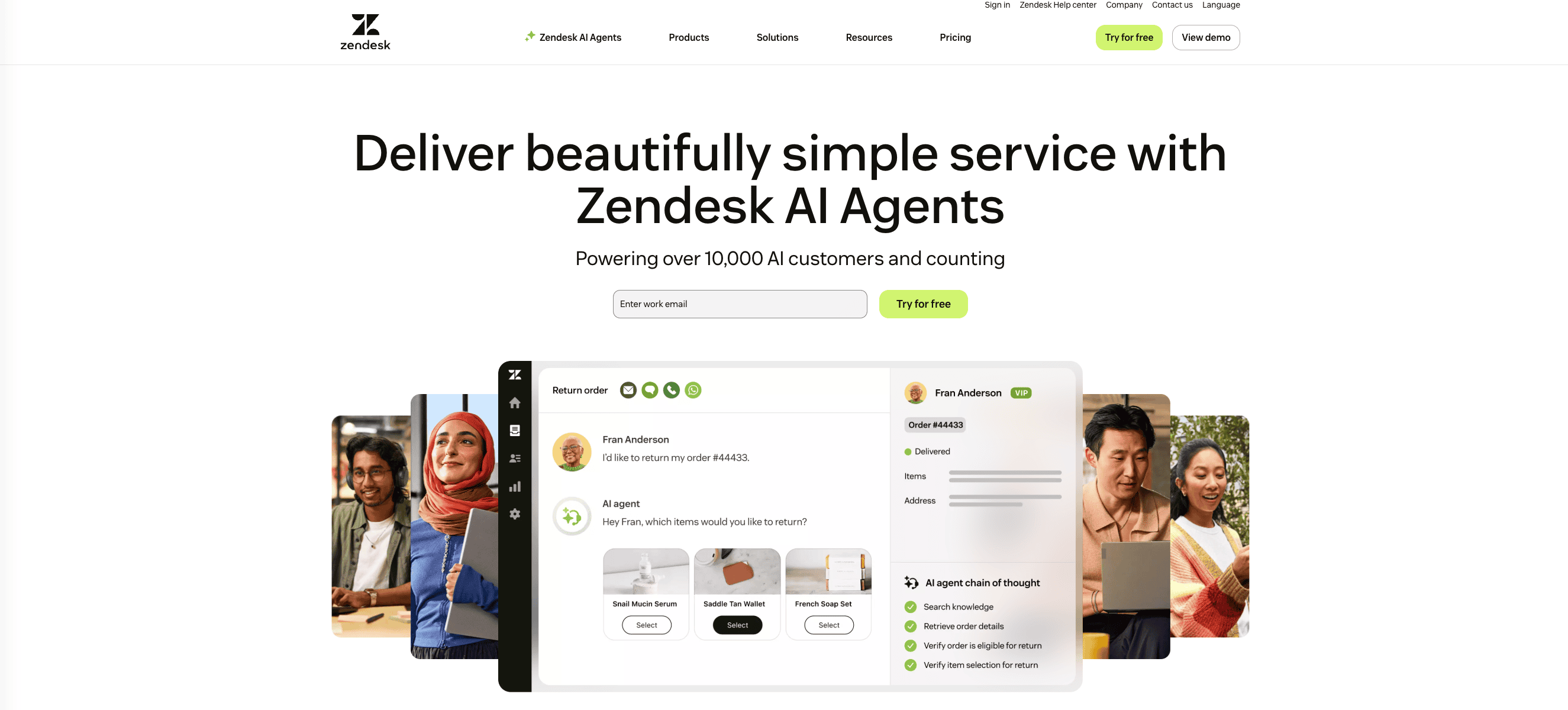
Best for: large support organisations that need routing, SLAs and native telephony.
Zendesk is the usual like-for-like choice for big Gladly customers. Its AI agents answer conversations, and Action Builder can connect to other systems. Shopify comes in through marketplace apps rather than the core product.
What it executes
Conversational AI with optional actions you build. Out of the box, it doesn’t edit Shopify orders or work with carriers.
Pricing
Support Team $19 per agent/mo, Suite Team $55, Suite Professional $115 (billed annually; $25, $69 and $149 billed monthly). Automated AI agent resolutions beyond the included amount are $1.50 each, and Copilot is a $50 per agent/mo add-on.
Pros and cons
- Pros: widest enterprise feature set, native voice, huge app marketplace.
- Cons: eCommerce actions need apps and building; heavy rollout.
Our take: strong governance, light store automation. For eCommerce-first options, see our guide to Zendesk AI alternatives.
7. Freshdesk
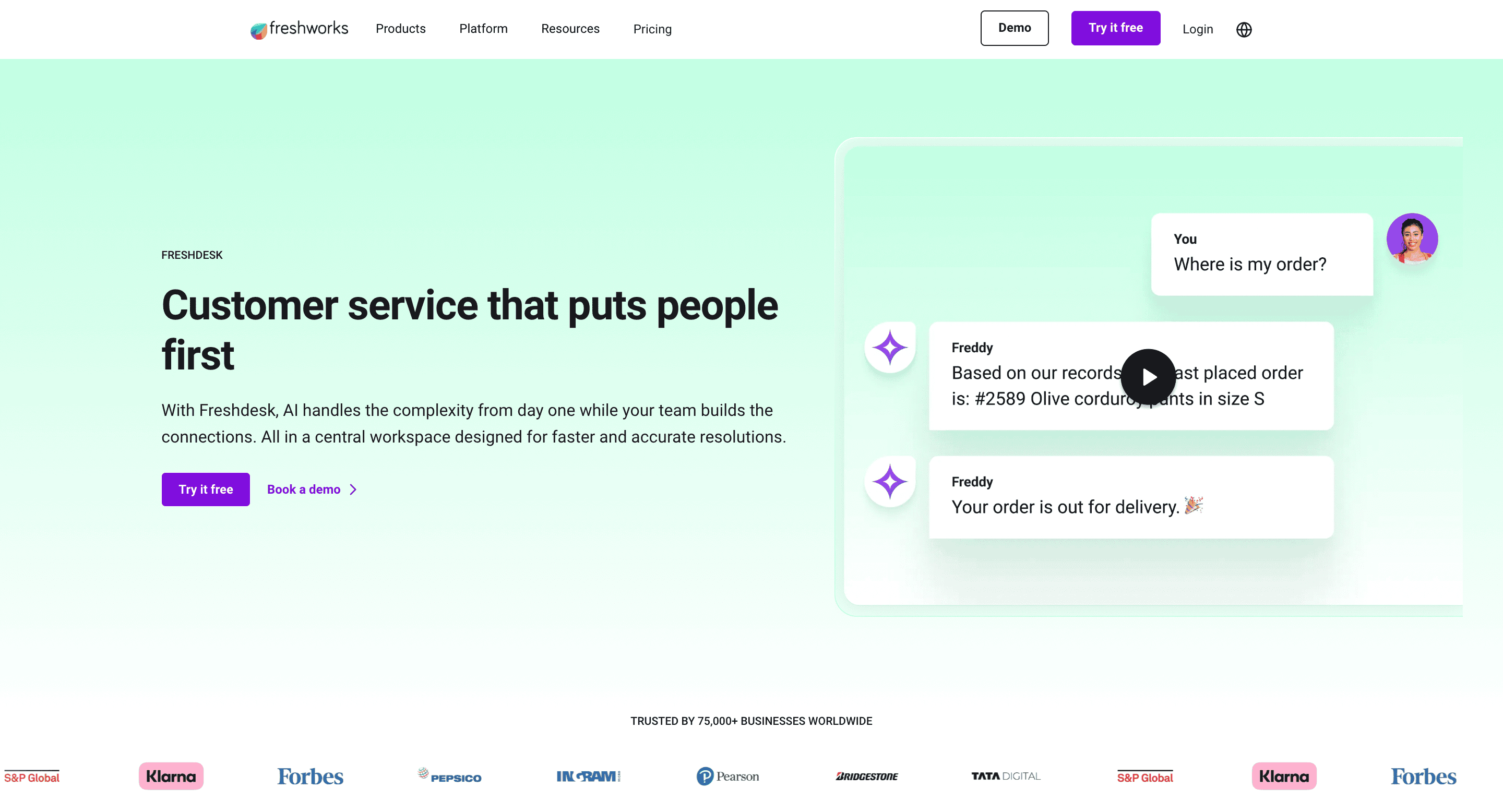
Best for: teams that want dependable ticketing and SLAs from a general helpdesk.
Freshdesk offers ticketing, a portal, a knowledge base and Freddy AI Agent, which answers conversations across channels. Shopify depth depends on marketplace apps.
What it executes
Mostly conversational. Store actions rely on apps and custom setup.
Pricing
Growth $19 per agent/mo, Pro $55, Enterprise $89 (billed annually). Freddy AI Agent sessions are $49 per 100 sessions, and Freddy AI Copilot is $29 per agent/mo.
Pros and cons
- Pros: solid SLA tooling, easy to start, day passes for peak season.
- Cons: AI focused on replies; little native logistics automation.
Our take: fine as a general helpdesk. It won’t resolve order problems on its own.
Pricing of the Gladly alternatives in 2026
| Tool | Starting price | Pricing model | AI cost |
|---|---|---|---|
| Minami | Custom | Custom pricing, contact sales | Custom |
| Gorgias | $40/mo | Monthly plan by ticket volume | $1.50 per automated interaction beyond included |
| Richpanel | $29 per user/mo (free tier available) | Per user, plus order-based AI plans | AI plans from $50/mo by order volume |
| Kustomer | Custom / not published | Quoted per team | Not published |
| Intercom Fin | $29 per seat/mo | Per seat, plus usage | $0.99 per Fin outcome |
| Zendesk | $19 per agent/mo | Per agent | $1.50 per automated resolution; Copilot $50/agent/mo |
| Freshdesk | $19 per agent/mo | Per agent | $49 per 100 AI Agent sessions; Copilot $29/agent/mo |
Checked against official vendor pricing pages on 29 October 2026 (USD). Treat them as a snapshot, not a quote.
People-centred or action-centred?
Decide what you want AI to do. If the answer is “talk to customers,” most tools here will do it, and Kustomer or Zendesk will feel closest to Gladly. If the answer is “fix the order, sort the parcel, run the exchange and sell something on the way,” you need an agent that executes inside your store. That’s Minami, and it’s why it’s first.
For human-led teams that want better order tools, Gorgias. For a helpdesk where AI can change orders and subscriptions, Richpanel. For strong conversational AI on your current stack, Intercom Fin. For a general helpdesk, Freshdesk.
Let Minami resolve, not route
If your agents spend their days inside Shopify and carrier portals doing work a customer asked for in one sentence, Minami takes that work over. It edits and cancels orders, updates addresses, resolves delivery incidents with couriers and runs exchanges, all in your brand voice, while recommending products that turn support into sales.
There’s no set-up cost and you get your money back if you’re not happy. Sign up at minami.ai or book a call to see it on your store. Comparing more AI options? Read our roundup of AI agents built for online stores.
Minami AI agent
Automate 100% of your eCommerce support
Minami doesn't just chat. It takes the action inside your store and sells while it solves.
- Order edits and cancellations
- Address changes and delivery incidents
- Returns, exchanges and product recommendations