On this page (6)
Netomi earns its place on enterprise shortlists. It’s built for companies where one customer request crosses a booking engine, a policy database and a CRM before anyone can answer. Airlines. Insurers. Telcos. If your CX org runs on long contracts and security reviews, it speaks your language. Related reading: Ada CX alternatives and enterprise AI help desks.
An online store has a different rhythm. Your customers want a parcel located, a size swapped on an order placed twenty minutes ago, a refund that matches the policy you wrote last spring. That’s work inside Shopify and a courier portal, repeated hundreds of times a week, and a platform designed for every industry leaves you configuring each step yourself, through a sales-led process, at a price nobody will quote you upfront. That’s usually the week someone types “Netomi alternative” into a search bar.
This guide walks through 7 options that come from the eCommerce side of the market. Some fit a lean Shopify team, some suit a large DTC operation, and one or two only make sense if you already run a particular helpdesk. Which one belongs on your list comes down to a single question: when a customer writes in, do you need a reply, or do you need the order fixed?
Netomi alternatives compared
| Tool | Best for | Executes store actions or chat only | Logistics automation depth | Product recommendations / sales |
|---|---|---|---|---|
| Minami | Stores that want AI to close order and delivery problems end to end | Executes actions itself | Full: order edits, cancellations, address changes, delivery incidents, courier claims, returns and exchanges, WISMO | Yes, in chat and inside exchanges, with in-chat checkout |
| Gorgias AI Agent | Shopify brands that want helpdesk and AI in one bill | Runs a set of Shopify actions; agents cover the rest | Medium: tracking, returns, selected order edits | Shopping Assistant on higher plans |
| Siena AI | Mid-size DTC brands with a strong brand voice | Runs actions through connected apps | Medium to high, depends on the stack | Yes, shopping and social flows |
| Yuma AI | Shopify Plus teams paying only for resolved tickets | Executes workflows on top of your helpdesk | Medium to high: order and subscription workflows | Some, mostly support focused |
| Ada | Enterprises that want a similar platform with more retail references | Conversational, with configured actions | Moderate, custom built | Not a focus |
| Intercom Fin | Brands that sell across web, app and social and want one AI | Conversational, with Shopify actions available | Medium, depends on configured procedures | Yes, Fin for sales |
| Zendesk AI agents | Teams already standardised on Zendesk | Actions via Action Builder flows | Low to medium, built by your admins | Not a focus |
Why retail teams start looking past Netomi
Nothing here is a knock on the technology. Netomi’s reasoning engine and its integrations with enterprise systems are the reason big names sign with it. The issue is fit, and it shows up in three places.
First, buying it. There’s no pricing page and no trial; Netomi has said new engagements come through referral. A 40-person DTC brand that wants to test AI on November’s ticket spike can’t move at that speed.
Second, the store itself. In a typical shop, 60 to 70% of contacts are post-purchase: tracking, changes, damage, returns. Each of those is a sequence of clicks in Shopify, a 3PL and a carrier account. A horizontal platform can automate them, but every flow is a project.
Third, revenue. Retail support conversations are full of buying moments, like the customer exchanging jeans who’d happily add a belt. Netomi is built to resolve, not to sell, so that upside goes unused.
Seven AI agents to replace Netomi in an online store
1. Minami
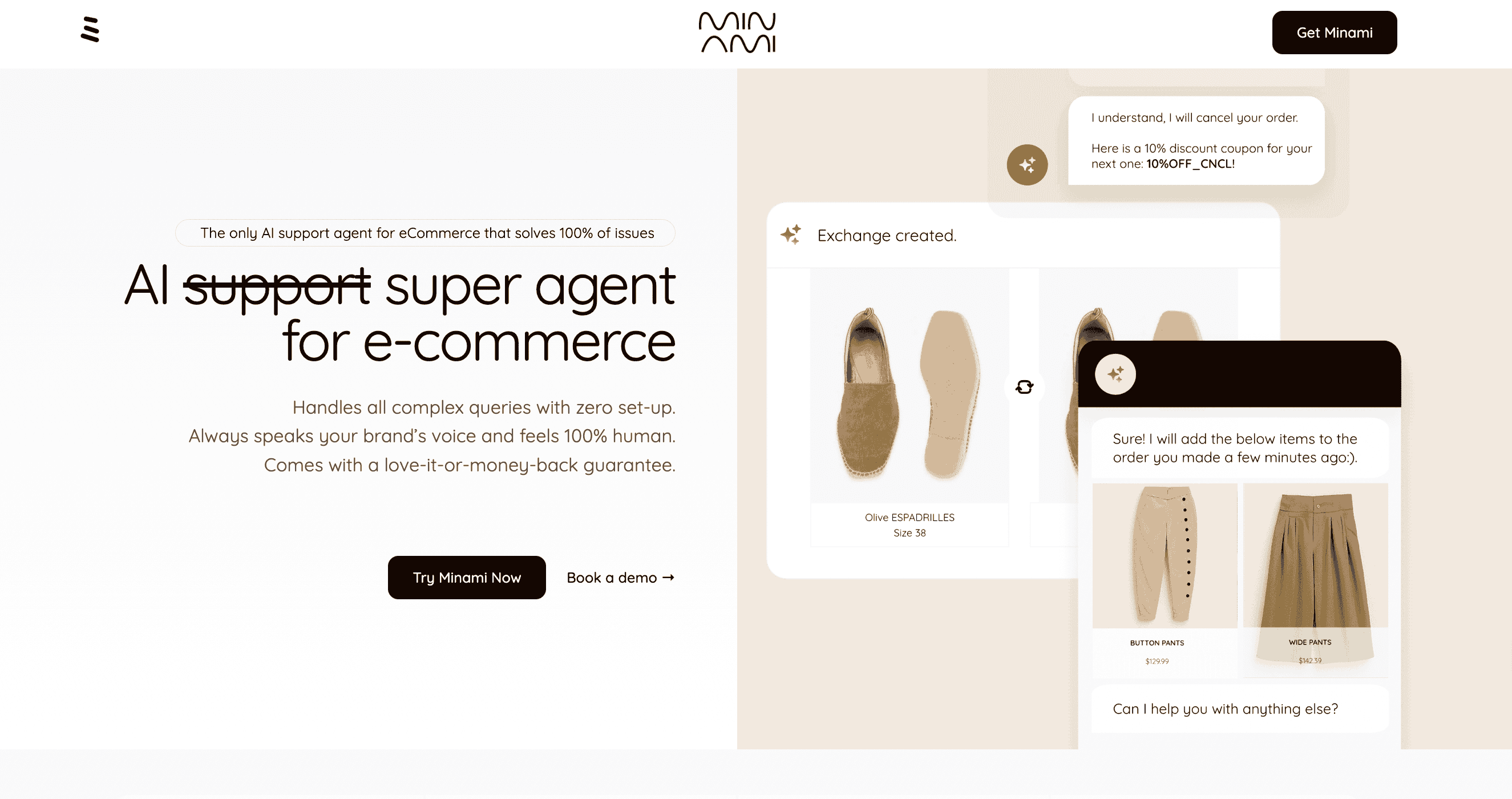
Minami doesn’t try to be a conversation platform for every industry. It’s an AI agent made for online stores, and the difference is that it acts. When a customer asks for a different colour, the paid order changes in Shopify. When a parcel goes missing, the courier claim gets filed. The target Minami sets is every logistics case in the shop handled by AI, start to finish, so people only see the genuinely odd ones.
Where it fits
Brands of any size whose queue is dominated by “where is it”, “change it” and “send it back”. It’s a strong match for teams that tried a chatbot, saw it deflect questions, and still found the same orders on someone’s to-do list.
What it can actually do in the store
- Edits paid orders before packing, adding or removing items without a new checkout.
- Cancels eligible orders pre-dispatch, offering a swap first.
- Corrects shipping addresses before the label prints.
- Works lost, late and damaged parcels; Minami reports resolving about 9 in 10 without a person.
- Talks to carriers, handling over 80% of that communication by its own count.
- Runs returns and exchanges on your rules and steers toward exchanges; see the returns and exchanges agent.
- Sends tracking updates before anyone has to ask.
On the sales side it recommends products during the chat and inside exchanges, with checkout in the conversation. The AI shopping experience page covers how. Installation goes through the Shopify app or a site snippet, with no flow builder and no set-up fee.
Pricing
Custom. Pricing is set per store; contact sales for a quote.
Watch out for
It’s focused on eCommerce. If you also need an AI for a bank branch or a call centre in another business line, you’ll want something broader. And because pricing isn’t public, you’ll need a short call to get a number.
2. Gorgias AI Agent
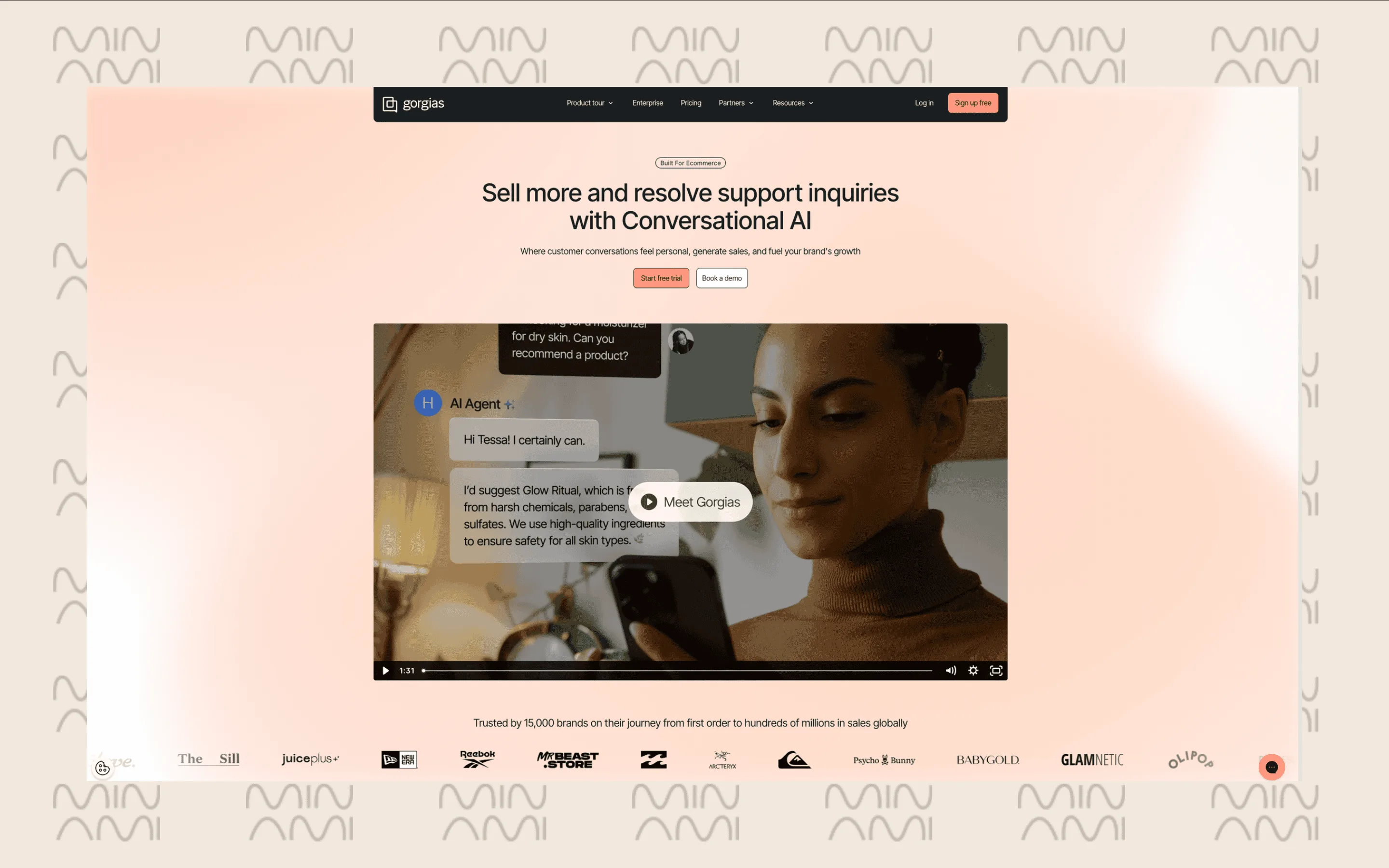
Gorgias is the helpdesk a lot of Shopify brands grow up on, and its AI Agent sits inside it. Compared with Netomi, it’s the opposite buying experience: pick a plan online, turn the agent on, see results the same week.
Where it fits
Shopify and BigCommerce teams of 3 to 30 agents who want tickets, macros and AI in one place.
What it can actually do in the store
Answers from your policies, shares tracking, starts returns and handles a set of order actions such as cancellations and address edits. More complex cases still go to an agent. A separate Shopping Assistant handles pre-sales.
Pricing
Starter $40/mo (monthly only, 50 tickets and 30 automated interactions); Basic $90/mo, or $77/mo billed annually (300 tickets); Pro $550/mo, or $471/mo annually; Advanced $1,430/mo, or $1,227/mo annually. Beyond the included volume, extra tickets cost $0.36 to $0.40 each and AI Agent automated interactions $1.50 each. The helpdesk alone, without AI Agent, starts at $10/mo.
Watch out for
Two meters run at once: tickets and AI interactions. In a peak month both climb together, so model December, not March.
3. Siena AI
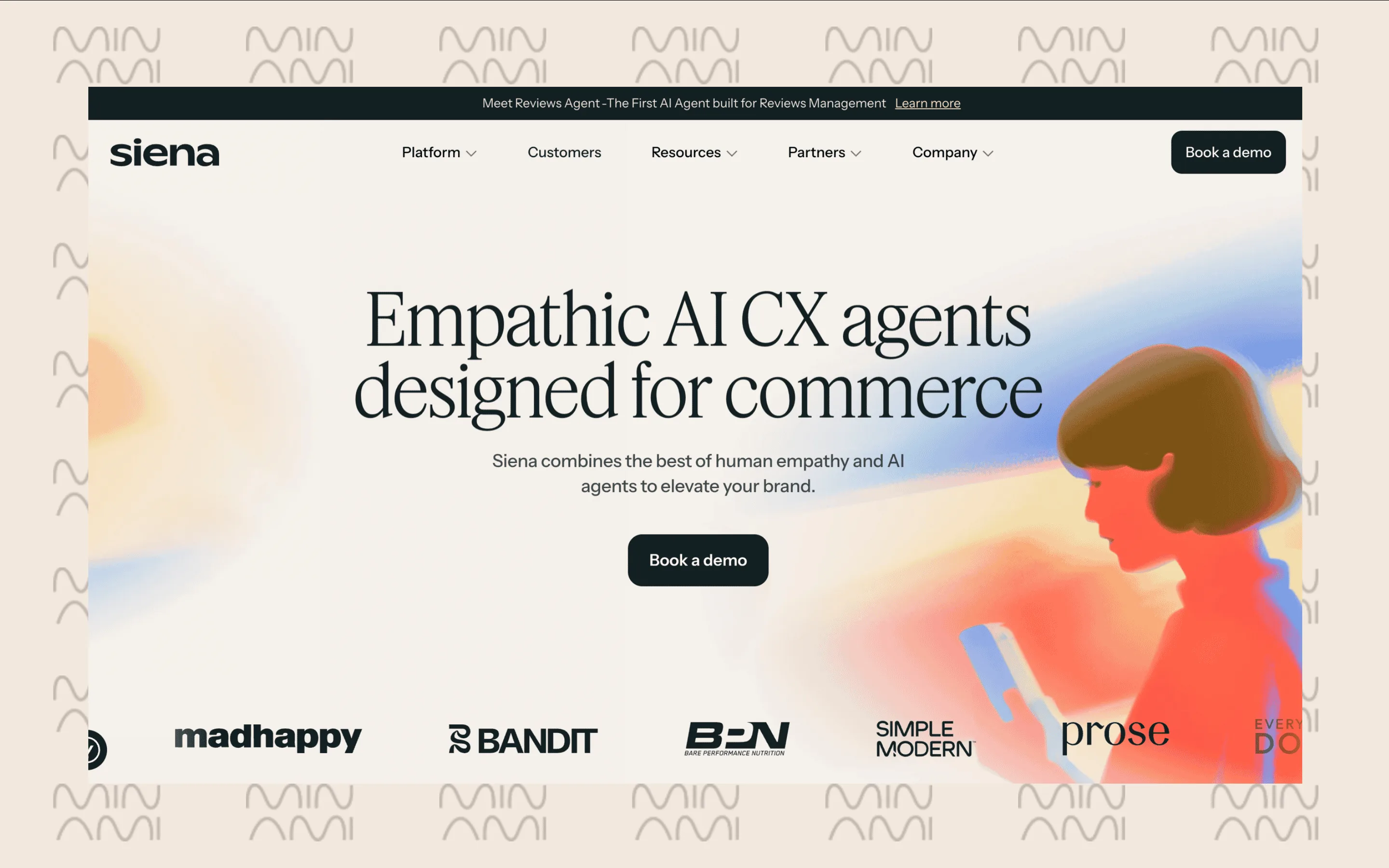
Siena markets itself as an agent of record for consumer brands, and its replies tend to sound like a person who likes the product. It plugs into Shopify, helpdesks like Gorgias and Zendesk, and returns or subscription apps.
Where it fits
DTC brands where tone of voice is part of the brand, and where support, social comments and shopping questions all deserve the same AI.
What it can actually do in the store
Order lookups, cancellations, address updates and returns through connected tools, plus social replies and shopping guidance. How far it goes depends on which apps you connect.
Pricing
$750/mo platform fee, then $0.90 per automated ticket through its Automation Pack. Implementation and Slack support are bundled; a final quote comes from sales.
Watch out for
The platform fee sets a floor that small stores will feel. It also leans on your existing helpdesk rather than replacing it.
4. Yuma AI
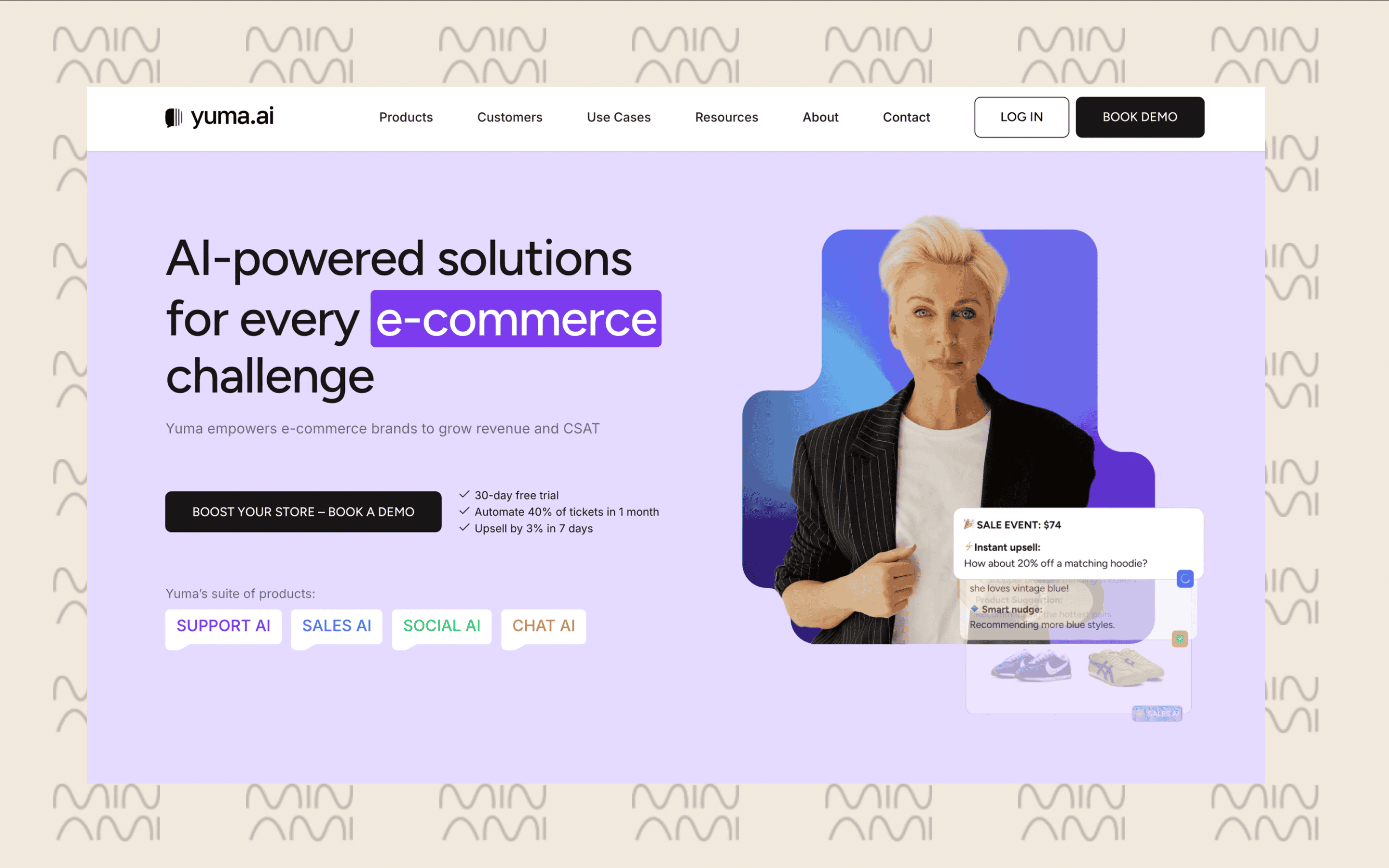
Yuma works on top of the helpdesk you already have and charges for outcomes (here’s what Yuma AI is in more detail). That model will feel familiar to anyone coming from enterprise contracts, minus the referral queue.
Where it fits
Shopify Plus brands on Gorgias, Zendesk or Kustomer that want automation without a migration.
What it can actually do in the store
Runs order, shipping and subscription workflows, drafts or sends replies, and can roll out gradually on a share of tickets while the team reviews quality.
Pricing
Custom / not published. Yuma bills per fully resolved ticket and offers a 30-day free trial on real ticket data; the rate comes from a demo.
Watch out for
You still pay for and run a separate helpdesk. Check how “resolved” is defined in your contract before comparing it with per-interaction tools.
5. Ada
Ada is the nearest like-for-like swap: an enterprise AI agent platform with a reasoning engine, many channels and a big-company sales motion. It has a longer list of retail references than Netomi.
Where it fits
Large retailers that want to stay on an enterprise platform but with more commerce experience behind it.
What it can actually do in the store
Answers across chat, email and voice and runs actions you set up through its integrations, Shopify included. Deeper logistics work is configured case by case.
Pricing
Custom / not published. Ada prices by contract after a demo.
Watch out for
You trade one enterprise sales cycle for another, so it solves fit more than speed.
6. Intercom Fin
Fin is Intercom’s AI agent and one of the most capable conversational models in support. It can run on Intercom’s helpdesk or on top of Zendesk or Salesforce.
Where it fits
Brands selling across web, app and social that want one AI voice everywhere, with sales conversations as well as support.
What it can actually do in the store
Resolves questions, follows procedures you write, and connects to Shopify to check and act on orders. Each action is something your team defines.
Pricing
Essential $29 per seat/mo ($19 billed annually), Advanced $85, Expert $132. Fin costs $0.99 per outcome on every plan; Copilot is $29 per agent/mo.
Watch out for
Seats plus outcomes can add up quickly in a busy season. The store-specific actions are yours to build and maintain.
7. Zendesk AI agents
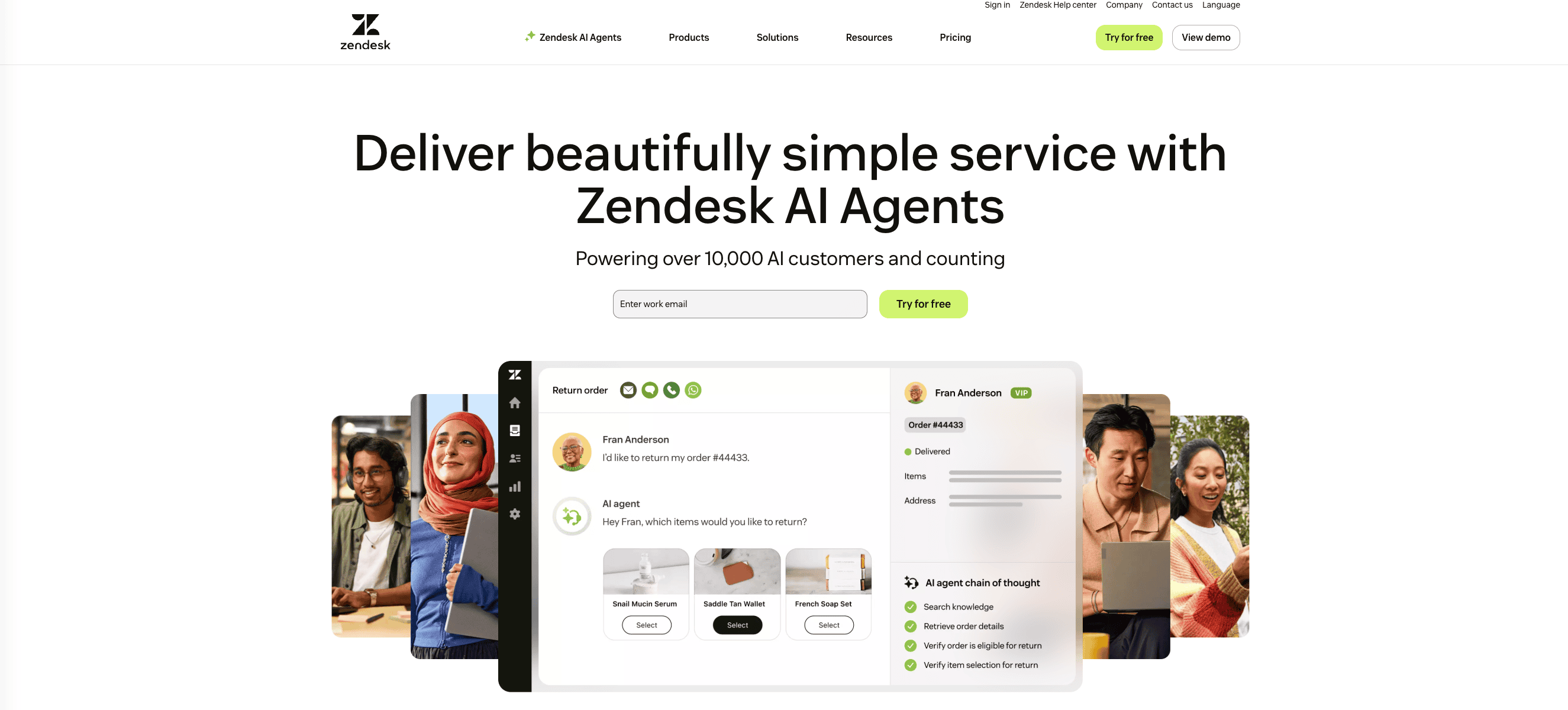
If your company already runs on Zendesk, its own AI agents are the least disruptive option. They’re included in Suite plans and billed by automated resolution.
Where it fits
Retailers with a Zendesk contract, an admin team and IT standards that favour one vendor.
What it can actually do in the store
Answers across messaging and email and can run multi-step flows via Action Builder, including calls to Shopify or your OMS once someone builds them.
Pricing
Suite Team $55 per agent/mo, Suite Professional $115 (annual billing; $69 and $149 monthly). Each plan includes 5 to 10 automated resolutions per agent a month; extra ones cost $1.50 committed or $2.00 pay-as-you-go.
Watch out for
Commerce logic isn’t built in. You’re assembling it from generic actions, which is close to the Netomi experience at a lower entry price.
Netomi alternatives: what each one charges (2026)
| Tool | Starting price | Pricing model | AI cost |
|---|---|---|---|
| Minami | Custom | Per store, quoted by sales | Included |
| Gorgias AI Agent | $40/mo | Monthly plan by ticket volume | $1.50 per automated interaction beyond included |
| Siena AI | $750/mo platform fee | Platform fee plus usage | $0.90 per automated ticket |
| Yuma AI | Custom / not published | Per resolved ticket | Not published |
| Ada | Custom / not published | Enterprise contract | Not published |
| Intercom Fin | $29 per seat/mo ($19 annual) | Per seat plus outcomes | $0.99 per Fin outcome |
| Zendesk AI agents | $55 per agent/mo (annual) | Per agent plus resolutions | $1.50 to $2.00 per extra automated resolution |
All figures in USD, taken from each company’s pricing page during October 2026.
Matching the tool to the tickets you actually get
Pull last month’s tickets and tag them. If more than half are about orders, shipping and returns, pick an agent that changes things in the store, and Minami is the one built to take all of it. If you want a helpdesk and AI on one invoice and can live with some manual order work, Gorgias. If brand voice and social replies are the priority and the budget clears $750 a month, Siena. If you love your current helpdesk and want to pay per resolution, Yuma.
Leaving Netomi but still need enterprise breadth? Ada is the closest swap. Selling on many channels? Fin. Locked into Zendesk? Use its agents and budget for admin time. For a wider look at the category, our guide to AI agents for eCommerce goes deeper.
Put Minami on your order queue
Netomi was built to answer across industries. Minami was built to close the store tickets that eat your team’s week: the edit, the cancellation, the parcel stuck in a depot, the exchange that becomes an extra sale.
Connect it through Shopify, share your policies, and watch it work on real orders. There’s no set-up fee, and pricing is custom to your store.
Minami AI agent
Automate 100% of your eCommerce support
Minami doesn't just chat. It takes the action inside your store and sells while it solves.
- Order edits and cancellations
- Address changes and delivery incidents
- Returns, exchanges and product recommendations