On this page (6)
Chatbase makes building a bot feel easy. Upload your help docs, point it at your site, and in an afternoon you have an assistant that answers in your tone, in dozens of languages, on chat, WhatsApp and more. For a lot of teams that first win is real. Stores that outgrow a FAQ bot on messaging should compare a dedicated WhatsApp ecommerce chatbot that can also edit orders.
Running a store exposes the limits. Customers don’t only ask what your return policy says. They want the size swapped on an order they paid for an hour ago, the parcel that’s been stuck in a depot found, the address fixed before the label prints. A bot trained on documents can describe all of that, and the work still lands on someone’s desk.
So this guide looks at 7 Chatbase alternatives built for eCommerce support. They solve different problems for different kinds of stores. Pick by your ticket mix: questions that need an answer, or orders that need someone to change them.
Chatbase alternatives side by side
| Tool | Best for | Executes store actions or chat only | Logistics automation depth | Product recommendations / sales |
|---|---|---|---|---|
| Minami | Stores that want order and delivery problems solved by AI from start to finish | Executes actions itself | Full: order edits, cancellations, address changes, delivery incidents, courier claims, returns and exchanges, WISMO | Yes, in chat and inside exchanges, with in-chat checkout |
| Gorgias AI Agent | Shopify teams that already live in Gorgias | AI runs some order flows; agents handle the rest | Medium: tracking, returns and selected order actions | Separate Shopping Assistant |
| Intercom Fin | Brands wanting one AI across many channels | Conversational, with Shopify actions available | Medium, depends on configured actions | Fin for sales |
| Alhena AI | DTC brands mixing support with guided shopping | Answers plus some order lookups | Low to medium | Strong focus on product discovery |
| Zipchat | Smaller Shopify stores focused on pre-sales chat | Mostly conversational | Low: order status and FAQs | Strong focus, proactive selling |
| Rep AI | Shopify brands treating chat as a sales channel | Mostly conversational, hands off to a helpdesk | Low | Core of the product |
| eesel AI | Teams adding AI on top of an existing helpdesk | Actions via configured integrations | Low to medium, depends on setup | Not a focus |
What Chatbase does well, and where a store outgrows it
Chatbase is a knowledge engine at heart. You feed it sources, it learns them, and it answers well, which is why it’s popular with SaaS companies, agencies and content-heavy sites. It has added a helpdesk, Shopify features and configurable actions, so it’s no longer only a widget on a docs page.
The friction for an online shop is the shape of the queue. In most stores, somewhere between half and three quarters of tickets are post-purchase: where’s my order, can I change it, it arrived broken, I want a different colour. Those aren’t questions with an answer. They’re tasks with steps in Shopify and in a courier’s portal. A bot that’s great at knowledge still has to hand them over unless someone builds and maintains each action.
That’s the moment people search for a Chatbase alternative. Not because the answers are bad, but because they want AI that finishes the job inside the store, and ideally sells while it’s there.
The 7 best Chatbase alternatives for eCommerce support
1. Minami AI
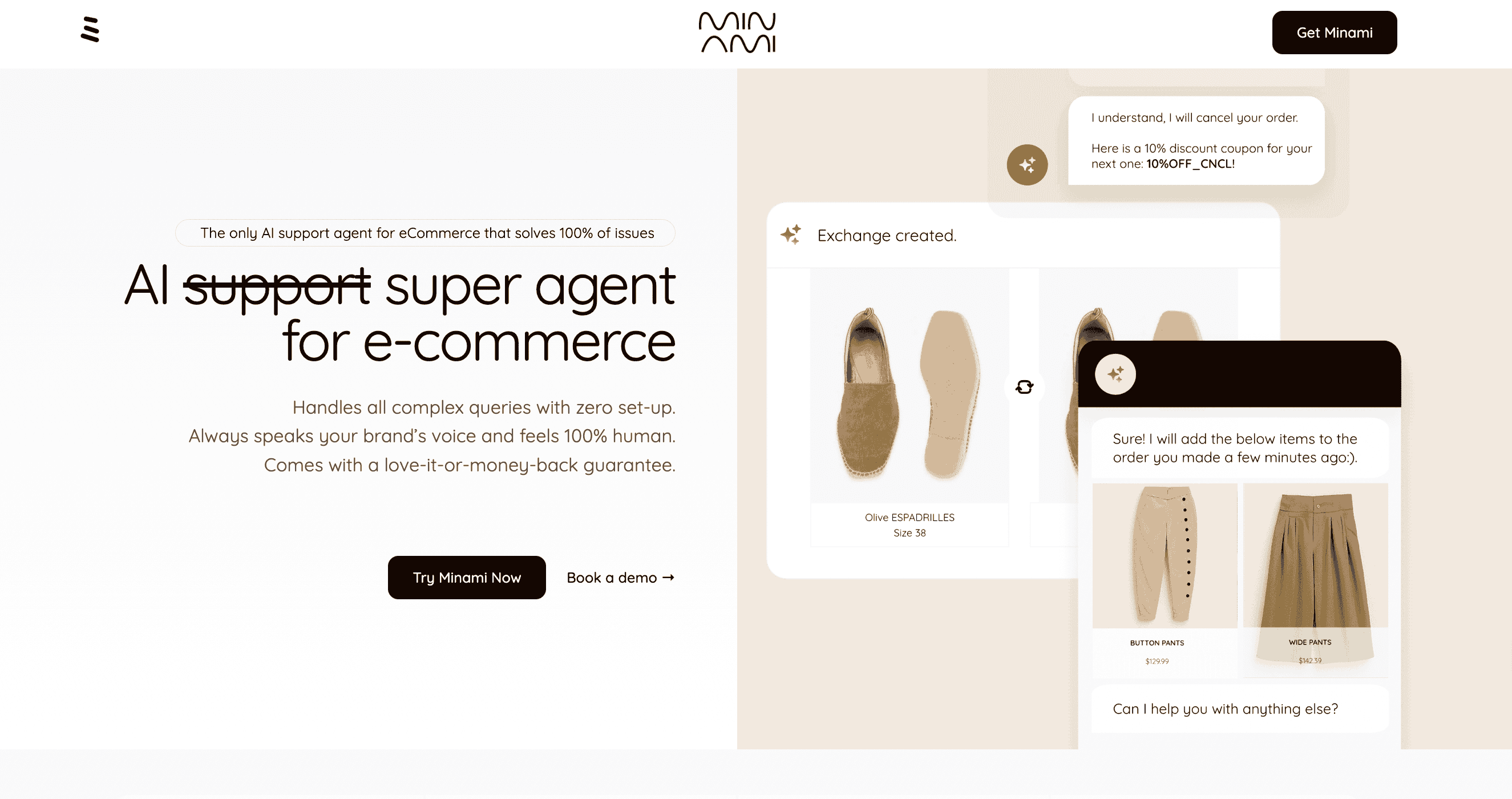
Best for: stores that want AI to close the logistics side of support completely, from edits and cancellations to lost parcels and exchanges, while pointing shoppers to products they’ll want.
Most tools in this space are a conversation layer: they talk, then route. Minami is built the other way round. It’s an AI agent that acts inside your store. Ask it to change a size and the paid order gets edited in Shopify. Report a damaged parcel and it opens the case with the carrier. The goal Minami sets itself is to automate 100% of an online store’s logistics resolution, with people only seeing real exceptions.
The store work it takes over
- Order edits: puts extra items on a paid order, or takes some off, before it’s packed.
- Cancellations: cancels eligible orders before shipping, offering an alternative first.
- Address changes: corrects delivery details before dispatch.
- Delivery incidents: lost, delayed and damaged parcels; by Minami’s figures, 9 in 10 get sorted with nobody stepping in.
- Courier claims: handles over 80% of carrier communication, by Minami’s count.
- Returns and exchanges: applies your policy and nudges toward exchanges over refunds. More on its returns and exchanges agent.
- WISMO: proactive tracking updates before the customer writes in.
Product recommendations and sales
Minami answers product questions, suggests items in the chat and, inside an exchange, can put any product from your range in front of the customer, paid for right in the chat. A customer who forgot something can have it added to a paid order, no new checkout needed. Its shopping experience page shows how.
Setup and pricing
You don’t build flows or train on a document dump. Share your policies, connect it through the Shopify app, or drop a snippet on the site, and escalations arrive with full context. There’s no set-up fee, and pricing is custom; you get it from sales.
Pros and cons
- Pros: does the order and carrier work rather than explaining it; covers the whole post-purchase journey; turns exchanges into sales; no flow-building.
- Cons: focused on chat and email rather than voice; only for eCommerce, so not a fit for SaaS or content sites.
Our take: if you moved off Chatbase because your bot kept passing orders to humans, start here. It’s the only pick on this list designed to take that work off the team entirely.
- Talks directly with carriers to change addresses, reroute parcels and open delivery incidents, then executes the change in the store or CMS end to end.
2. Gorgias AI Agent

Best for: Shopify brands already running support in Gorgias who want AI inside the same inbox.
Gorgias is an eCommerce helpdesk with Shopify data next to every ticket. Its AI Agent handles a set of order and return flows, and a separate Shopping Assistant covers pre-sales. We’ve broken down the costs in our guide to Gorgias AI Agent pricing.
What it executes
The AI can track orders, start returns and run configured actions; other changes still fall to the team, working from the ticket view.
Pricing
Starter $40/mo (monthly only, 50 tickets and 30 automated interactions); Basic $90/mo, or $77/mo billed annually (300 tickets); Pro $550/mo, or $471/mo annually; Advanced $1,430/mo, or $1,227/mo annually. Beyond the included volume, extra tickets cost $0.36 to $0.40 each and AI Agent automated interactions $1.50 each.
Pros and cons
- Pros: deep Shopify context, large app ecosystem, one inbox for every channel.
- Cons: AI and helpdesk are billed separately, and complex logistics still lean on agents.
Our take: a sensible move if your team wants to stay hands-on. Less so if the aim is to remove the logistics queue.
3. Intercom Fin
Best for: brands that want one AI agent across chat, email, voice and social, on Intercom or another helpdesk.
Fin is Intercom’s AI agent. It’s strong at reading help content and has Shopify actions for orders and returns that you can switch on. See our Intercom Fin pricing breakdown for how the per-outcome model adds up.
What it executes
Order lookups, tracking and some returns via configured Shopify actions; anything outside them goes to a person.
Pricing
Essential $29 per seat/mo ($19 billed annually), Advanced $85, Expert $132. Fin costs $0.99 per outcome; Copilot is $29 per agent/mo.
Pros and cons
- Pros: polished AI, many channels, works on top of other helpdesks.
- Cons: born in SaaS support, so store logistics need setup; outcome fees grow with volume.
Our take: good if knowledge answers are most of your queue. Stores heavy on order changes will still be doing setup work.
4. Alhena AI
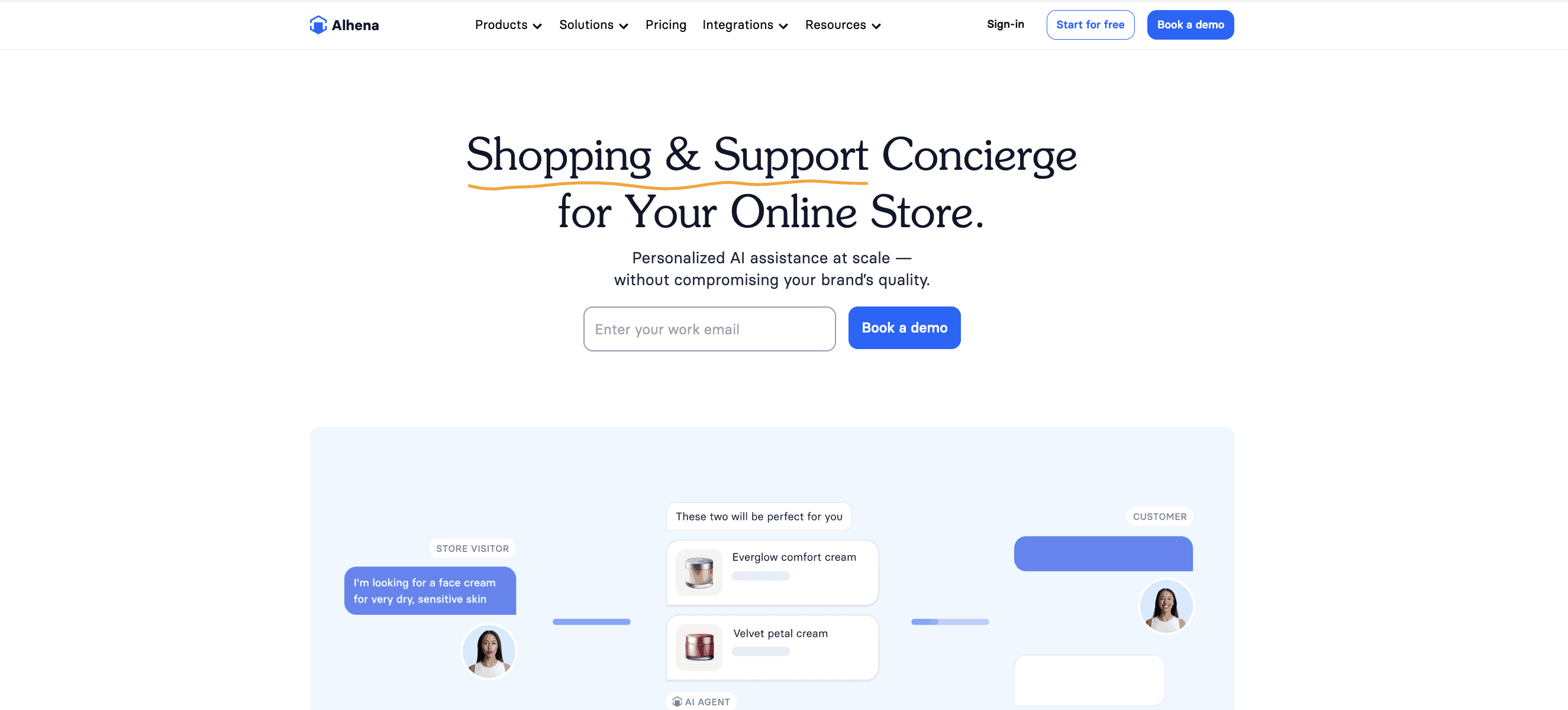
Best for: DTC brands that want support and guided shopping from the same assistant.
Alhena positions itself as hallucination-free AI for CX and revenue. It answers from your catalogue and policies and leans into product discovery.
What it executes
Order status and lookups through store integrations; deeper changes are typically escalated.
Pricing
Free plan (25 conversations), Essentials $199/mo billed annually ($239 monthly), Growth $499/mo ($599 monthly), Scale $999/mo ($1,199 monthly), Enterprise custom.
Pros and cons
- Pros: strong shopping assistant, free plan to test.
- Cons: logistics actions are limited compared with an action-first agent.
Our take: a fit when pre-sales matters more than post-purchase.
5. Zipchat
Best for: smaller Shopify stores that want a selling chatbot on site and WhatsApp.
Zipchat markets itself as an AI agent and chatbot for eCommerce on every channel, with proactive messages that start conversations with shoppers.
What it executes
Order status and FAQs; it’s built more for conversion than for changing orders.
Pricing
Starter $64/mo billed annually ($80 monthly, 750 replies), Pro $240/mo, Scale $480/mo, Scale Plus $960/mo (annual prices). Extra replies cost $49 per 250 ($49 per 500 on Scale Plus); an unlimited plan starts at $2,100/mo.
Pros and cons
- Pros: quick to launch, proactive selling, clear reply-based pricing.
- Cons: light on post-purchase actions; reply caps need watching in busy months.
Our take: worth a look for a small store chasing conversions. Not the tool for clearing order-change tickets.
6. Rep AI

Best for: Shopify brands that treat chat mainly as a sales channel.
Rep AI describes itself as an agentic commerce platform. It engages shoppers, recommends products and recovers carts, and hands support cases to a helpdesk such as Gorgias or Zendesk.
What it executes
Pre-sales actions and order lookups; complex post-purchase cases go to human agents in the connected helpdesk.
Pricing
Custom / not published.
Pros and cons
- Pros: sales-first design, behaviour-based engagement.
- Cons: support depth relies on another tool.
Our take: pair it with something else if your problem is the support queue.
7. eesel AI
Best for: teams that want to add an AI agent to the helpdesk they already use.
eesel plugs into helpdesks and knowledge sources and can be given actions such as order lookups through integrations.
What it executes
Whatever actions you configure, commonly order status and tagging; logistics work beyond that needs custom setup.
Pricing
Free trial (100 credits), Teammate from $299/mo (500 credits) up to $1,749/mo (5,000 credits); extra credits $0.80 each.
Pros and cons
- Pros: sits on top of existing tools, flexible.
- Cons: you build and maintain the actions yourself.
Our take: handy as a layer. Less so if you want logistics handled without building anything.
How much the Chatbase alternatives cost (2026)
| Tool | Starting price | Pricing model | AI cost |
|---|---|---|---|
| Minami | Custom | Custom pricing, contact sales | Custom |
| Gorgias AI Agent | $40/mo | Monthly plan by ticket volume | $1.50 per automated interaction beyond included |
| Intercom Fin | $29 per seat/mo | Per seat, plus usage | $0.99 per Fin outcome |
| Alhena AI | Free (25 conversations); paid from $199/mo annual | Monthly plans by tier | Included in plan |
| Zipchat | $64/mo billed annually | Plans by reply volume | $49 per 250 extra replies |
| Rep AI | Custom / not published | Quoted | Not published |
| eesel AI | $299/mo | Credit-based plans | $0.80 per extra credit |
USD figures, read off each company’s public price list (snapshot dated 29/10/2026); Rep AI doesn’t publish its pricing.
Knowledge bot or store agent?
Ask what your tickets are actually about. If most are questions with answers, many of these tools will feel like a lateral move from Chatbase, and Intercom Fin or eesel will slot in with little friction. If most are orders that need changing, parcels that need chasing and exchanges that need processing, you want an agent that works inside the store. That’s Minami, which is why it leads the list.
Leaning toward conversion over support? Rep AI, Zipchat and Alhena AI are built around selling. Already on Gorgias with a hands-on team? Its AI Agent keeps everything in one place.
Swap the bot for an agent that finishes the job
If your current bot answers well but your team still ends up in Shopify and the carrier portal after every chat, Minami takes that part over. It edits and cancels orders, updates addresses, resolves delivery problems with couriers and runs exchanges in your brand voice, and it recommends products so support starts bringing in revenue.
It costs nothing to set up, and if the results don’t hold up you get your money back. Sign up at minami.ai, or ask for a demo on your own catalogue. Weighing more options? We’ve rounded up AI support agents worth trying on Shopify too.
Minami AI agent
Automate 100% of your eCommerce support
Minami doesn't just chat. It takes the action inside your store and sells while it solves.
- Order edits and cancellations
- Address changes and delivery incidents
- Returns, exchanges and product recommendations