On this page (6)
Intercom Fin AI Agent is easy to get started with, but understanding how pricing really behaves over time takes a closer look. On paper, it’s a simple resolution-based model.
In practice, costs grow in direct proportion to how well automation performs, how many conversations you handle, and how Fin is deployed across your support stack.
This guide breaks down Intercom Fin AI Agent pricing for 2026 in plain terms. You’ll see how the per-resolution model works, when seat costs apply, what counts as a billable resolution, and which add-ons can meaningfully increase your monthly spend. If you’re running high-volume support or planning to scale automation, this overview helps you set realistic expectations before committing.
Intercom Fin AI Agent pricing: A summary for 2026
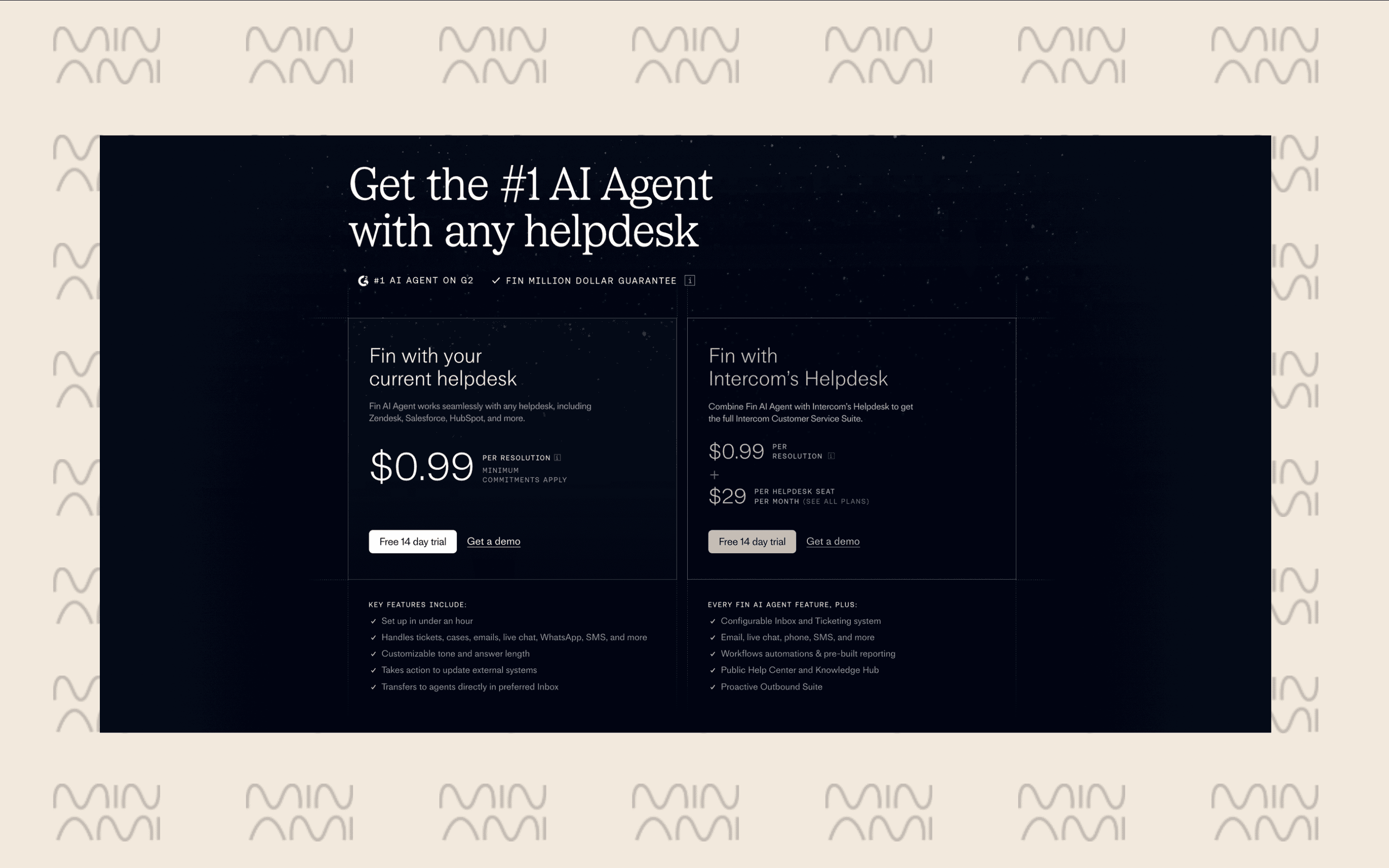
Intercom Fin AI Agent operates on a resolution-based pricing model at $0.99 per successful resolution, with a mandatory minimum of 50 resolutions per month.
If integrated within Intercom’s helpdesk, additional seat costs ($$29–$139/seat/month) apply.
The total cost of this AI Agent scales dramatically with automation success, making predictable budgeting challenging for high-volume support operations.
There are no volume discounts or pricing caps.
Core Fin AI pricing model
Intercom’s pricing is mainly based on resolutions.
A resolution happens when Fin answers a customer’s question and the conversation comes to a natural close.
This can be because the customer confirms the answer helped, or simply because they don’t reply again or ask for more help after receiving the response.
| Pricing Component | Cost | Details |
|---|---|---|
| Per-Resolution Fee | $0.99 USD | Standard rate for all customers; no tiering |
| Minimum Commitment | $49.50/month | Equivalent to 50 resolutions; applies to standalone Fin on external helpdesks |
| Seat Costs | $0–$139/month | Required only if using Fin within Intercom suite |
| Currency | USD only | Intercom does not bill in other currencies |
| Resolution Reset | Monthly | Unused resolutions do not carry over |
Key billing clarifications
-
You’re charged once per conversation, no matter how many questions Fin handles in the same thread
-
Quick greetings or short replies that don’t actually solve anything don’t count as a resolution
-
If a customer reopens a conversation and needs help again, the original resolution charge is reversed, and there’s no extra charge
-
When a human agent steps in, the resolution charge only applies if the customer was already happy. If the agent joins before the issue is confirmed as resolved, the charge is removed
Intercom Suite integration costs
When you use Fin inside Intercom’s own helpdesk, rather than running it on platforms like Zendesk or Salesforce, you’ll need at least one paid Intercom seat on one of the available plans.
| Plan | Annual/Seat | Monthly/Seat | Key Features | Free Lite Seats |
|---|---|---|---|---|
| Essential | $29 | $39 | Shared inbox, Messenger, basic Help Center, Fin access | None |
| Advanced | $85 | $99 | Essential + Workflows, multiple inboxes, round-robin | 20 free |
| Expert | $132 | $139 | Advanced + SSO, HIPAA, SLAs, multibrand support | 50 free |
Why this matters: With five agents on the Advanced plan, seat pricing alone adds up to $495 per month, even before any Fin resolution costs come into play.
Add-ons and other features
1. Fin AI Copilot Pricing

Copilot supports your agents in real time with AI-powered reply drafts and quick context summaries. Each teammate gets up to 10 AI-assisted conversations per month by default. Teams that want unlimited access can upgrade with simple per-user pricing:
-
$35 per user per month with monthly billing
-
$29 per user per month with annual billing
Copilot is available for Full Seat teammates. For a team of 10 agents, unlimited Copilot comes to $350 per month, or 290 per month on annual billing.
2. Proactive Support Plus
This add-on unlocks outbound engagement tools like product tours, surveys, and mobile push notifications:
-
Base price: $99 per month
-
Includes 500 outbound messages
-
Extra messages are billed based on usage once you go beyond the included volume
3. Messaging channels (usage-based)
Some channels are billed based on how much you use them:
-
SMS: Charged per message sent or received, with rates depending on the region
-
WhatsApp: Charged per conversation, with different pricing for inbound and outbound messages
-
Bulk email campaigns: Charged per email sent, while standard inbox emails remain included
Intercom Fin AI agent pricing: Real-world scenarios
Scenario 1: Small ecommerce team
A small ecommerce team handling around 1,000 customer conversations per month usually starts with a modest level of automation. In this case, Fin resolves about 30% of conversations, which equals roughly 300 resolutions. The support setup includes two agents on the Intercom Advanced plan, with no extra add-ons enabled. The fixed cost comes from the two Advanced seats, adding up to $198 per month.
On top of that, Fin charges $0.99 per resolution, adding $297 in variable usage costs.
-
This brings the monthly total to $495.
-
At this stage, the blended cost averages around $0.50 per conversation.
Seat pricing and usage-based charges are relatively balanced, and the cost structure remains easy to reason about. Automation provides efficiency, but the financial impact is still limited by relatively low volume.
Scenario 2: Mid-market SaaS or ecommerce
As the business grows, conversation volume increases quickly. In this example, the company handles around 10,000 customer conversations per month, with Fin resolving about half of them. That translates into roughly 5,000 paid resolutions.
The support team grows to five agents, all on the Intercom Advanced plan. To help with more complex conversations, unlimited Copilot is enabled for three agents, and Proactive Support Plus is turned on.
Seat costs now add up to $495 per month. Fin resolutions become the main cost driver, contributing $4,950.
Copilot adds $105, and Proactive Support Plus adds $99.
- Altogether, the monthly spend reaches $5,649, with an average cost of about $0.56 per conversation.
At this stage, most of the bill comes from per-resolution charges. As automation handles more conversations, total spend increases alongside it, linking automation performance directly to cost growth.
Scenario 3: Enterprise, multi-brand operation
This scenario represents an organization managing more than 50,000 customer conversations per month across multiple brands. Fin resolves about 60% of conversations, or roughly 30,000 resolutions.
The setup includes 15 agents across different teams, running on the Intercom Expert plan to support advanced requirements. Unlimited Copilot is enabled for 10 agents, Proactive Support Plus is active, and WhatsApp is used as a support channel with an estimated $500 in monthly messaging costs.
Expert plan seats account for $2,085 per month. Fin resolutions represent $29,700. Copilot adds $350, Proactive Support Plus adds $99, and messaging usage contributes around $500.
-
The total monthly spend reaches approximately $32,734.
-
The average cost per conversation increases to around $0.65.
At this scale, per-resolution pricing dominates the cost structure. Even marginal gains in automation rate translate directly into higher monthly spend, and forecasting costs becomes increasingly dependent on how much the AI is allowed to resolve.
Minami AI: a better option if you’re running an ecommerce business
Minami works as an autonomous AI agent for ecommerce operations, not as a per-resolution layer on top of conversations. It takes ownership of order issues, delivery problems, returns, and exchanges end to end, making decisions and executing actions across your logistics and support stack. The result is predictable automation that grows with your business, not against it.
Teams use Minami to keep automation rates high while keeping spend easy to forecast. No resolution counters to monitor. No incentives to limit what the AI can solve. Just an agent that handles real operational work and lets your team focus on the exceptions that matter.
If you are exploring AI agents for ecommerce and want automation that supports growth with calm and control, Minami AI is worth a closer look.
Savings calculator
EstimateWhat could Minami save your support team?
Saved per month
$0
0 agent hours freed
0 tickets handled by AI
Estimate based on your inputs. Default automation rate reflects the "on average 90% less customer queries" figure on minami.ai; your results will vary. Excludes Minami subscription cost.