On this page (4)
HappyFox does tickets well. Categories, SLAs, queues, a knowledge base. If your team needs a tidy place to work requests, it gets the job done.
But you are not reading this because you need a tidier queue. You want fewer tickets in it. And on HappyFox, the AI is a stack of add-ons on top of a per-agent bill, and most of it helps your agents work faster rather than doing the work for them.
So here are 7 HappyFox alternatives for teams moving to AI-first support, from ecommerce AI agents to helpdesks with a real AI agent built in. The question to ask each one is simple: when a customer wants their order changed, does the tool change it, or does it open a ticket?
HappyFox alternatives compared
| Tool | Best for | AI that acts or replies | Store and carrier actions | Price from |
|---|---|---|---|---|
| Minami AI | Ecommerce post-purchase | Acts end to end | Store edits + carriers | Custom |
| Gorgias | Shopify helpdesk teams | Replies + set actions | Shopify actions | $10/mo |
| Richpanel | DTC brands with subscriptions | Replies + order updates | Order updates | $99/seat/mo |
| Zendesk | Large, multi-team support | Replies + built actions | Custom build | $19/agent/mo |
| Intercom Fin | Chat-first teams | Mostly replies | Via connectors | $19/seat/mo + $0.99/outcome |
| Freshdesk | Classic ticketing on a budget | Mostly replies | Via connectors | $19/agent/mo |
| Help Scout | Small email-first teams | Replies | None native | Free, then $25/user/mo |
Why teams look for a HappyFox alternative
HappyFox Help Desk is priced per agent. Basic is $24 per agent per month billed annually ($29 monthly) and stops at 5 agents. Team is $49, Pro is $99 and Enterprise Pro is quoted. There is also an unlimited-agent model with a yearly ticket allowance for bigger teams.
The AI costs extra, and it comes in pieces. HappyFox AI, the agent copilot, runs $14 to $39 per agent per month on top of the help desk. The Chatbot is $0.33 per resolution. Autopilot, the agentic layer, starts at $0.02 per successful action. Assist AI covers employee support in Slack and Teams. Four products, four billing units.
Autopilot is the interesting one. Its prebuilt agents work behind the scenes inside the help desk: they triage and tag tickets, fill in fields, flag duplicates and, for Shopify stores, check a return request against your policy window. Useful. But they act on the ticket, not on the order. Nobody calls the carrier, and nobody changes the address.
Reviewers point at the same gaps. On Capterra, a retail head of support called ticket routing “very limiting and time consuming to set up” and said the team stopped using the AI because it was not reliable. G2 reviewers mention confusing reports and features locked to higher tiers. To be fair, the support team gets praise almost everywhere.
If you are adding up the real cost of a per-agent desk plus AI add-ons, our guide on cutting customer support costs with AI breaks down where the money goes.
The 7 best HappyFox alternatives, ranked
1. Minami AI
Best for: ecommerce brands whose queue is full of orders, parcels and returns.
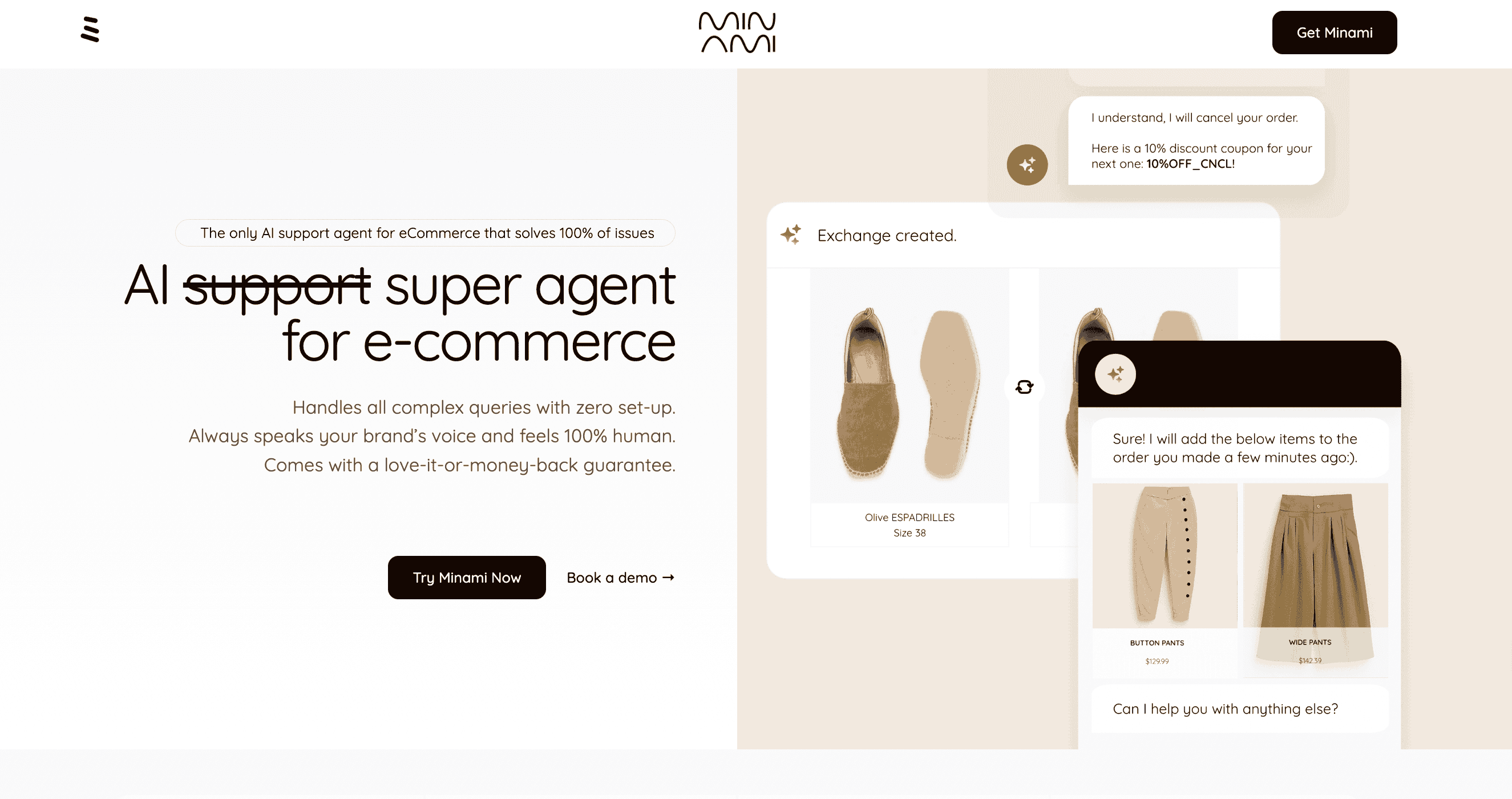
Minami is an AI agent built for ecommerce post-purchase work, and it does the work rather than routing it. When a customer needs a new address, Minami talks to the carrier and changes it. When an order needs editing, it edits it in your store. It closes the request end to end and only hands real exceptions to your team.
- Talks directly to carriers to change addresses, reroute parcels and resolve delivery incidents
- Executes every change in the store and CMS, end to end
- Edits and cancels orders after checkout
- Turns returns into exchanges and recommends the right product
- Sends proactive WhatsApp notifications before customers have to ask
That is the gap between a help desk and an agent. HappyFox’s AI can tag the ticket and check the return window; Minami answers the customer, makes the change and confirms it. Setup is the Shopify app plus your policies, with no flows to build, and it can run next to your current helpdesk while you move. Set-up is free and pricing is custom.
Price: Custom.
2. Gorgias

Best for: Shopify brands that want a helpdesk built around the order.
Gorgias is the ecommerce helpdesk most HappyFox refugees look at first. Order data sits next to every ticket, agents can edit, cancel and refund Shopify orders from the sidebar, and the AI Agent answers and runs set actions on top. Pricing is by ticket volume, not by agent, which suits teams that hate seat math.
The limits show up on the harder tickets. Carrier problems and complex edits still land on a person. Our breakdown of Gorgias AI Agent pricing shows how ticket and AI fees stack up.
Price: Starter from $10 per month with 50 tickets, monthly billing only. AI Agent interactions cost $0.90 each on annual plans or $1.00 monthly, and each one also counts as a helpdesk ticket.
Pros: ecommerce-native, no per-agent pricing. Cons: costs climb with volume, carrier work stays manual.
3. Richpanel

Best for: DTC brands that want helpdesk and AI on one bill.
Richpanel bundles a helpdesk with AI agents that handle order and subscription updates under your rules, with human handoff. A self-service portal lets customers track and update orders, and a paid Returns and Exchanges add-on covers the return side. It also handles migration for you.
It is a strong swap if you want ecommerce context without stitching tools together. Carrier contact and incident handling are not part of the AI’s job.
Price: $99 per seat per month billed annually ($119 monthly), plus AI at about $0.20 per conversation. The AI minimum is $200 per month, so one seat plus AI starts at $299 per month on an annual commitment.
Pros: AI and helpdesk in one plan, ecommerce focus. Cons: real minimum spend, carrier side stays with your team.
4. Zendesk
Best for: large teams that need routing, SLAs, reporting and governance.
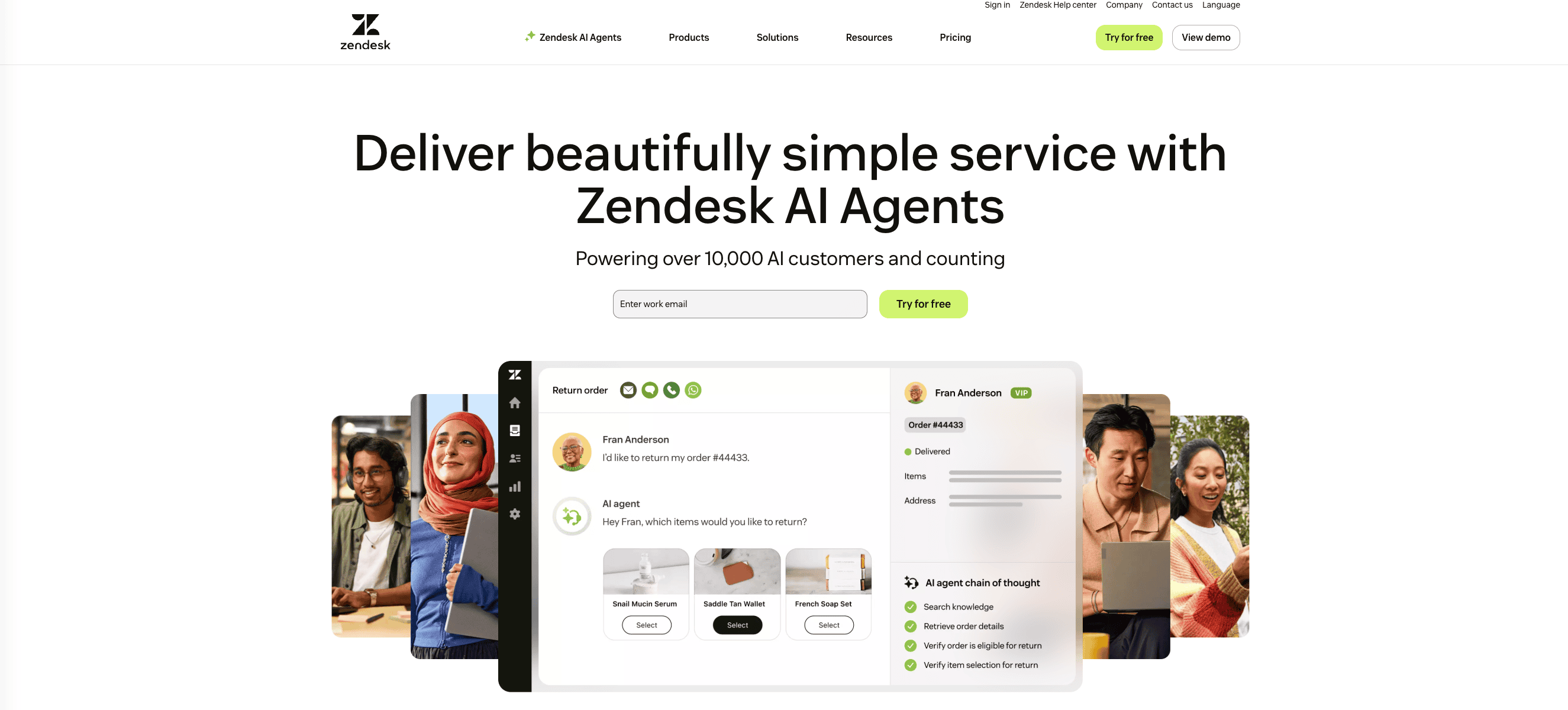
Zendesk is the enterprise answer. Ticketing, messaging, voice, a huge marketplace, AI agents and Copilot. If you are leaving HappyFox because you outgrew it, this is the grown-up version of the same model, with AI agents that can run actions once you build them.
For an ecommerce team, that “once you build them” is the catch. Order edits and carrier work are a project, not a setting.
Price: Support Team from $19 per agent per month billed annually, Suite Team from $55. Automated resolutions beyond what is included cost $1.50 each committed or $2.00 pay-as-you-go.
Pros: depth, scale, ecosystem. Cons: price and setup effort grow fast.
5. Intercom Fin
Best for: chat-first teams that want the strongest conversational AI.
Fin is a very good talker. It answers from your content across chat, email and more, can take action on external systems through connectors, and hands off to your team in the Intercom inbox. You can also run Fin on top of another helpdesk if you are not ready to move your inbox.
It is built for every industry, so ecommerce actions depend on what you wire up. More on that in our Intercom alternatives for ecommerce.
Price: Essential is $29 per seat per month, or $19 billed annually for new customers. Fin costs $0.99 per outcome on every plan. Copilot is $29 per agent per month.
Pros: excellent answers, flexible setup. Cons: per-outcome bills add up, not store-native.
6. Freshdesk
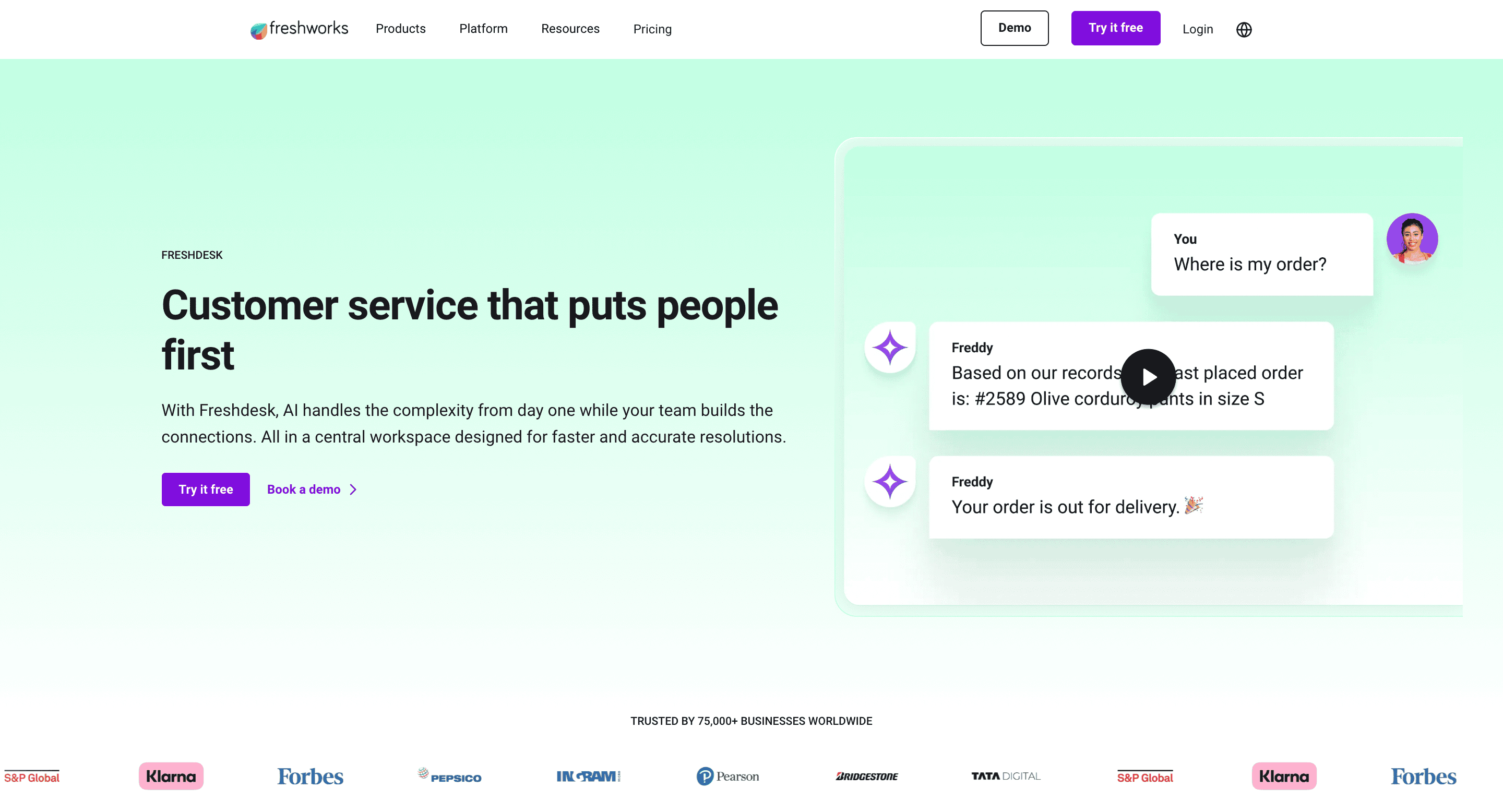
Best for: teams that want classic ticketing with an AI agent included.
Freshdesk is the closest like-for-like HappyFox help desk alternative. Ticketing, shared inbox, portal, knowledge base and SLAs, with Freddy AI Agent on every paid plan. If you like how HappyFox works and just want AI included in the box, start here.
The AI is mostly conversational. Actions come through connector app tasks and MCP actions, which you pay for separately.
Price: Growth from $19 per agent per month billed annually, Pro $55, Enterprise $89. Each account gets 500 Freddy AI Agent sessions once; after that, sessions cost $49 per 100. Freddy AI Copilot is $29 per agent per month on Pro and up.
Pros: familiar, affordable entry. Cons: AI sessions and actions are metered extras.
7. Help Scout
Best for: small teams that live in email and want simple AI on top.
Help Scout is the friendly, lightweight option. A shared inbox, live chat, a knowledge base, and Envoy, an AI assistant that resolves questions from your help content. There is a free plan for up to 5 users, so you can test it without a contract.
It answers questions. It does not change orders or talk to carriers, so ecommerce teams will still work those tickets by hand. Our roundup of ecommerce help desk software compares it with store-native options.
Price: Free for up to 5 users. Standard is $25 per user per month billed annually ($30 monthly). Envoy costs $0.75 per resolution, with a 3-month free trial.
Pros: easy, cheap to start, pay per resolution. Cons: no store actions.
How to switch from HappyFox without breaking support
Start with your contract. HappyFox bills monthly, annually or on two-year terms, so check your renewal date before you plan the cutover.
Then pull your last 30 days of tickets and tag them. Where is my order, address changes, cancellations, edits, returns, delivery problems. If most of the queue is post-purchase logistics, you need an AI agent that acts in the store and with carriers, not another place to read tickets.
Export what you want to keep: tickets, contacts and knowledge base articles. HappyFox includes webhooks and a REST API on every plan, which helps. Rebuild your top 20 macros and routing rules first, not all 200.
Run the new tool next to HappyFox on one channel for two weeks. Measure resolution rate, reopen rate and CSAT, then move the rest. And if your customers ask “where is my parcel?” all day, add proactive updates early; our guide to WhatsApp chatbots for ecommerce shows how to stop those tickets before they start.
Minami AI agent
Automate 100% of your eCommerce support
Minami doesn't just chat. It takes the action inside your store and sells while it solves.
- Order edits and cancellations
- Address changes and delivery incidents
- Returns, exchanges and product recommendations