On this page (4)
What are the best AI tools for reducing customer support costs in eCommerce?
- Minami AI - Best for massive customer suppor cost reduction
- Gorgias - Best for ecommerce teams wanting centralized tickets with order context
- Zendesk - Best for high-volume multichannel ticketing across any industry
- Intercom - Best for in-chat AI resolution with smooth human handoff
- Tidio - Best for small stores needing simple chatbot deflection
How to reduce customer support costs using AI tools
Support costs in ecommerce come from volume and time. Every ticket a person opens, reads, and replies to carries a labor cost. The more tickets reach a human, the more the support function costs to run.
Ecommerce teams use AI for support in two different ways. Some tools cut the time per ticket by drafting replies or surfacing order data so an agent works faster. Others remove the ticket from the human queue entirely by resolving the request without a person involved.
The size of the saving depends on where the automation stops. A tool that drafts a reply still needs a person to review and send it. A tool that executes the requested change closes the loop without that step.
The difference between answering a customer and acting on their request is what separates a smaller saving from a larger one.
👉How to boost sales using generative AI
The best AI customer support software for reducing support costs and workload
| Tool | What it is | Main feature | Pricing |
|---|---|---|---|
| Minami AI | Autonomous AI agent | Backend operation execution | Custom quote |
| Gorgias | Ecommerce helpdesk | Order context in tickets | $$0.90–$$1.00/resolution |
| Zendesk | Service platform | Multichannel ticketing | $$1.50–$$2.00/resolution |
| Intercom | AI chat agent | In-chat resolution | $29+/seat plus AI $fees |
| Tidio | Chatbot tool | Storefront chat deflection | Free–$39+/month |
1. Minami AI
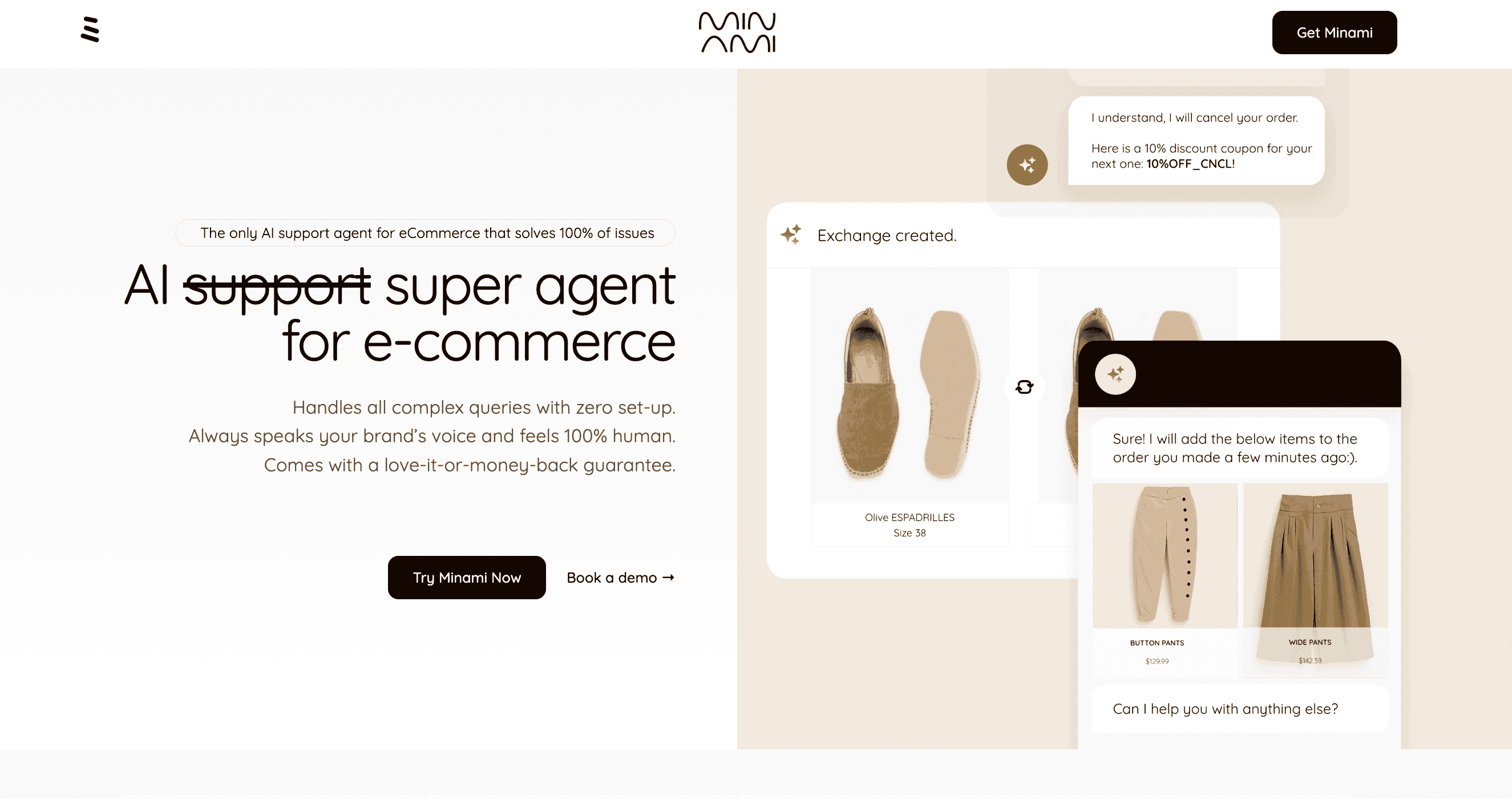
Minami AI is an autonomous AI agent platform built for ecommerce operations.
Instead of working like a traditional chatbot, it connects directly to ecommerce, logistics, and post-purchase systems and resolves 99% customer and operational issues without a person handling them.
It automates a large share of post-purchase support work, which lowers the operational cost of running a support function. Where most tools reply to the customer, Minami acts on the order, the return, or the shipment itself.
Key features
-
Fully autonomous AI support management
-
End-to-end ecommerce operations orchestration
-
Autonomous order edits, cancellations, and address updates
-
Returns and exchanges management with refund-to-exchange flows
-
Delivery incident resolution across carrier networks
-
WISMO automation for ecommerce customer service
-
Automated carrier communication for logistics
-
Post-purchase upsell and exchange flows for revenue recovery
-
Product recommendations thought the shopping experience
Pros
-
Massive customer support cost reduction
-
Executes real actions inside ecommerce systems
-
One AI layer for support, logistics, and returns
Cons
-
Built for enterprise and high volume brands, not small stores
-
Specialized in ecommerce post-purchase, not general support use cases
Pricing
2. Gorgias

Gorgias is a helpdesk built for ecommerce support teams. It centralizes tickets from across channels into one view and pulls order data into each ticket so an agent sees context without switching tabs. Its AI drafts or sends replies to repeat questions, keeping the resolution inside the helpdesk. The work it automates is the response; processing the underlying order change stays with the agent.
Key features
-
Ticket centralization across channels
-
Order data inside the ticket view
-
AI-drafted and AI-sent replies
-
Macro and rule-based automation
-
Native ecommerce platform integrations
Pros
-
Built specifically for ecommerce support
-
Order context sits next to the conversation
-
AI handles common repeat questions
Cons
-
Replies to requests rather than executing the order change
-
Cost rises with ticket volume
Pricing
Gorgias pricing is split between helpdesk plans based on ticket volume and a separate AI agent fee. The Gorgias AI Agent starts at around $0.90 per resolved conversation on annual plans or $1.00 on monthly billing, with overage fees of approximately $0.36–$0.40 per extra ticket.
👉 Best AI tools for BigCommerce stores
3. Zendesk
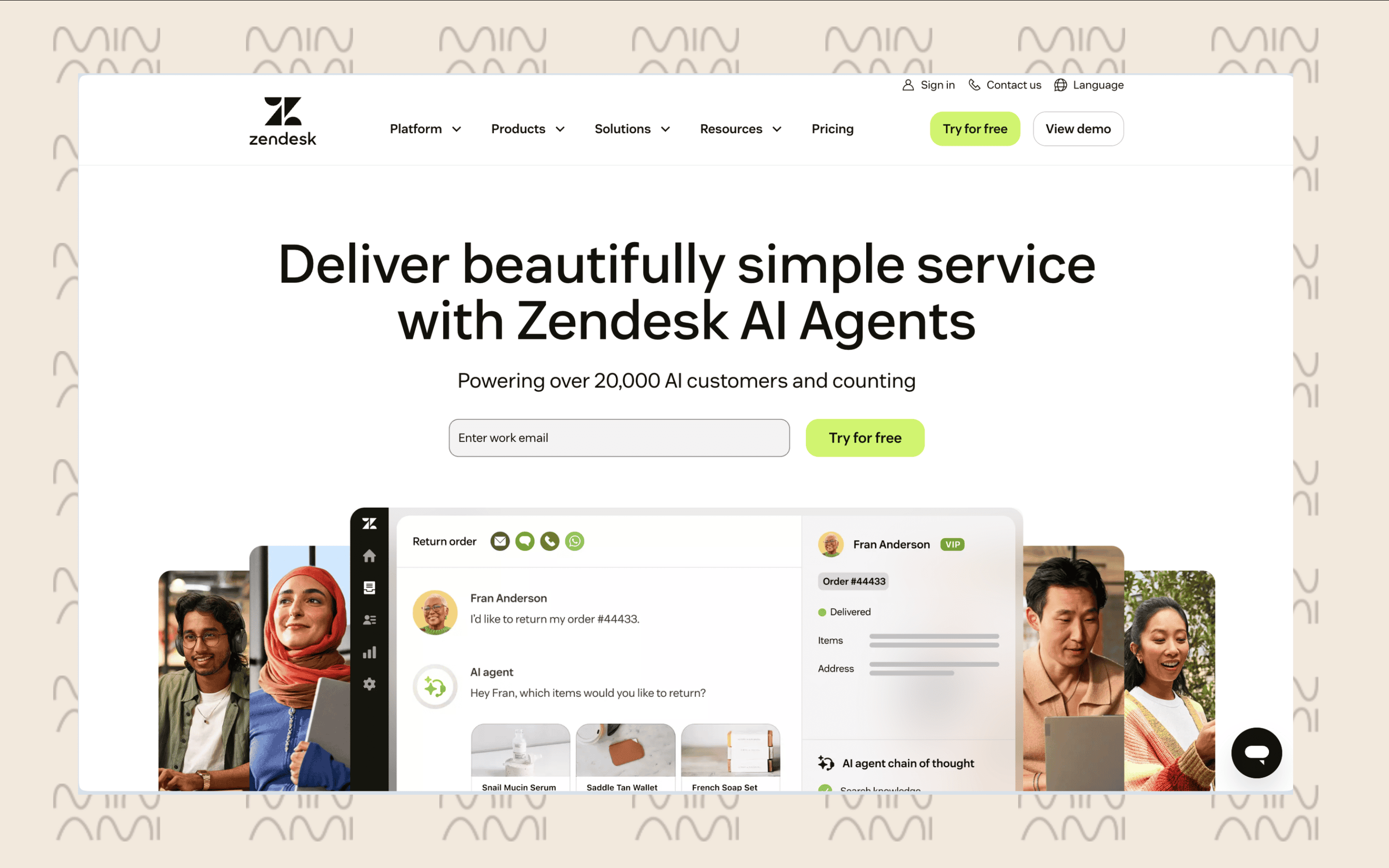
Zendesk is a customer service platform built around a unified ticketing system. It collects requests from email, chat, and social into a single queue and routes each to the right agent. Its AI suggests responses and classifies incoming tickets to speed up handling. It covers a wide range of industries rather than ecommerce specifically.
Key features
-
Unified multichannel ticketing
-
AI response suggestions and routing
-
Knowledge base and help center
-
Reporting and analytics dashboards
-
Broad app marketplace
Pros
-
Handles high ticket volume across channels
-
Deep configuration and reporting
-
Large integration ecosystem
Cons
-
Not ecommerce-specific out of the box
-
Resolves by replying, not by acting on the order
Pricing
Zendesk AI pricing includes a Suite seat plus separate AI add-ons billed per agent/month, automated resolution fees starting around $1.50 per resolved ticket (or ~$2 pay-as-you-go), and extra costs for Copilot and advanced AI agent builder features.
👉 The best agentic AI solutions for enterprise eCommerce in the US market
4. Intercom
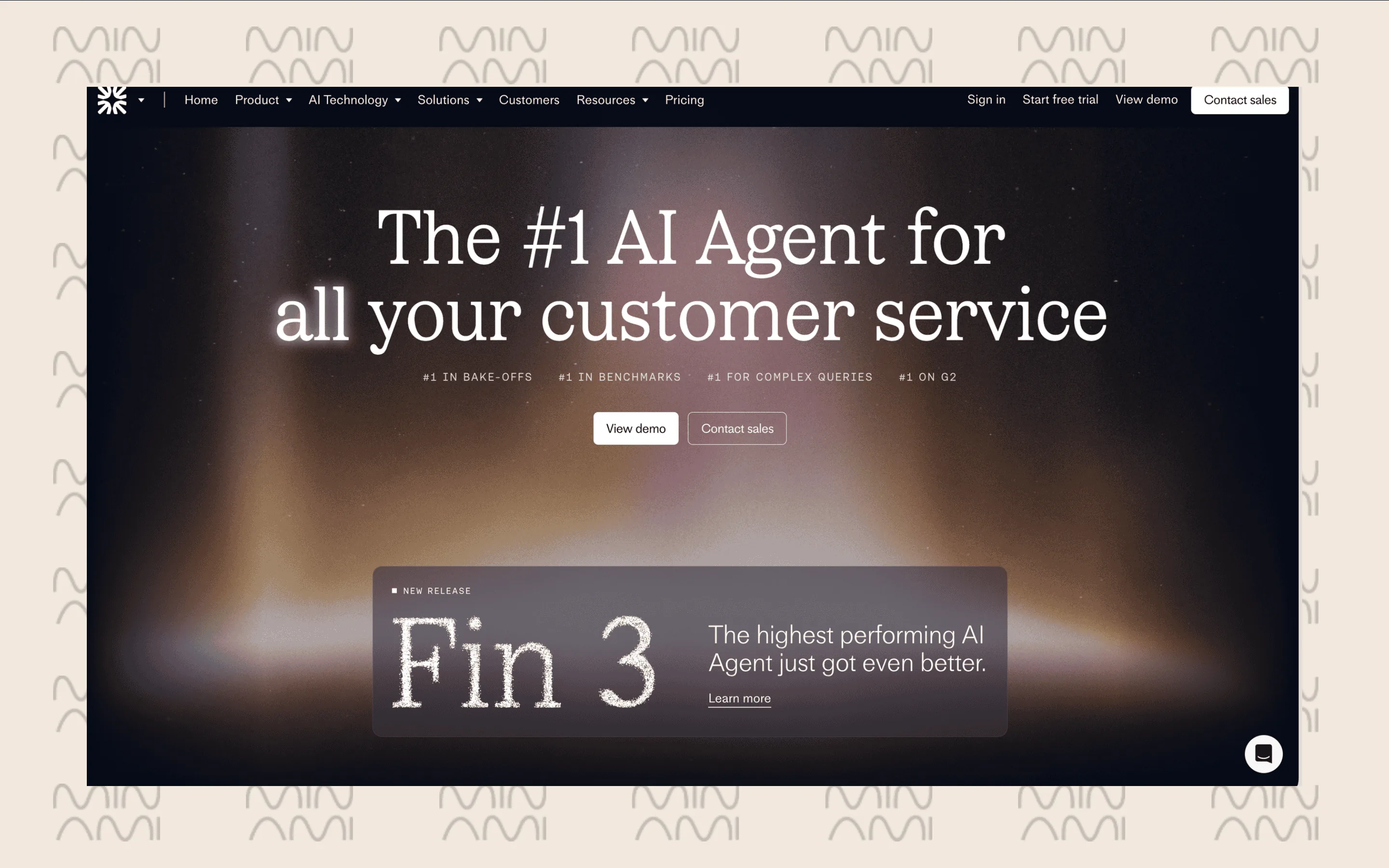
Intercom is a support platform centered on an AI agent layered over live chat. Its agent answers common questions directly in the chat window and hands off to a person when a case needs one. It works inside the conversation, replying to the customer rather than acting on the order behind it. Its AI is priced around resolved conversations.
Key features
-
AI agent for chat resolution
-
Live chat with human handoff
-
Help center and articles
-
Conversation routing rules
-
Outbound messaging tools
Pros
-
Resolves common questions in-chat
-
Clean handoff to human agents
-
Resolution-based AI pricing
Cons
-
Acts on the conversation, not the order
-
AI resolution costs add to the seat price
Pricing
Intercom pricing uses a hybrid model with per-seat costs plus AI resolution fees. Plans start at $29 per seat/month, while the Fin AI Agent costs around $0.99 per resolved conversation, with additional charges for Copilot, proactive messaging, SMS, and other advanced AI features.
👉 Best AI tools for Shopify stores
5. Tidio
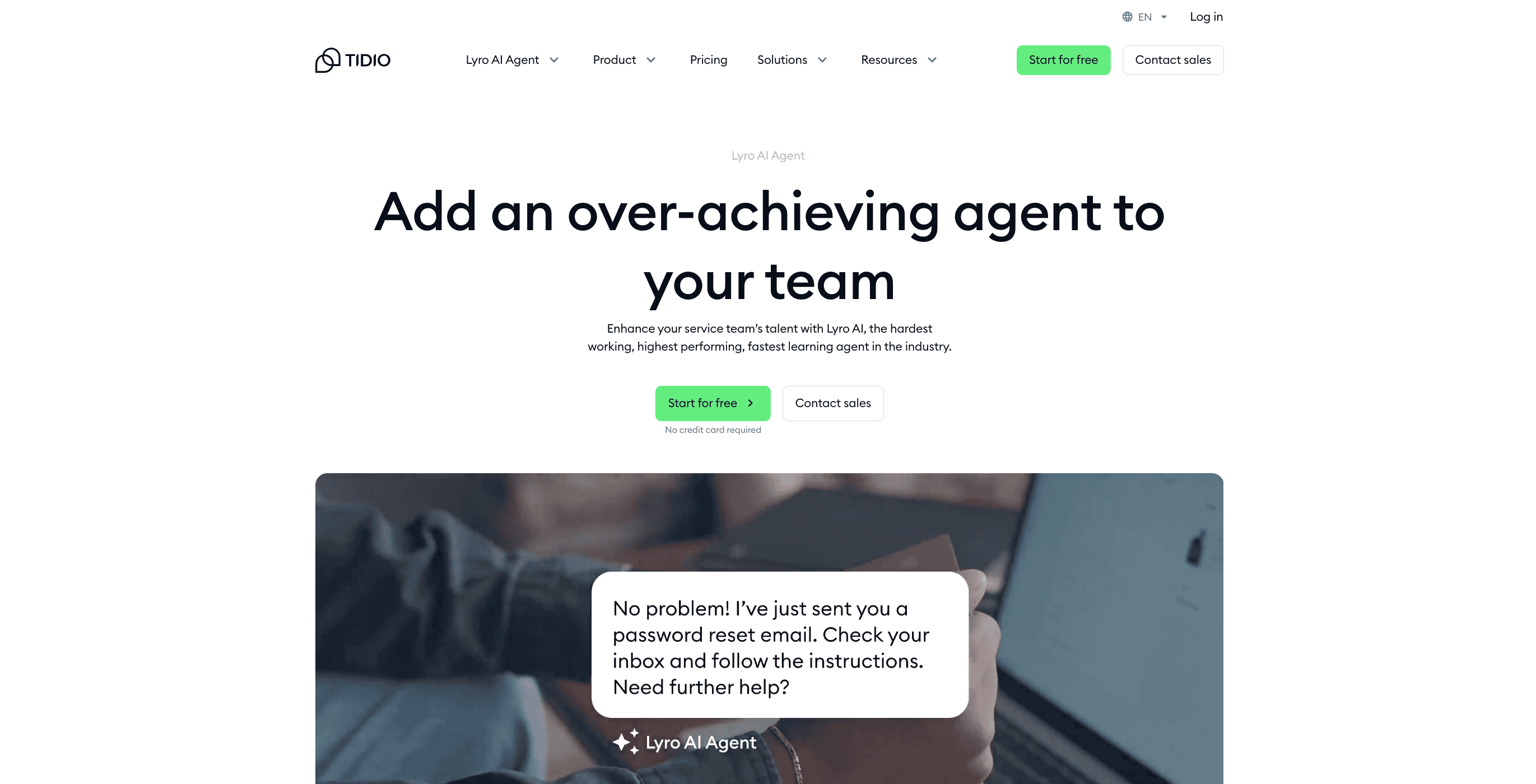
Tidio is a chatbot and live chat tool aimed at smaller stores. It places chat widgets and bot flows on the storefront to answer repetitive questions before they reach a person. Its bots run preset flows, deflecting common queries at the first touch. It fits a store automating a first layer of support rather than complex operations.
Key features
-
Visual chatbot flow builder
-
Live chat widget
-
Storefront and platform integrations
-
Visitor tracking
-
Prebuilt automation templates
Pros
-
Free plan to start
-
Simple flow builder
-
Quick storefront setup
Cons
-
Deflects questions rather than executing changes
-
Automation depth limited for complex post-purchase cases
Pricing
Tidio pricing combines customer service plans with separate Lyro AI conversation limits. Paid plans start around $29/month, while the Lyro AI add-on starts at roughly $32–$39/month for 50 AI conversations, with pricing increasing based on automation volume and usage.
Strategies to reduce customer support tickets with the best AI tools
Automate your tier-1 tickets first
List your top ten incoming questions by volume and build automation for those before anything else. Tier-1 requests follow fixed patterns, so a bot resolves them end to end without judgment calls.
Use AI to speed up agents, not just replace them
Turn on reply suggestions, ticket summaries, and order context inside the conversation. The agent acts on what’s in front of them instead of opening tabs to find it.
Push self-service before the chat opens
Map your twenty most common topics and make sure each has a clear, current help-center article. Surface those articles in the widget before the chat opens so the customer resolves it first.
Build a hybrid model with clear escalation
Set routing rules by query type, order value, and complexity. Send disputes, cancellations, and high-value cases straight to a person, and let the AI take the rest.
Measure resolution, not deflection
Track cost-per-resolution and the share of requests that close without a human touching them. Use those two numbers to decide what to automate next.
Let the AI execute real actions
Connect the AI to your order, return, and shipping systems so it processes the return, updates the order, or reroutes the shipment itself. The request resolves the moment it’s made, so the backend work never reaches an agent. This is what Minami AI is built to do.
Savings calculator
EstimateWhat could Minami save your support team?
Saved per month
$0
0 agent hours freed
0 tickets handled by AI
Estimate based on your inputs. Default automation rate reflects the "on average 90% less customer queries" figure on minami.ai; your results will vary. Excludes Minami subscription cost.