 Nobikage San
 Introducing
5 Best Alternatives to Lyro, the Tidio AI chatbot platform for customer support
Explore how the best alternatives to Lyro help eCommerce teams automate complex tasks, improve response times, and cut support costs without adding extra tools.-
If you’re here, you probably already know how effective AI chat tools can be for a customer support team. And you’re planning — or at least considering — Lyro, Tidio’s AI tool. Choosing the right chatbot or AI agent matters. If you pick the wrong one, the cost and time of migrating later can be very high.
That’s why, in this article, we’ll take a look at Lyro and the alternatives that might work better for eCommerce brands and online sellers who want the best AI platform for their support team.
Top alternatives to Lyro AI, summarized
| Tool | Core Use | AI Capabilities | Price |
|---|---|---|---|
| Minami AI | AI Agent for Ecommerce | Full automation, real actions | Custom |
| Gorgias AI | Helpdesk + AI | Auto-resolve tickets | Base plan + ~$1/resolutio |
| WotNot | No-code bot builder | Flows + intent detection | €29–€299/mo |
| Ada | Enterprise AI | Advanced intent + proactive | Custom |
| Crisp | Chat + inbox | Translation, ML bot | €95–€295/mo |
What is Lyro AI by Tidio?
Lyro AI is Tidio’s built-in conversational support agent. It uses natural language processing to engage visitors and answer their questions as if a human agent were responding. Lyro is trained on your store’s data – you feed it FAQ pages, product information, etc. – so that it can pull answers directly from your knowledge base.
Why Look for an Alternative?
Lyro is a solid starting point, but growing businesses often hit some of its limits. For example, Lyro excels at basic FAQs, but it can struggle with multi-part or highly specific queries. You also can’t run Lyro’s AI chat at the same time as Tidio’s visual Flows (rule-based bots) – you must choose one approach, which forces a trade-off between a flexible AI and structured scripts.
Best Alternatives to Lyro AI (Tidio)
1. Minami AI
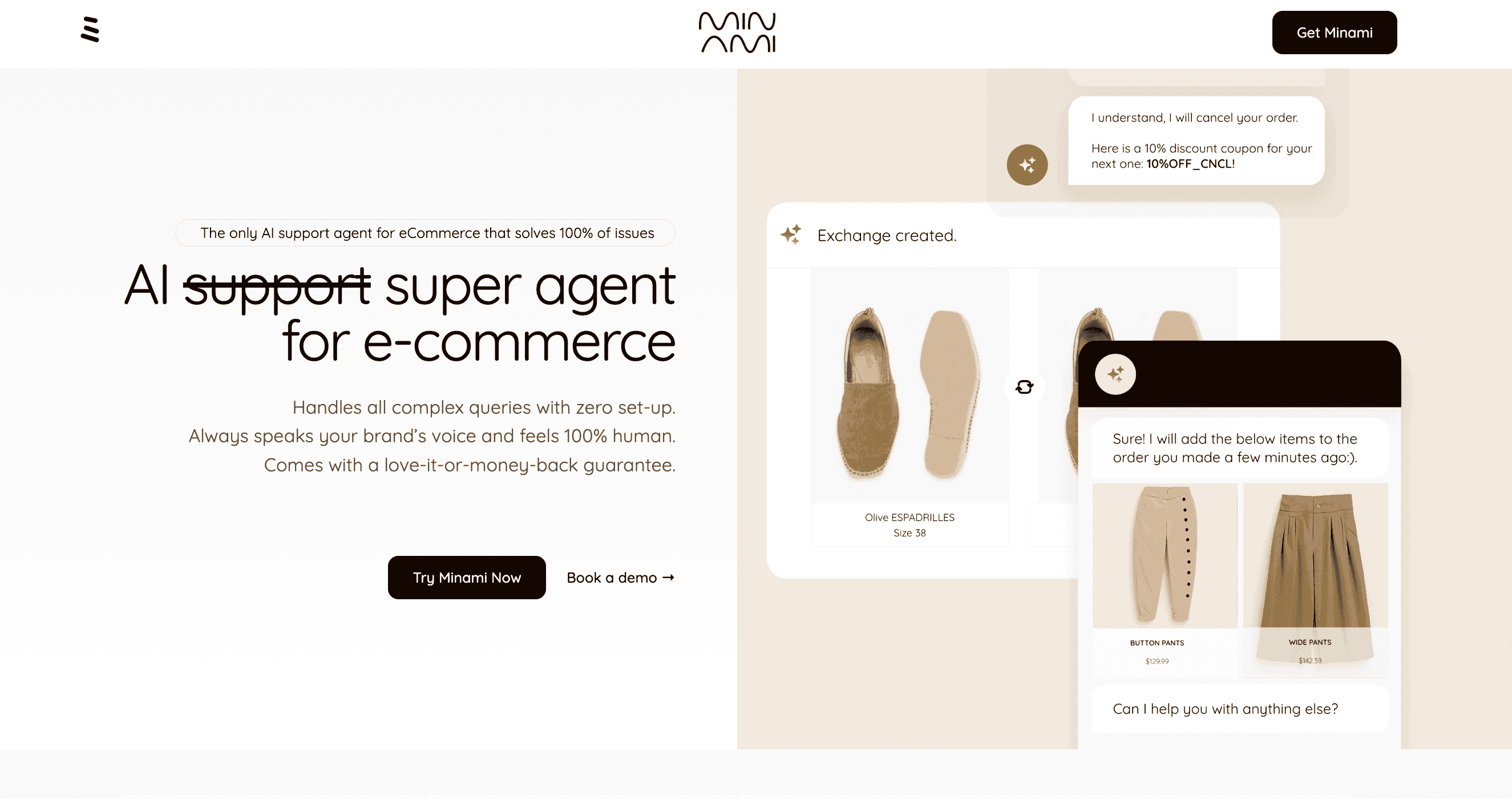
Minami is designed specifically for Ecommerce and goes far beyond just chat. It’s an autonomous AI support agent that covers every stage of the customer journey – from checkout to delivery – and automates even complex tasks.
In practice, this means Minami can instantly perform order edits like adding or removing products, issuing refunds or store credit, and even communicating with courier services about delays or lost packages.
For example, if a customer wants to add an item after checkout, Minami can update the order and charge the payment in real time. Likewise, if someone ordered twice by accident, Minami can remove the extra item and process a refund in seconds. The tool is also designed to manage the entire tracking or return process directly from the chat. When a customer requests anything, Minami automatically sends the right information to your carriers and backend systems, allowing everything to run without manual work.
It also drives revenue by offering upsells or coupons during cancellations, so you retain sales instead of losing customers.
Pricing
2. Gorgias AI Agent
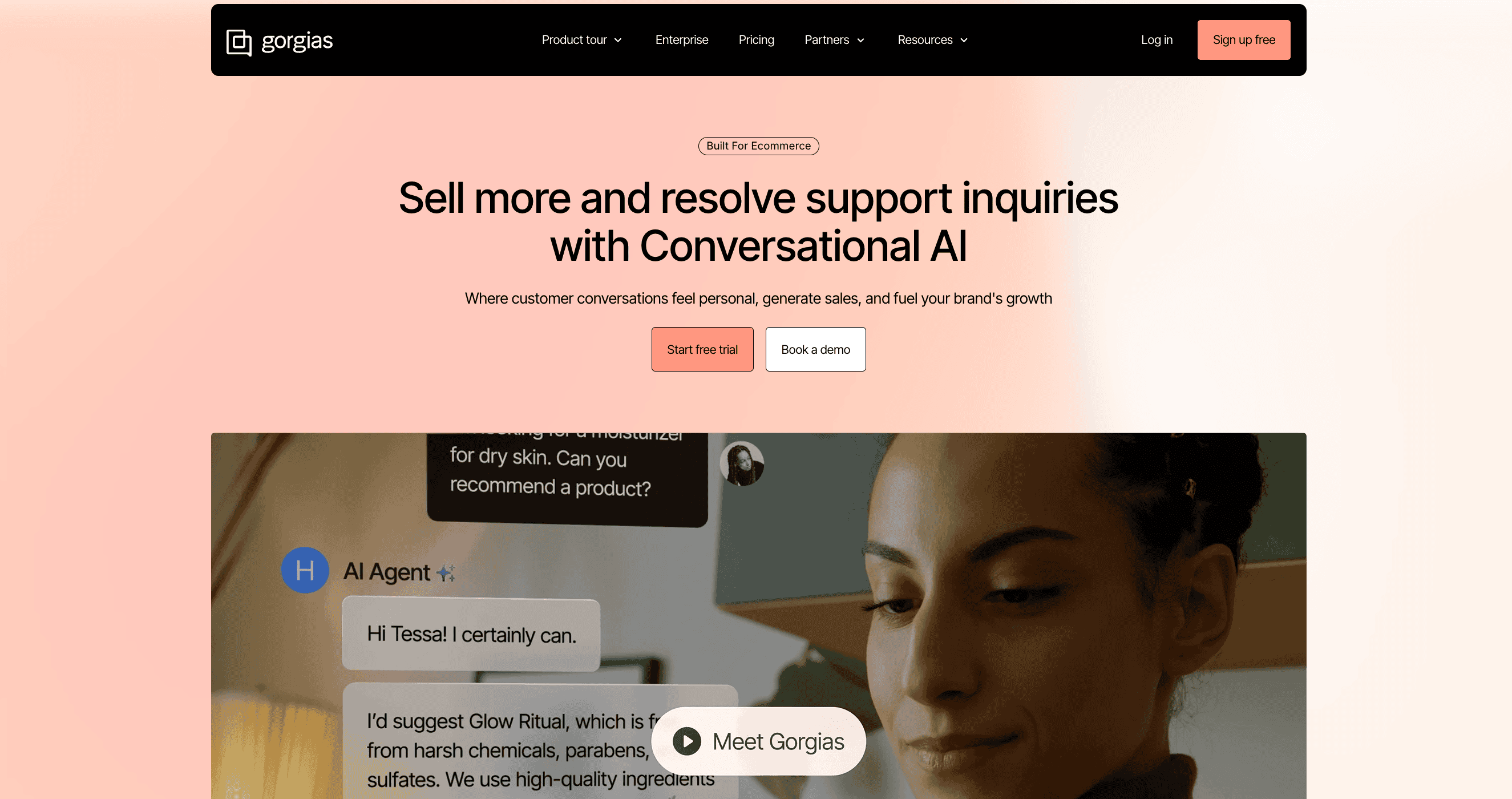
Gorgias is a helpdesk platform built specifically for Shopify and fast-growing eCommerce brands. Its main value is centralizing every customer interaction — email, chat, social media, reviews, and SMS — in one inbox, so your team doesn’t have to jump between tools.
Gorgias also includes an AI agent designed to automate the most common support tasks. It can read incoming messages, identify what the customer needs, and respond using real data pulled from your Shopify store. That means it can answer questions about refunds, order status, shipping updates, cancellations, or modifications right inside the conversation.
The platform focuses heavily on workflow efficiency. You get AI-powered tagging, intent detection, macros, autoresponders, and rules that trigger actions automatically. When the AI can handle a case, it replies instantly. When it can’t, it routes the ticket to your team with all the context already prepared.
Pricing
You pay the base help-desk plan plus around US $0.90–$1.00 for each ticket the AI Agent resolves automatically.
3. WotNot AI Agent
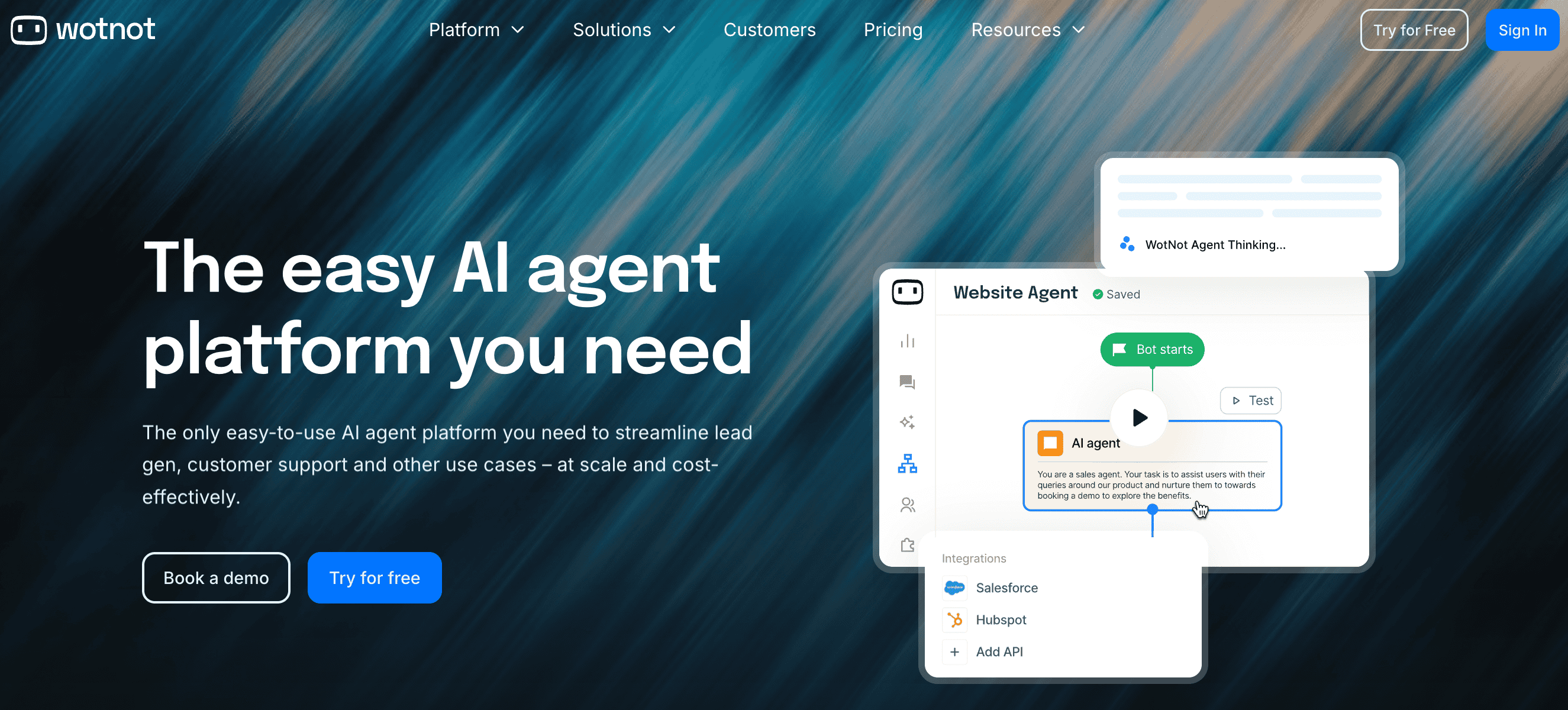
WotNot is a no-code AI agent builder that you can adapt for eCommerce without touching a single line of code. The platform positions itself as an all-in-one automation layer for support, sales, qualification, and lead generation across multiple channels.
With WotNot, you can design conversational flows that handle pre-purchase questions, guide shoppers through product choices, and capture leads directly from your website, WhatsApp, SMS, or other messaging apps. The builder lets you map out logic, create branching paths, and connect data sources so the bot can deliver more personalized responses.
Beyond customer support, WotNot also focuses on automation for sales and marketing teams. You can use it to qualify visitors, book demos, collect contact details, and route high-intent users to human agents. Everything runs inside a visual interface, making it easy to test and deploy new workflows as your store grows.
Pricing
From 29€ to 299€ per month
4. Ada AI Agent
Ada is an enterprise-grade AI chatbot platform designed for larger retailers and high-volume support teams. Its strength lies in how it uses advanced intent recognition and behavioral triggers to engage customers before they even ask for help. For example, Ada can detect when someone is stuck on a checkout page and send a proactive message to guide them, recover the sale, or answer last-minute questions.
Ada connects with your CRM and other internal systems to personalize conversations using real customer data—order history, preferences, loyalty status, and more. This allows the AI to deliver responses that feel context-aware instead of generic.
The platform also supports multiple languages and channels, making it suitable for international brands with complex support needs. And while Ada is powerful, it doesn’t require heavy development work: it comes with a low-code workflow builder that lets teams create automations, route cases, and design custom logic without technical skills.
Pricing
Custom pricing
5. Crisp Chat + AI
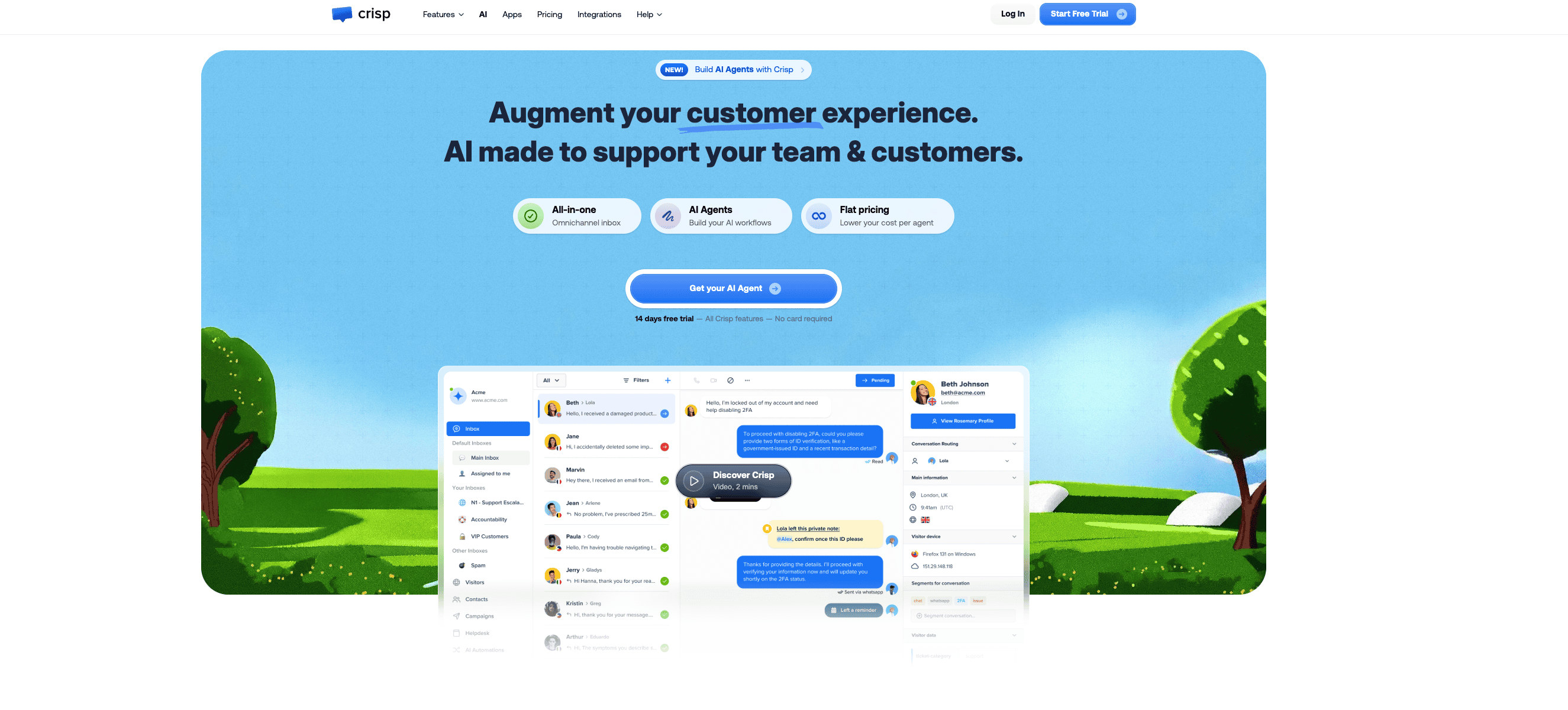
Crisp is a well-known customer communication platform that includes an AI chatbot, although it isn’t positioned as a full autonomous agent. Instead, Crisp combines real-time messaging with a broad set of support and engagement tools. You get a unified inbox for live chat, email, and social media, so your whole team operates from one place.
On the AI side, Crisp includes useful features like automatic language translation, machine-learning chatbots, intent detection, and automated replies for common questions. It also offers a Knowledge Base, campaigns, and chatbot flows that help guide customers during sales or support conversations.
Because everything is integrated—chat, email, bots, CRM, and help articles—Crisp works well for companies that want a lighter solution focused on communication, not deep operational automation. It’s easy to implement and flexible enough for small and mid-size eCommerce brands looking to add AI features without overhauling their whole support stack
Pricing
From 95€ to 295€ per month
How to choose the best alternative to Lyro AI
1. Start with your platform integrations
Your first filter is compatibility. Check whether the AI agent connects smoothly with your store platform or support environment. Agents designed for e-commerce usually sync more deeply with orders, customer profiles, and fulfillment data.
If you manage several communication channels, choose a tool that centralises chat, email, and messaging apps in the same place.
2. Define the level of automation you need
Not every business needs full autonomy. Some only want fast responses to common questions. Others need an agent able to handle actions like updating orders, checking delivery details, processing returns, or solving exceptions without human help.
Knowing your required automation level will narrow down the right type of solution.
3. Choose between plug-and-play or custom builders
Some platforms offer instant setup: the agent learns from your existing FAQs, knowledge base, and past tickets with almost no training. Others give you more control through advanced builders where you design flows, conditions, and escalation rules.
Decide whether you prefer speed and simplicity or complete customization.
Why Minami AI can be the strongest upgrade over Lyro AI
When you compare AI agents side by side, the biggest difference is not in how they chat, but in how much real work they can take off your team. Lyro focuses on answering questions, which is useful for smaller stores or limited support teams. Minami goes further by acting inside your operations and solving tasks that normally require a support agent or logistics manager.
If your goal is to move from “answering questions” to “automating real work,” Minami delivers a broader impact than traditional chat-focused systems like Lyro. It becomes part of your operational engine, not just your support inbox—helping your business stay fast, efficient, and resilient as it grows.
Frequently Asked Questions
Have more questions? Fill this form and our team will be in touch to answer them!
-
Which Lyro alternative works best for eCommerce brands?
- Minami is usually the strongest choice if you want a fully autonomous AI agent. It acts inside your store—changing orders, issuing refunds, sending tracking updates, and preventing cancellations with upsells.
-
What features should I look for in Lyro alternatives?
- Look for tools that go beyond chat replies: automated order edits, shipping issue resolution, real-time tracking updates, and the ability to actually do tasks inside your eCommerce backend.
Get Started
Minami is available with zero setup
No integrations. No workflows. No dev time. Just power up Minami and let your AI agent cut refunds, manual labor, and losses