 Nobikage San
 We tested every Gorgias AI alternative and these 7 are the ones worth your time in 2026
A clear, friendly guide to the Gorgias AI chatbot alternatives that outperformed Gorgias in real ecommerce scenarios this year.
Are you looking for an alternative chatbot to the Gorgias AI Agent?
For a long time, if you were using Gorgias, the obvious move was to turn on Gorgias AI Agent and hope it would speed things up.
And it does, to a point. But a lot of brands have started to realize something: answering tickets faster doesn’t remove the work. It just moves it around.
In this guide, we break down what Gorgias AI Agent really handles, why some stores hit a ceiling with it, and which options go further.
How I picked these Gorgias AI chatbot alternatives
You’re not here to compare helpdesks. In fact, you probably already know what an ecommerce helpdesk does. You’re looking for an AI agent that can truly manage your customer service without relying on too many human agents.
So for this comparison of Gorgias AI chatbot alternatives, I ignored the usual things like inboxes, macros, or ticket views and focused only on how each platform handles real ecommerce work.
Best alternatives to Gorgias AI agent
| Tool | What stands out | Pricing |
|---|---|---|
| Minami AI | Delivers up to 90% end-to-end automation for ecommerce issues | Custom pricing |
| Zendesk AI | Massive training dataset and enterprise stability | $69 – $219 per seat/month + ~$1.5 per AI resolution |
| Fin | Human-like replies with smart product guidance | From ~ $0.99 per resolution |
| Alhena AI | Built-in shopping assistant + L1 deflection | Around ~$240/month |
| Freshdesk | Simple setup with pre-trained ecommerce models | $0 – $79 per seat/month + $49 per 100 AI sessions after 500 free |
| Kustomer AI | Full customer timeline powering AI decisions | $89–$139 per seat/month + 0.60 per AI conversation |
| Lyro | 70–90% FAQ automation with fast setup | $32–$583/month + Tidio subscription |
What Gorgias AI agent actually delivers
Gorgias AI Agent works as an add-on inside your Gorgias helpdesk, using your existing help center, macros, and Shopify data to handle common questions. It pulls tracking details, shares policies, and takes care of routine requests. It can also support light sales moments with product suggestions or small discount offers during live chat.
Discover the best AI agents and AI tools for Shopify stores.
Why brands look for alternatives to Gorgias AI platform
1. Cost structure is difficult to forecast
You pay for your Gorgias plan based on ticket volume, and then you pay again for each AI-handled resolution. Those AI resolutions still count toward your ticket quota, so a single interaction increases costs in two places.
2. No flexibility outside the Gorgias ecosystem
The AI Agent only works inside Gorgias. There’s no option to use it with Zendesk, Front, Freshdesk, or any other helpdesk. All your training, macros, and AI setup stay locked inside the platform. If you switch systems later, none of that work transfers.
3. Limited execution for operational tasks
It handles simple actions, but the heavier work — refunds, exchanges, address fixes, delivery issues — still falls back on human agents.
Best Gorgias AI agent alternatives for Ecommerce
1. Minami AI
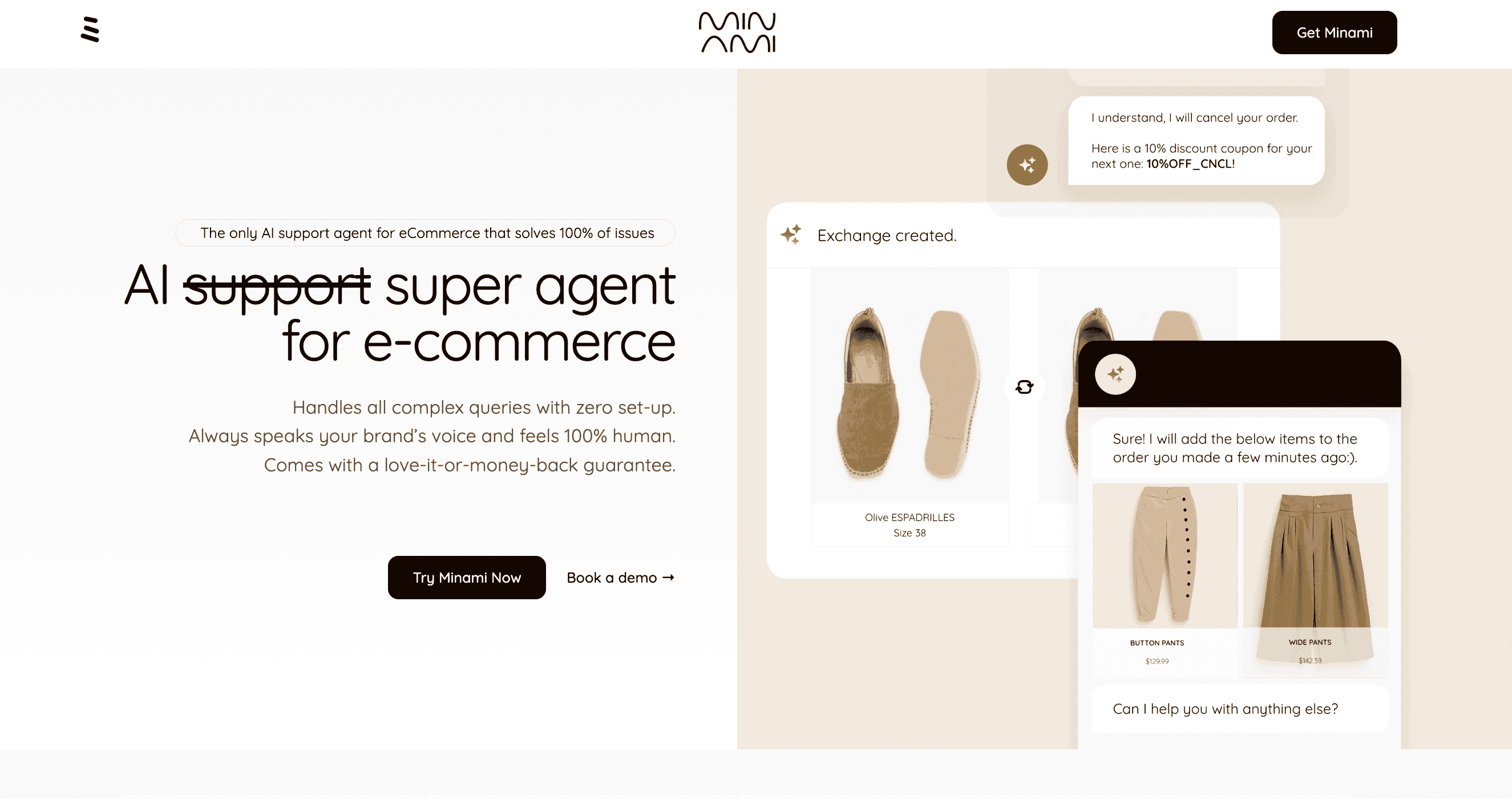
Minami AI isn’t a chatbot or an add-on for your help desk. It works inside your store and handles the operational jobs your team normally takes on—fixing orders, managing returns and exchanges, talking to carriers, and issuing refunds or credits based on your policies. Everything happens in real time, fully connected to your ecommerce stack.
It’s built for brands that want their AI to take over the work, not just guide an agent through it. If a big part of your day goes into order corrections, delivery issues, or return processing, this level of autonomous execution can change the way your entire support workflow operates.
Key strengths
-
Automates core post-purchase tasks on its own (edits, cancellations, returns, exchanges, delivery issues)
-
Removes most tickets, reducing support costs by 90%+
-
Resolves shipping problems by working directly with carriers
-
Protects revenue through smart exchanges and refund-prevention logic
-
Integrates deeply with ecommerce platforms for instant order actions
Limitations
-
Best suited for mid- to large-scale retailers
-
Needs policy setup rather than one-click activation
Pricing
Contact the sales team for pricing
2. Zendesk AI
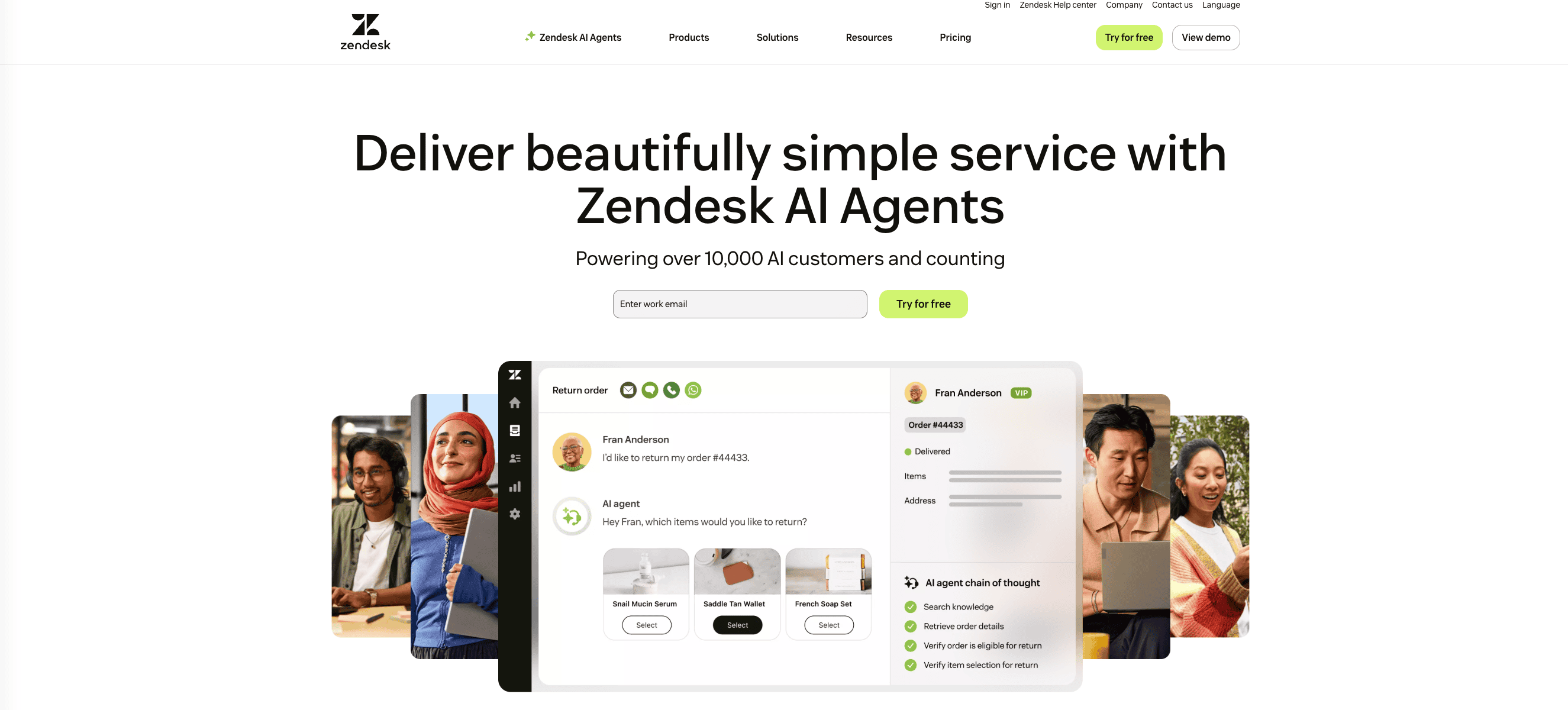
Zendesk’s AI is built on an enormous dataset—roughly 18 billion support interactions—which means it comes ready to work with very little tuning. It’s designed to absorb high-volume traffic across every channel you use, from email and chat to social and WhatsApp, and it keeps things stable even during heavy shopping periods. The draw here is the size of the ecosystem: hundreds of integrations, enterprise-grade reporting, and the kind of infrastructure that big retailers lean on when nothing can break.
Key strengths
-
Strong accuracy from day one thanks to large-scale pre-training
-
Handles high-volume repetitive requests
-
Works across all major channels
-
Supports agents with real-time suggestions and summaries
-
Offers solid reporting for AI performance and CSAT
Limitations
-
Not focused on ecommerce use cases
-
Can get expensive as teams grow
-
The best AI features sit behind higher-tier plans
Pricing
Zendesk’s basic Support plan starts at $25 per agent per month, but AI is only available in the Suite plans ($69–$219 per agent per month), and the AI resolution fee is around $1.5 per automated resolution.
3. Intercom Fin AI Agent
Fin is Intercom’s take on an AI agent, and the focus is crystal clear: make conversations feel natural and use those moments to guide customers before they get stuck. It resolves a big chunk of inquiries on its own by pulling from your knowledge base, while also stepping in to help with things like tracking orders, processing refunds, or walking someone through an exchange.
Intercom Fin is a solid match for brands that see support as part of the sales experience.
Key strengths
-
Strong conversational quality that feels closer to a human than a rules-based bot
-
Behavior-based triggers that jump in when shoppers hesitate or need guidance
-
Upsell and cross-sell support during conversations with smart product recommendations
-
Smooth handoff to human agents with full context and message history
-
Works across chat, messaging apps, and email with a consistent feel
Limitations
-
Resolution rates typically sit around 50–65%, which can land below expectations for complex questions
-
Struggles with layered problems that require deeper reasoning or operational context
-
Conversation-based pricing can climb quickly, especially if resets occur too often
Pricing
From $0.99 per resolution
4. Alhena AI
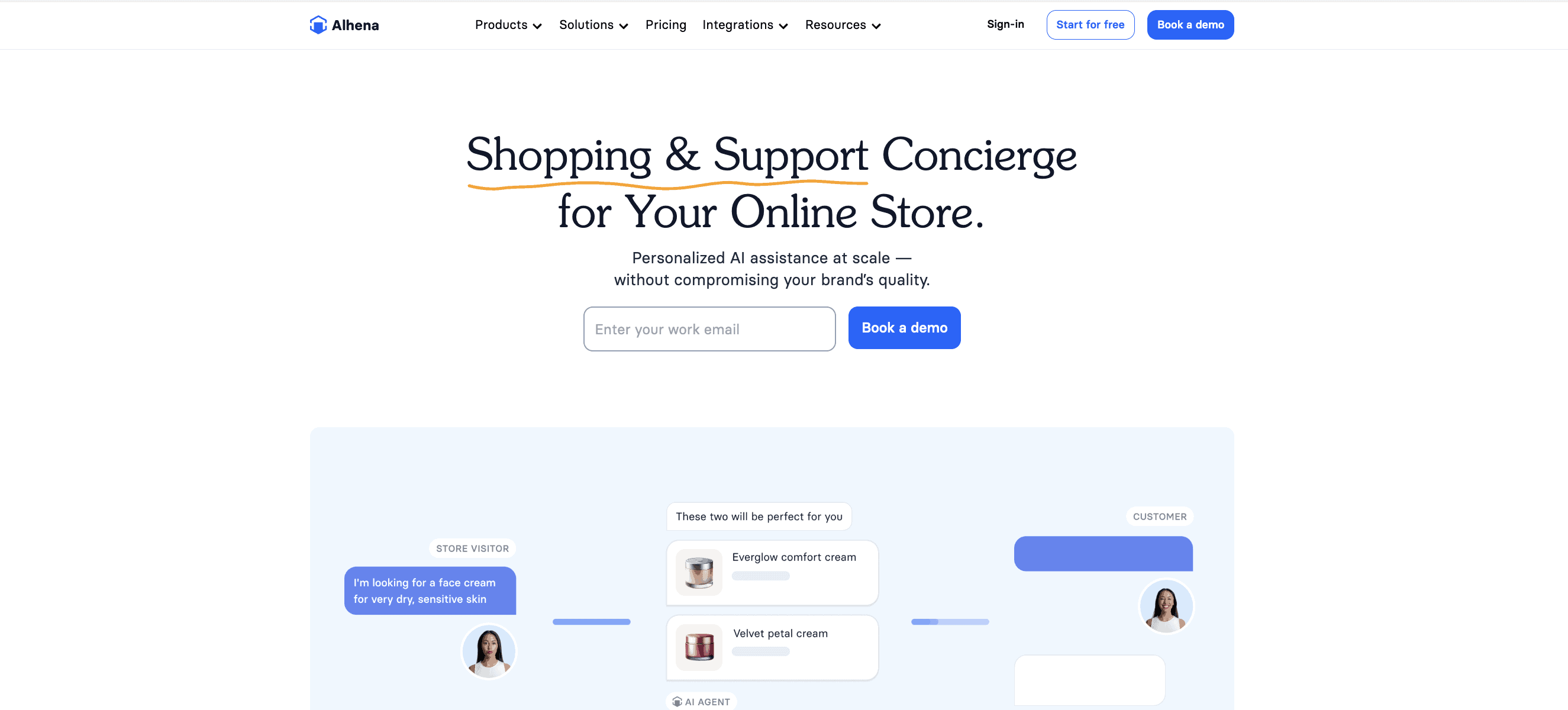
Alhena AI packs two major jobs into a single platform. On the front end, shoppers get a conversational assistant that helps them search, compare, and discover products in a more natural way. After the purchase, the same system shifts into support mode, taking care of order tracking, returns, and all the routine questions that usually flood your inbox. Everything it generates is grounded in your actual catalog and knowledge base, so you avoid the usual hallucination issues.
Key strengths (shortened)
-
Shopping assistant for personalized product discovery
-
Automates most L1 questions and key post-purchase flows
-
Agent Assist speeds up manual replies
-
Works as an add-on for major helpdesks
Limitations (shortened)
-
Newer platform with lower market visibility
-
Not as deep in post-purchase as specialized tools
-
Requires connecting multiple systems
Pricing
Around $240 per month. They offer a free plan with a limit of 25 conversations.
5. Freshdesk AI (Freddy)
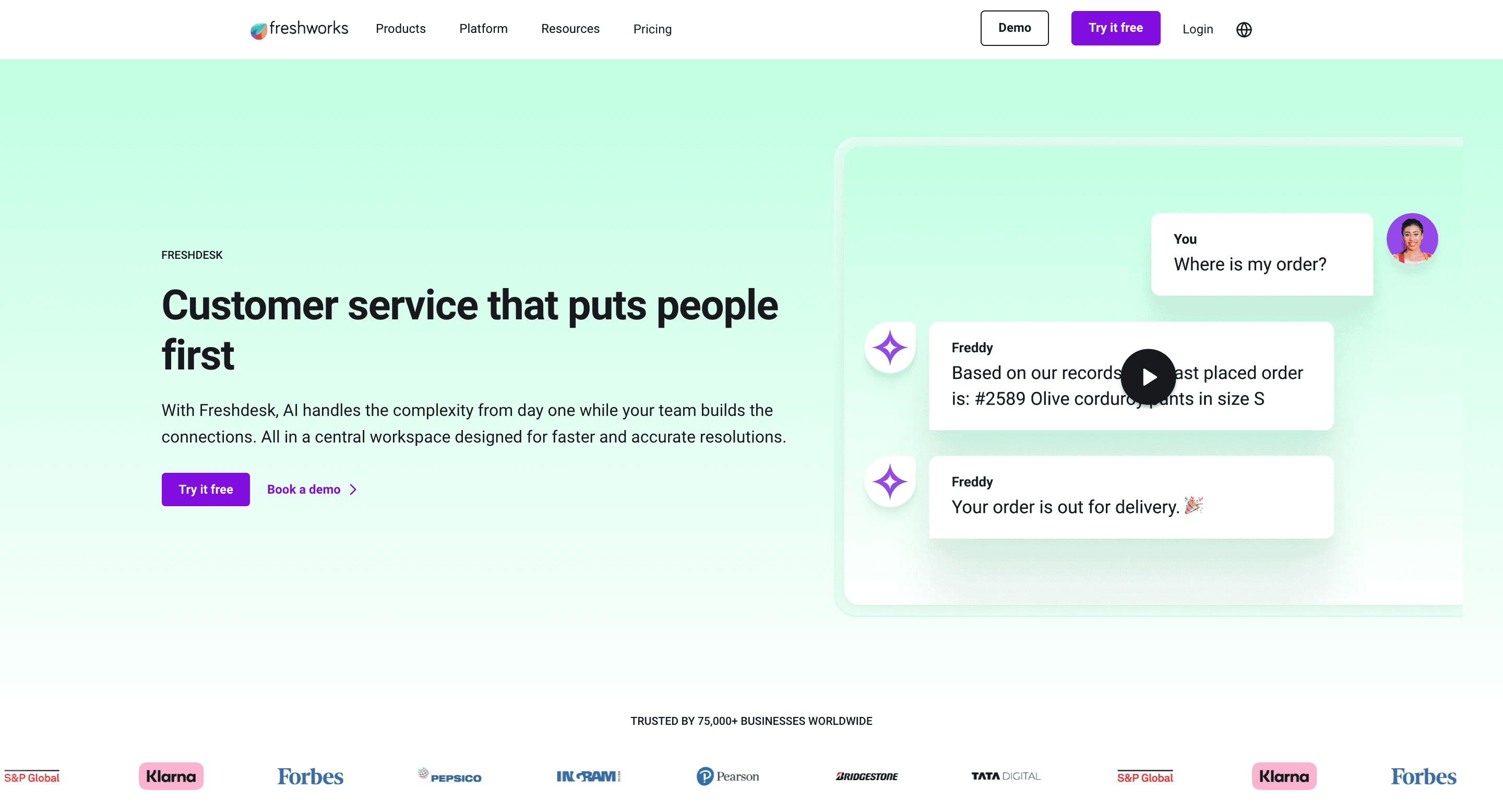
Freshdesk keeps its AI assistant, Freddy, focused on simple automation at a price most smaller brands can handle. It’s built for stores that deal with a steady flow of routine questions and want something cheap, fast to set up, and easy for agents to use. Most of the heavy lifting comes from organizing tickets, routing them cleanly, and handling the typical “Where’s my order?” type of inquiries without slowing down your team.
Key strengths
-
Quick setup with core integrations
-
Pre-trained on common ecommerce queries
-
Unified dashboard for analytics and automations
-
GDPR-friendly for international stores
Limitations to keep in mind
-
AI mainly suggests articles instead of acting
-
Limited depth in post-purchase automation
-
Freddy AI adds extra costs for advanced features
Pricing
Freddy AI Agent requires a basic Help Desk plan ($$0–$$79 per agent/month) and is then charged based on usage, with the first 500 sessions free and $49 for every additional 100 sessions.
6. Kustomer AI
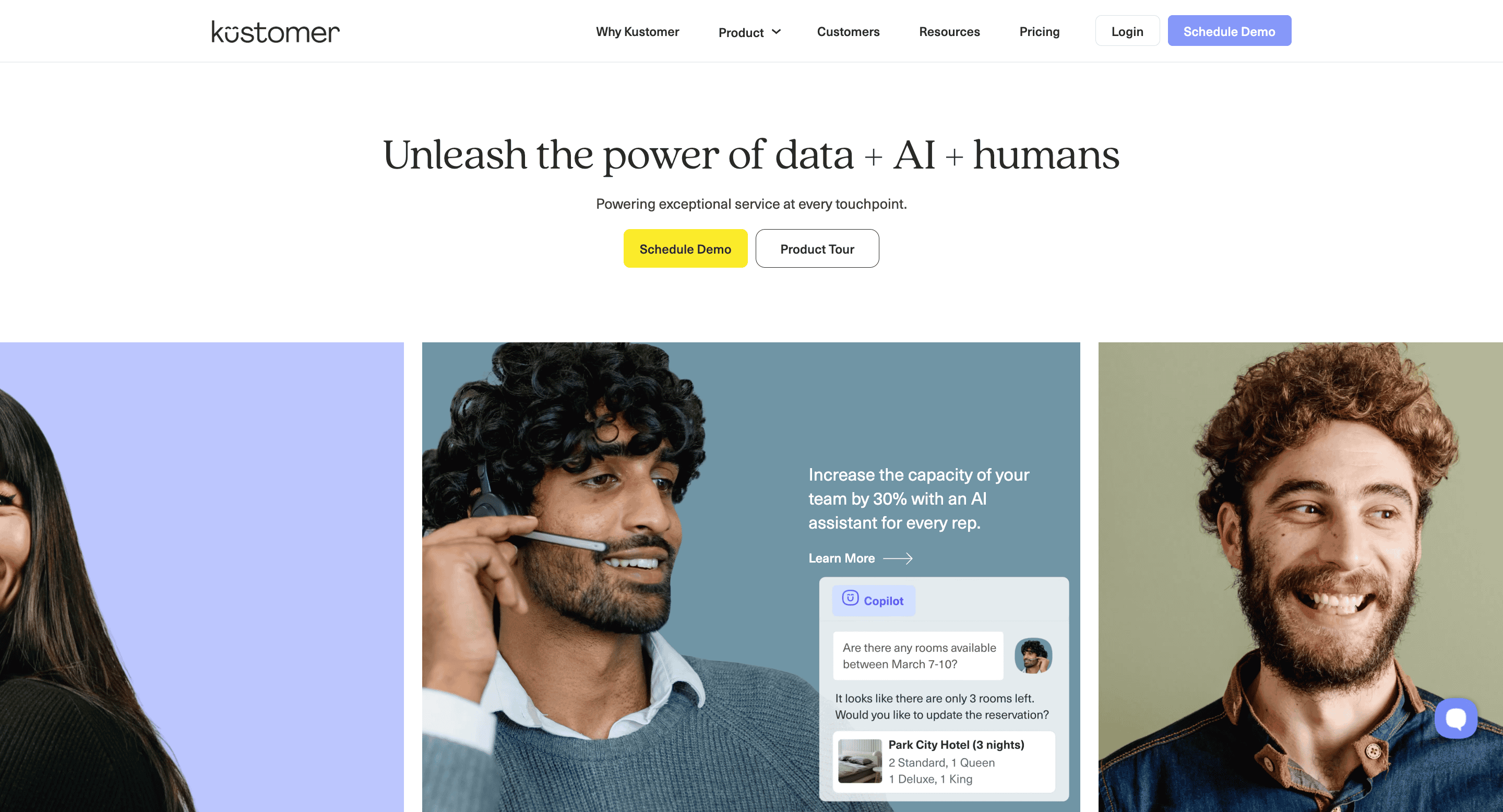
Kustomer approaches AI from a data-first angle. Instead of treating automation as a layer on top of tickets, it builds every AI action around a complete, real-time customer profile. The system analyzes order history, browsing behavior, past conversations, and internal notes to generate replies that feel context-aware. Its AI focuses on anticipating intent, flagging issues before they escalate, and giving agents the information they need without searching through tabs or tools.
Key strengths
-
Context-based replies from basic customer timelines
-
Predictive prompts for common issues
-
AI Assist for quicker routine responses
-
Simple intent detection for frequent questions
-
Lightweight automation recipes for small workflows
-
Basic conversation summaries to speed up reviews
Limitations to keep in mind
- Works best with modest data structures
- Not built specifically for ecommerce
Pricing
Core plans run between $89–$139 per seat/month, while AI add-ons cost aroud $0.60 per customer conversation
7. Tidio with Lyro AI Agent
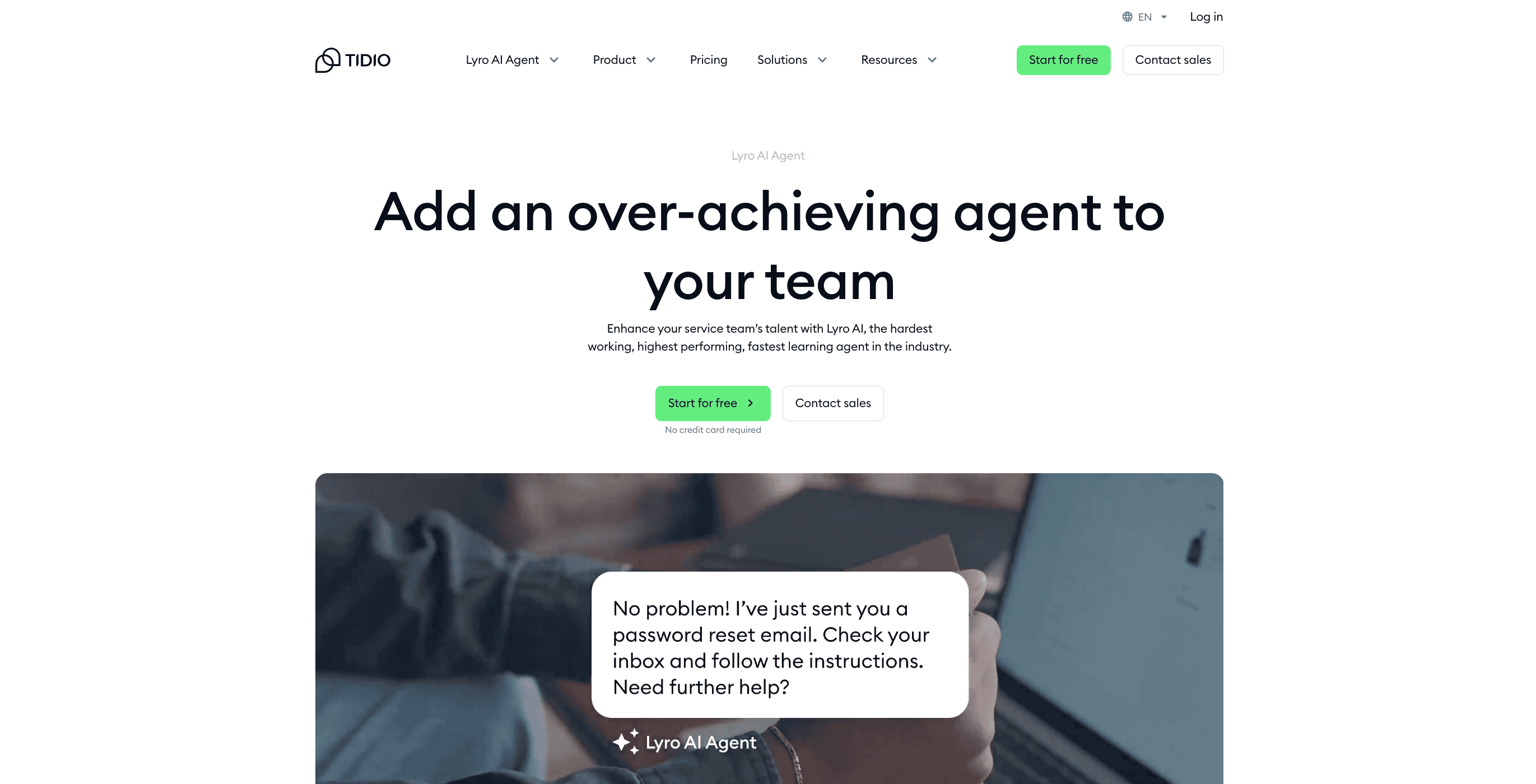
Tidio is one of the easiest ways for smaller stores to bring AI into their support stack. Lyro, its AI agent, handles the bulk of everyday questions—usually 70–90%—while the platform itself blends live chat, simple ticketing, and automation in a lightweight setup. It’s built with Shopify and WordPress in mind, so most teams can get everything running without touching code.
Key strengths
-
Setup takes minutes thanks to one-click integrations
-
Lyro responds only when the answer is verified in your help center, so it avoids hallucinations
-
Automated flows for cart recovery, abandoned browsing, and post-purchase messages
-
Multilingual support for global shoppers
-
Free plan available; paid plans stay budget-friendly
Limitations to keep in mind:
-
AI is basic—great for FAQs, not for deeper post-purchase tasks
-
Tidio’s own customer support gets mixed feedback
-
Designed for small teams; enterprise brands may find it too simple
Pricing
From $32/month to $583/month + Tidio subscription
Gorgias AI agent alternatives: key takeaway
If you ever feel stuck choosing the right AI for your store, come back to the list and walk through it slowly. A good trick is to shortlist two or three tools, compare how each one handles your actual workflows, and then dive into their reviews to see how they perform once they’re live.
Just to keep things fresh in your head, these are the Gorgias AI Agent alternatives that deserve a real look:
-
Minami AI
-
Zendesk AI
-
Intercom Fin
-
Alhena AI
-
Freshdesk AI
-
Kustomer AI
-
Tidio with Lyro
Before you jump into trials, get clear on two things: your budget and the work you actually want off your team’s plate. Stores that map this out upfront make better choices, skip inflated tools, and see results sooner. And if real task completion is the priority — not just faster replies — Minami tends to stand out quickly. It’s built to take over the operational jobs that usually drain support teams, so the impact shows up from day one.
Frequently Asked Questions
Have more questions? Fill this form and our team will be in touch to answer them!
-
What’s the difference between Gorgias AI Agent and a fully autonomous AI agent?
- Gorgias AI Agent supports your team. It answers, suggests, and routes, but it still works inside a traditional ticket flow. Autonomous agents like Minami go further. They take the entire workflow off your plate—returns, refunds, order edits, carrier problems, all handled without anyone jumping in. One assists; the other executes. One reduces friction; the other removes the work entirely.
-
How do I compare ecommerce AI agents before choosing the best alternative to the Gorgias chatbot?
- Start with your real workload. List your top ticket types and note which need information and which need action. Test each AI with those exact cases—most tools offer trial modes or simulations. Look at integration depth, not just logos: can the AI actually update orders, check stock, or talk to your 3PL? Review pricing carefully, especially how it scales during busy seasons. And be honest about setup time—some tools go live in days, others need full policy mapping.
Get Started
Minami is available with zero setup
No integrations. No workflows. No dev time. Just power up Minami and let your AI agent cut refunds, manual labor, and losses