On this page (5)
If you run a high-volume ecommerce operation in the US, you already know where your support queue actually hurts: the WISMO floods, the returns and exchanges, the address changes racing against dispatch, and the Black Friday spike that no headcount plan ever fully covers. You are past the chatbot question. What you need is an agent that can take real action inside your stack and resolve those tickets without a human in the loop.
Five platforms cover most enterprise ecommerce shortlists in the US market right now: Minami AI, Zendesk AI, Gorgias, Ada and Siena AI. They are built for different kinds of merchant, different stacks and different price models, so the goal here is to match the right one to your operation, not to crown a single winner.
Use the comparison first, then read the platform that fits how your store runs.
What are the best agentic AI companies for enterprise ecommerce in the US?
- Minami AI — Best for automating up to 90% of issues with no humans
- Zendesk Copilot — Best for enterprise governance and audit control
- Gorgias — Best for converting support chats into sales
- Ada — Best for multilingual support across 50+ languages
- Siena AI — Best for autonomous voice support
Top agentic AI platforms for enterprise ecommerce in 2026
| Tool Name | Primary Use Case | Starting Price | Biggest Weakness |
|---|---|---|---|
| Minami AI | Autonomous post-purchase resolution | Custom | Newer platform |
| Zendesk Copilot | Omnichannel ticketing | ~$2/resolution | Low automation ceiling |
| Gorgias | Support-to-sales conversion | $0.90/resolution | Double-billed resolutions |
| Ada | Multilingual resolution | ~$30K/yr + usage | No public pricing |
| Siena AI | Empathic, on-brand resolution | ~$750/mo | Lighter enterprise governance |
What is an agentic AI agent for ecommerce enterprises?
It is autonomous software that acts as a member of your support team, with authenticated access to your order management system, payment processor and helpdesk. “Agentic” means it has the authority to take action on its own; “enterprise” means it operates under permissions, audit logs and live data, governed for the scale and compliance demands of a high-volume store. In practice, it is a digital support worker that owns a ticket from first message to closed case.
Most popular agentic AI tools for enterprise ecommerce, reviewed
1. Minami AI
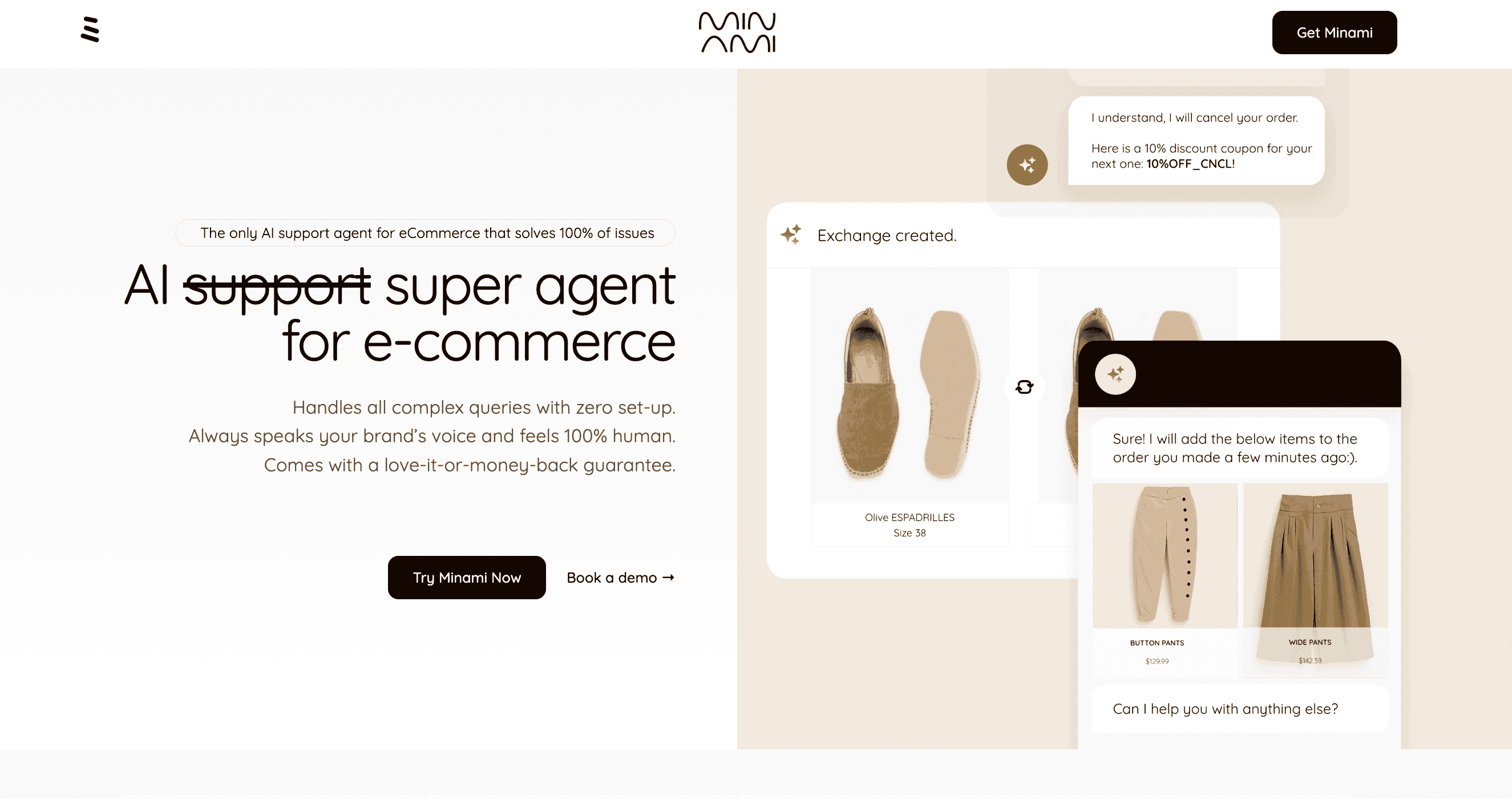
Minami AI is the only AI agent platform on this list built specifically for ecommerce operations. Instead of adapting a generic support chatbot to retail workflows, Minami was designed around the real operational layer of ecommerce: orders, shipments, returns, exchanges, carriers, tracking events, delivery incidents, and customer actions.
The platform connects directly to the post-purchase journey and operates inside ecommerce systems to reduce human resource needs and significantly lower support costs.
What Minami AI does:
- Resolves post-purchase conversations autonomously across shipping, delivery incidents, returns, exchanges, refunds, and order modifications as an advanced AI agent for eCommerce customer service
- Automates AI returns and exchanges management, including return labels, exchange flows, refund prevention, and carrier coordination
- Functions as an AI agent for eCommerce logistics by detecting delivery delays, failed deliveries, frozen tracking updates, and incorrect addresses before customers contact support
- Enhances the shopping journey as an AI agent for shopping experience through personalized recommendations, exchange suggestions, and proactive communication
- Deploys almost instantly through a lightweight integration or app install, with no workflows or decision trees to build
Pros of Minami AI
- Built specifically for ecommerce, so the agent understands orders, shipments, returns, and carrier incidents natively
- Combines AI agent for eCommerce customer service capabilities with real operational execution inside ecommerce systems
- Strong focus on AI returns and exchanges management and post-purchase revenue retention
- Fast deployment with minimal setup compared to traditional enterprise AI platforms
Cons of Minami AI
- Focused exclusively on ecommerce
Minami AI pricing:
2. Zendesk Copilot
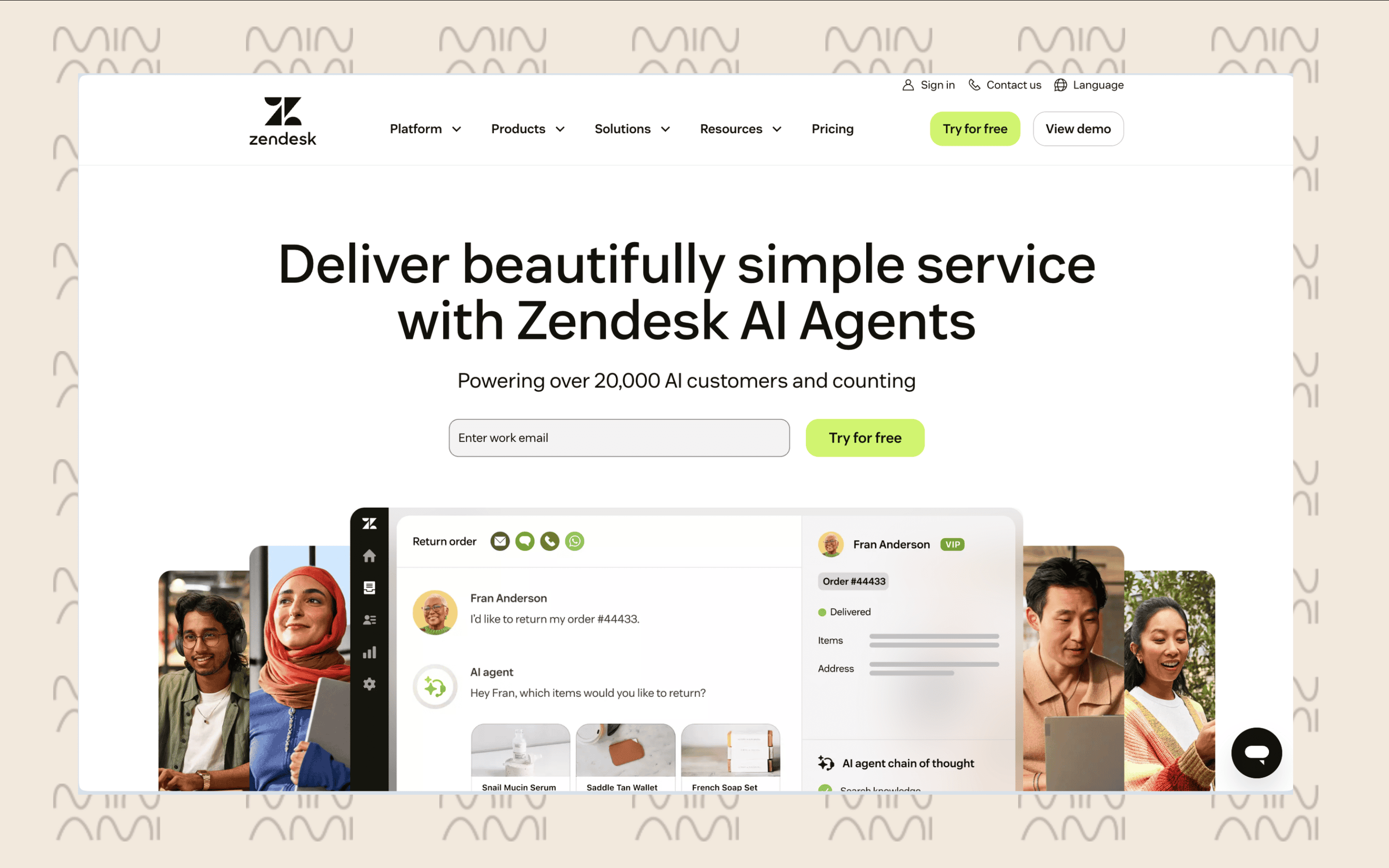
Zendesk Copilot is an agentic layer built on top of the mature ticketing platform that many large retailers already run as their system of record. If your support reaches well beyond the storefront, across multiple teams, regions and compliance requirements, it fits the way you already work, with strength in breadth and control over the sharpest retail automation.
What Zendesk AI does:
- Runs autonomous AI agents on front-line tickets and gives human reps a Copilot for suggested replies, summaries and knowledge surfacing
- Covers email, chat, voice and social in one platform, with support for 40-plus languages
- Connects to Shopify so agents can view orders and process refunds and cancellations
- Provides enterprise governance with role-based access, audit trails, routing rules and reporting
- Verifies resolutions with a separate evaluation step before counting them as billable
Pros of Zendesk AI
- Mature, widely deployed platform with deep governance and compliance controls
- Broad omnichannel and multilingual coverage suited to large, multi-team operations
- Single system of record across an entire support footprint, not just ecommerce
- Outcome-based billing available, so you can pay per verified resolution
Cons of Zendesk AI
- Independent assessments place incumbent platforms in the 20 to 30 percent automation band, a lower ceiling than purpose-built agents
- Costs stack across seats, the AI agent layer and add-ons, so the total compounds with volume
- AI was layered onto a ticketing workflow, so retail automation is less native
Zendesk AI pricing:
- Suite seat plus a separate Advanced AI add-on, billed per agent per month
- Outcome-based fees of roughly $1.50 per automated resolution on committed volume and $2.00 pay-as-you-go
- Copilot and advanced AI agent builder sold as further add-ons
3. Gorgias

Gorgias is built on the Shopify model itself, so order edits, returns and subscription actions execute against your store with no integration project, handling tickets from pre-sale through post-purchase in one setup. For a brand whose entire operation lives on Shopify or Shopify Plus, that tight coupling means meaningful automation live within days.
What Gorgias does:
- Edits Shopify orders, accesses real-time product info, processes refunds and manages subscriptions from the helpdesk
- Handles the full ticket lifecycle with tagging, intent detection, shipping updates and cancellations across chat, email, social and SMS
- Runs macros and automation rules to auto-assign and tag tickets, with sensitive actions gated behind approvals
- Bills per resolved conversation so spend tracks outcomes
- Offers a Shopping Assistant skill to convert shoppers alongside support resolution
Pros of Gorgias
- Deep, native Shopify integration that works out of the box for DTC and retail brands
- Outcome-based billing, so you only pay when the agent fully resolves a conversation
- Fast to deploy with meaningful automation inside the Shopify ecosystem
- Unlimited agent seats, since pricing scales on ticket volume rather than headcount
Cons of Gorgias
- AI-resolved tickets are double-billed, counting as both a helpdesk ticket and a resolution fee
- The AI agent runs on Gorgias only and does not port to other helpdesks
- Leans on rules and macros under the agent layer, getting lighter once you move beyond Shopify
- Overage fees during peak seasons like Black Friday can raise the bill sharply
- Gorgias return management system is limited
Gorgias pricing:
- Helpdesk plans tiered by ticket volume, billed separately from the AI agent
- Gorgias AI Agent pricing starts at $0.90 per resolved conversation on annual contracts and $1.00 on monthly
- Overage fees of roughly $0.36 to $0.40 per ticket once you exceed your plan limit
4. Ada
Ada is a horizontal reasoning platform built to absorb millions of interactions across more than 50 languages without quality dropping at the tail. It serves global brands and is the natural pick when your defining constraint is operating everywhere, so support has to operate everywhere too.
What Ada does:
- Reasons through context, isolates the issue and builds an action plan across chat, email, voice and social
- Supports 50-plus languages and holds resolution quality across millions of conversations a year
- Connects to your store, CRM and helpdesk to look up orders, personalize authenticated interactions and take action
- Hands off complex conversations to live agents without losing context
- Maintains a broad enterprise security stack including SOC 2 Type II, HIPAA, GDPR and PCI
Pros of Ada
- Built for very high volume and global, multilingual operations
- Reasoning-based responses grounded in your knowledge base rather than rigid scripts
- Deep integrations and clean human handoff that preserves context
- One of the broadest certification sets in the category
Cons of Ada
- Ada pricing is not public, so every quote requires a sales conversation
- Full enterprise implementation can take roughly 8 to 16 weeks
- Pricing is hard to forecast and climbs fast as conversation volume grows
- Aimed at large enterprises, with a high effective floor that rules out smaller teams
Ada pricing:
- Custom and sales-led, with a base platform fee around $30,000 per year
- Per-resolution charges of roughly $1.00 to $3.50 per AI-handled interaction
- Median enterprise deal near $70,000 per year, with high-volume contracts exceeding $200,000
5. Siena AI
Siena AI calls itself the first empathic AI customer service platform for ecommerce, built by the founders of conversational marketing platform Cartloop. Its whole pitch is resolution that sounds human: it reads customer sentiment, adapts its tone, and speaks in a brand persona you design, so automated support still feels like your best agent rather than a script.
What Siena AI does:
- Resolves customer issues autonomously with its Cognitive Reasoning Engine (CoRE), which reasons through context instead of following rigid rules
- Lets you design channel-specific AI Personas that match your brand’s voice and tone across every conversation
- Detects customer sentiment and adapts its responses, aiming for empathetic replies rather than robotic ones
- Handles multi-step ecommerce workflows like refunds and subscription changes, and reads photos through Siena Vision
- Operates across email, SMS, chat, Instagram and WhatsApp in over 100 languages
Pros of Siena AI
- Strongest brand-voice and tone control in the category, built around AI Personas
- Reasoning engine handles multi-intent conversations rather than scripted flows
- Genuinely social-first, resolving and converting on Instagram and WhatsApp
- Reported to handle around 80% of daily customer interactions
Cons of Siena AI
- Lighter enterprise governance and compliance tooling than the larger incumbents
- Strength is conversation quality more than deep back-office orchestration
- Best fit is DTC and mid-market, so very large enterprises may outgrow it
- Pricing starts around $750 per month, a high floor for smaller brands
Siena AI pricing:
- Custom, contact-for-pricing model
- Entry point reported around $750 per month
- Scales with conversation volume and channels
Conclusion
This guide ranks the best agentic AI for ecommerce enterprises in the US market in 2026, pairing strengths, pricing, and use cases so leaders can make confident, data-driven choices for autonomous customer support. By matching each platform’s capabilities to organizational needs, whether ecommerce-native post-purchase resolution, enterprise governance, Shopify-native automation, or global multilingual scale, companies can unlock measurable reductions in support cost and real gains in customer experience.
Minami AI is the clear choice for ecommerce-first enterprises, built natively around orders, shipments and returns, deployed with near-zero setup, and focused entirely on resolving the post-purchase tickets that flood high-volume stores.
If you’d like to see it in action, book a demo with Minami.
Savings calculator
EstimateWhat could Minami save your support team?
Saved per month
$0
0 agent hours freed
0 tickets handled by AI
Estimate based on your inputs. Default automation rate reflects the "on average 90% less customer queries" figure on minami.ai; your results will vary. Excludes Minami subscription cost.