On this page (7)
Enterprise customer help desk tools have moved well beyond basic ticketing. Today, the leading platforms combine AI-powered chatbots, agent assist tools, intelligent routing, and analytics in a single environment.
I spent weeks testing the leading AI help desk tools on the market. The results were not equal. Some platforms deliver genuine AI automation.
Others slap a chatbot onto a legacy ticketing system and call it transformation.
Here is what I found, and which tools actually hold up at enterprise scale.
What are the leading help desk and chatbot solutions for enterprises?
- Minami AI, Best for autonomous AI agents that fully handle ecommerce post-purchase operations and support
- Zendesk, Best for large companies needing scalable customer support with strong AI and reporting
- ServiceNow CSM, Best for enterprises with complex internal workflows and cross-team case management
- Intercom, Best for instant AI support and fast customer self-service automation
- Freshdesk, Best for affordable all-in-one support with built-in AI features
- Genesys Cloud CX, Best for call centers with heavy voice support and enterprise routing tools
- Kustomer, Best for ecommerce brands that need full customer history in one view
Enterprise AI tools and platforms: 2026 comparison
| Name | Best for | Star feature | Price range |
|---|---|---|---|
| Minami AI | Ecommerce automation | Autonomous AI agent | Custom enterprise pricing |
| Zendesk | Scalable support teams | AI ticketing system | $69–219 per agent |
| ServiceNow CSM | Complex workflows | Cross-team orchestration | $100K+ annually |
| Intercom | Fast self-service | Fin AI agent | $39–139 per seat |
| Freshdesk | Budget enterprises | Freddy AI automation | $$19–$89 per agent |
| Genesys Cloud CX | Voice contact centers | Predictive voice routing | $75–240 per agent |
| Kustomer | Ecommerce support | Unified customer timeline | Custom |
Why AI matters in enterprise customer support departments
At enterprise scale, the ticket volume of customer support departments multiplies.
Additionally, there are more channels, time zones, and languages, making the job more complex and costly.
This can be a real problem for an enterprise company, especially if they work directly with end customers and care about loyalty.
Good customer service is important, but it also consumes resources.
To summarize
- Volume overwhelms human teams. A 50-agent team handling 10,000 tickets per month faces a fundamentally different challenge than a startup with a shared inbox
- Inconsistency damages brand reputation. Human agents vary. An AI system applies the same logic at 3 a.m. on Sunday as it does at 9 a.m. on Monday
- Repetitive queries drain senior talent. Skilled agents spend hours on password resets and order status checks. AI deflection frees them for work that actually requires judgment
The numbers reflect this shift: enterprises deploying AI help desk tools report up to 60% ticket deflection rates, 3x faster first response times, and 40% reductions in return costs.
What is an enterprise help desk tool?
An enterprise help desk tool is a centralized support platform for large organizations that uses AI to manage, track, and resolve customer and internal requests at scale.
Today, these tools also integrate generative AI agents to automate and learn from customer interactions.
Features any help desk for large companies should have
-
AI-powered triage and routing: The platform classifies, tags, and assigns tickets automatically. Based on intent, sentiment, urgency, language, and custom rules
-
Conversational AI chatbot: A deployable bot that resolves common queries, collects information, and escalates to human agents with full context
-
Agent assist and copilot features: Real-time response suggestions. Automatic knowledge base surfacing. Sentiment analysis visible to the agent during the conversation
-
Omnichannel coverage: Email, live chat, voice, WhatsApp, SMS, social media, in-app messaging, all in a single inbox
-
API depth and integration ecosystem: Pre-built connectors for Salesforce,ServiceNow, Jira, SAP, and major e-commerce platforms. Plus a flexible API for custom integrations
-
Advanced analytics: Custom dashboards. SLA monitoring. CSAT and NPS tracking. Volume trends by channel, agent, and category. Leadership needs this data
Best AI chatbots and help desk tool for enterprise
1. Minami AI
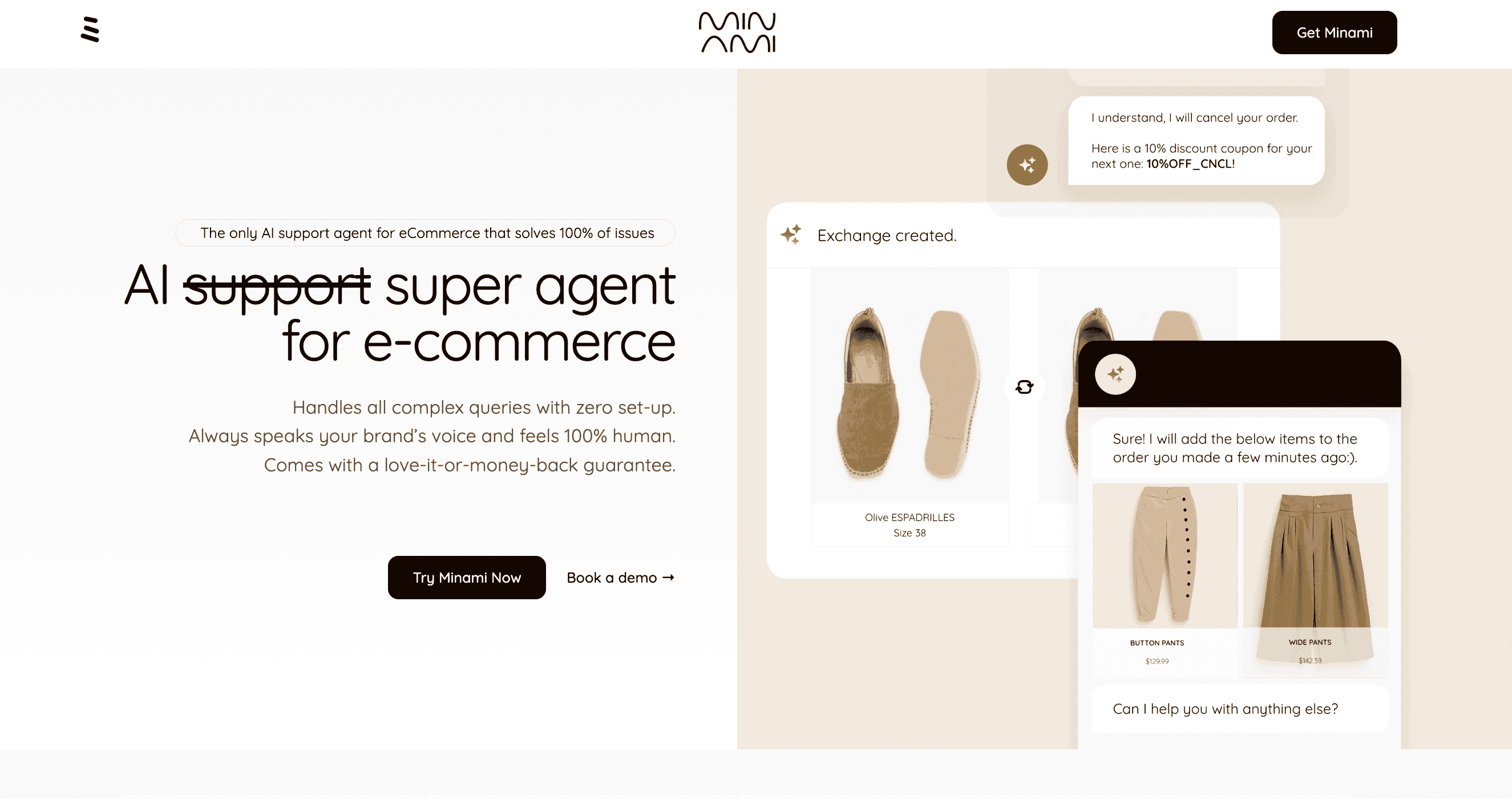
Minami AI is an autonomous AI agent for ecommerce designed to execute and resolve post-purchase operations without human intervention.
It automates some of the most costly ecommerce operations, including returns, order management, and carrier issues. It also provides an AI-driven customer support layer that proactively handles requests before tickets are created.
Unlike traditional help desk tools, Minami acts directly inside ecommerce systems and executes actions across platforms instead of only responding to customers.
Key features:
- Autonomous AI agent for ecommerce operations
- End-to-end resolution of post-purchase requests
- Automated handling of support, logistics, and order workflows
- Direct execution across connected ecommerce systems
- Reduction of human dependency in customer operations
Pricing: Custom enterprise pricing. Contact sales for a quote.
Best for: Enterprise ecommerce brands that want end-to-end automation and massive cost reduction
Pros:
- Only platform covering pre-ticket and post-ticket in one layer
- Eliminates context loss between marketing and support
- Reduces tool sprawl across the customer journey
Cons:
- Custom pricing requires a sales conversation
- Newer market entrant than legacy players
2. Zendesk
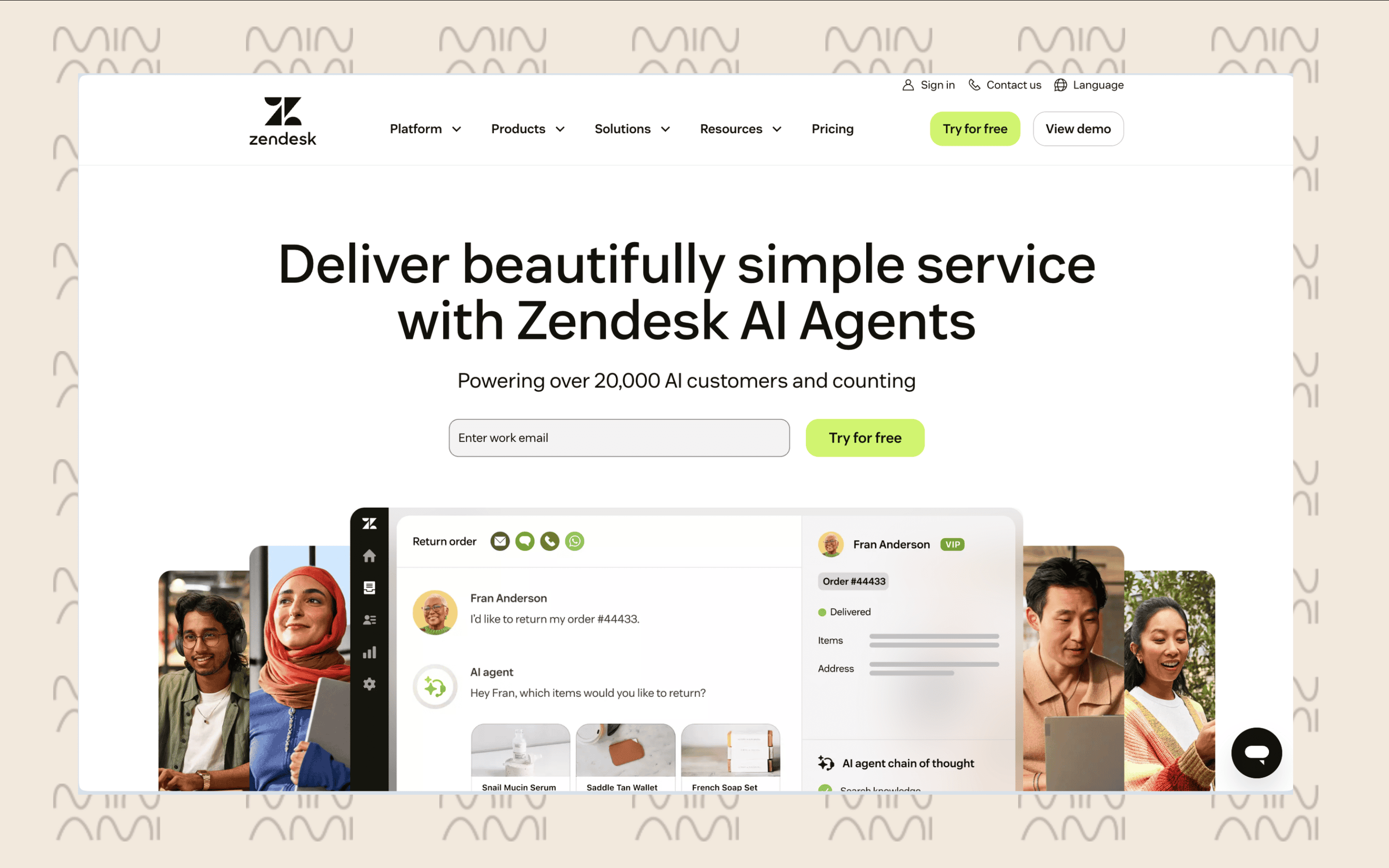
Zendesk is a customer service platform built for operational depth at enterprise scale.
It centralizes every support channel, automates ticket workflows, and gives support leaders granular visibility through advanced analytics.
Key features:
- AI-powered ticket deflection and routing
- Agent copilot with real-time response suggestions
- 1,000+ marketplace integrations
- Advanced reporting and custom dashboards
- Omnichannel inbox (email, chat, voice, social)
- Enterprise compliance (GDPR, HIPAA, SOC 2)
Pricing
| Plan | Price | What’s included |
|---|---|---|
| Suite Team | $69/agent/month | Omnichannel inbox, basic reporting, 1,000+ integrations |
| Suite Growth | $149/agent/month | + AI features, self-service portal, multilingual support |
| Suite Enterprise | $219+/agent/month | + Custom roles, advanced AI, sandbox, premium support |
Best for: Large B2B and B2C teams running complex, high-volume support operations.
Pros:
- Best-in-class analytics and reporting
- Largest integration marketplace in the category
- Highly configurable AI workflows
- Strong multilingual support
Cons:
- Premium pricing at enterprise scale
- Requires dedicated admin resources
- AI features gated to higher-tier plans
3. ServiceNow CSM
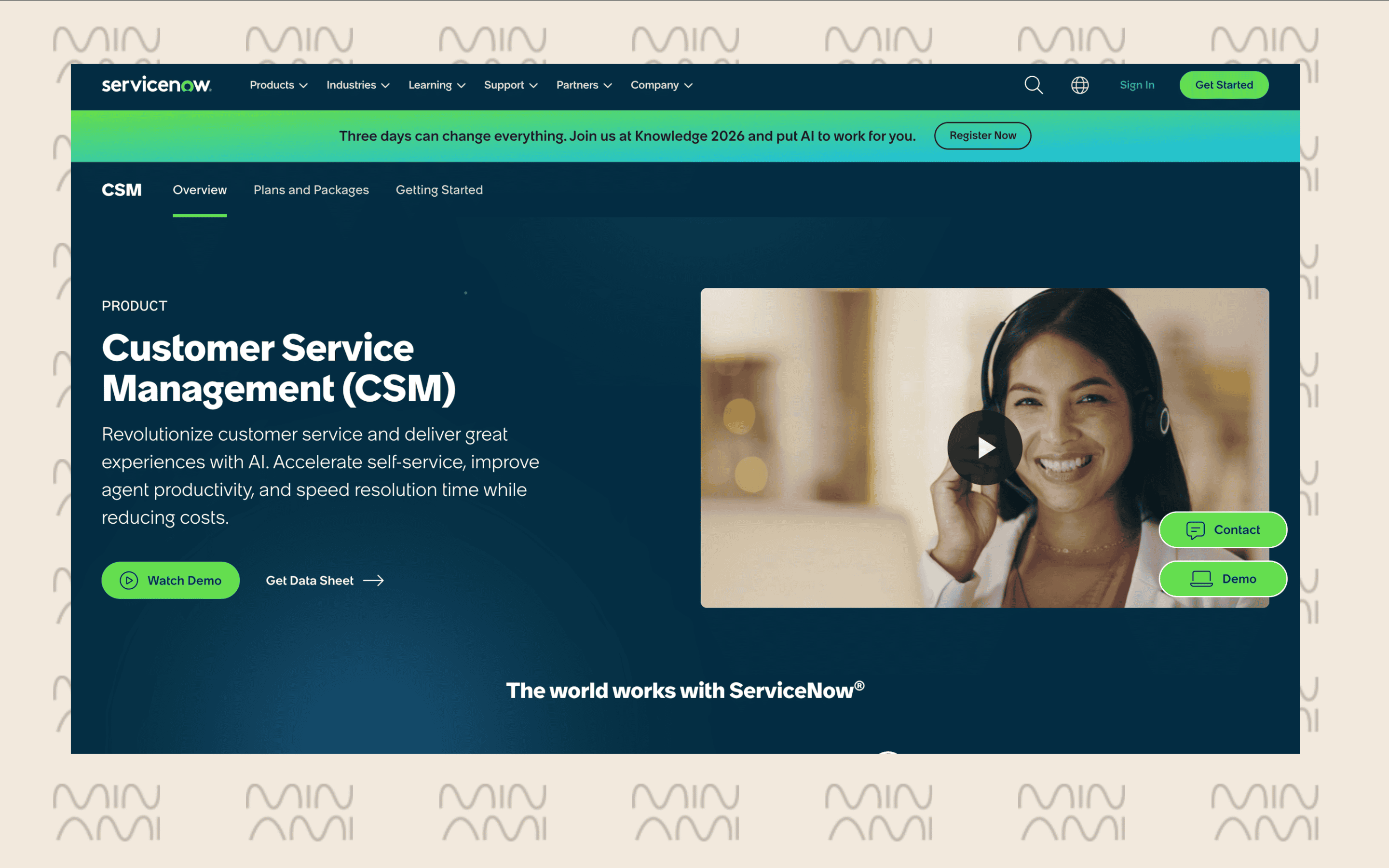
ServiceNow CSM is a service management platform that connects customer-facing support with internal operations.
When a customer issue requires action from engineering, logistics, or finance, ServiceNow routes and tracks that work automatically.
Key features:
- Cross-departmental workflow orchestration
- Now Assist generative AI for case summaries and resolution suggestions
- Native ITSM and CSM unification
- Automated multi-team routing
- Enterprise compliance tooling
- Custom SLA management
Pricing: Custom enterprise contracts. Typically $100K+/year.
Best for: Telecom, manufacturing, and financial services enterprises with complex internal resolution workflows.
Pros:
- Only platform unifying ITSM and CSM natively
- Powerful cross-departmental automation
- Strong compliance and audit tooling
Cons:
- Long implementation timelines
- Not suited below enterprise tier
- Agent UI less modern than competitors
4. Intercom
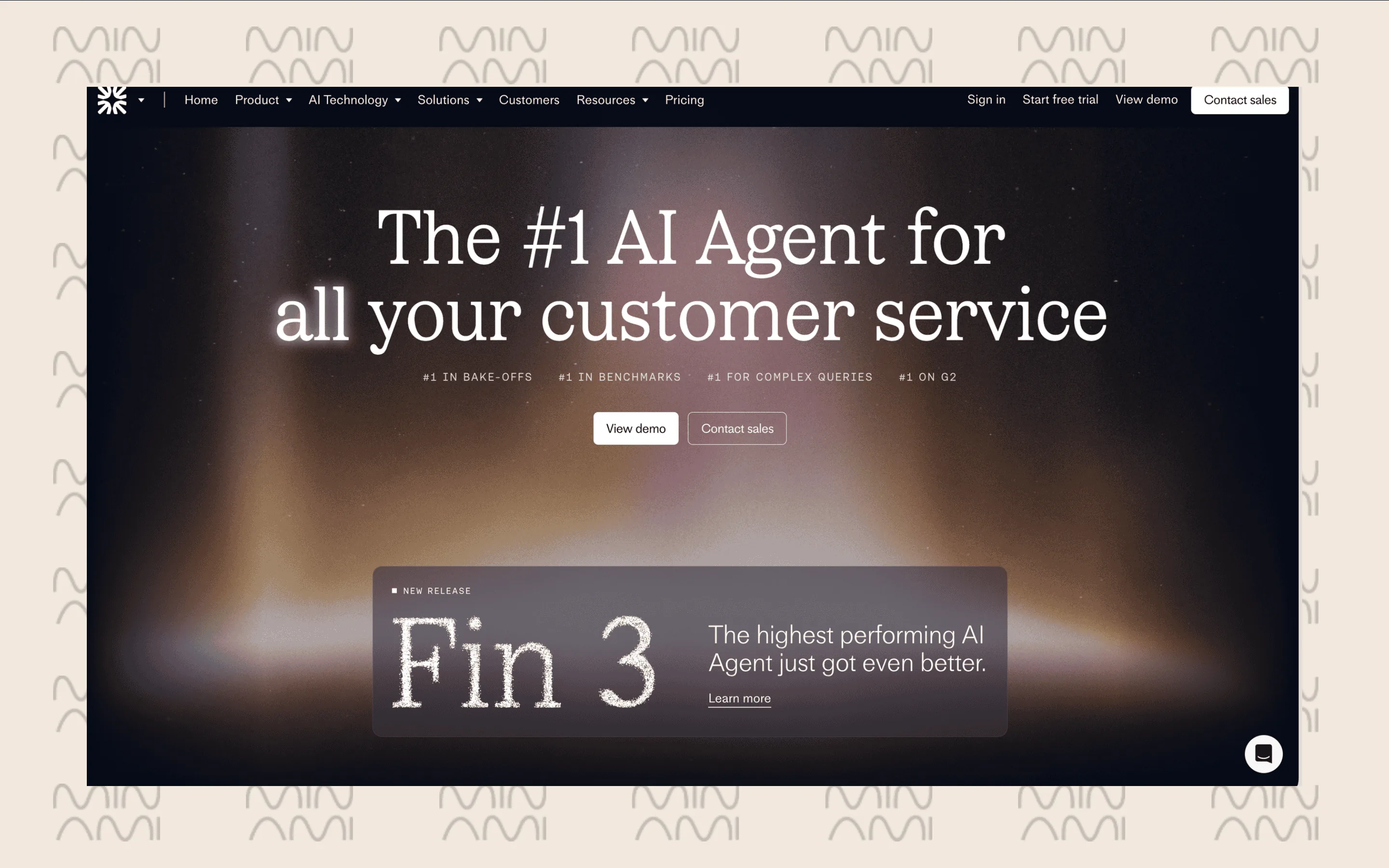
Intercom is a customer messaging platform centered on Fin, an AI agent that resolves support queries directly from help center content.
Key features:
- Fin AI agent with multi-turn conversation handling
- AI-assisted agent workspace
- Automated conversation routing
- In-app and web messaging
- Knowledge base with AI-assisted authoring
- Fast deployment (weeks, not months)
Pricing:
| Plan | Price | What’s included |
|---|---|---|
| Essential | $39/seat/month | Shared inbox, ticketing sysem, Fin AI, public help center |
| Advanced | $99/seat/month | + AI workflows, reporting, multiple team inboxes |
| Expert | $132/seat/month | + Workload management, SSO, custom roles, SLA rules |
| Fin resolutions | $0.99 each | Per automated resolution on top of any plan |
Best for: SaaS companies and digital-first enterprise brands with high self-serve support volume.
Pros:
- Fin AI agent resolves complex multi-turn queries
- Fastest time-to-value on this list
- Clean, modern agent experience
Cons:
- Limited voice and phone support
- Reporting less deep than Zendesk
- Enterprise compliance still maturing
5. Freshdesk
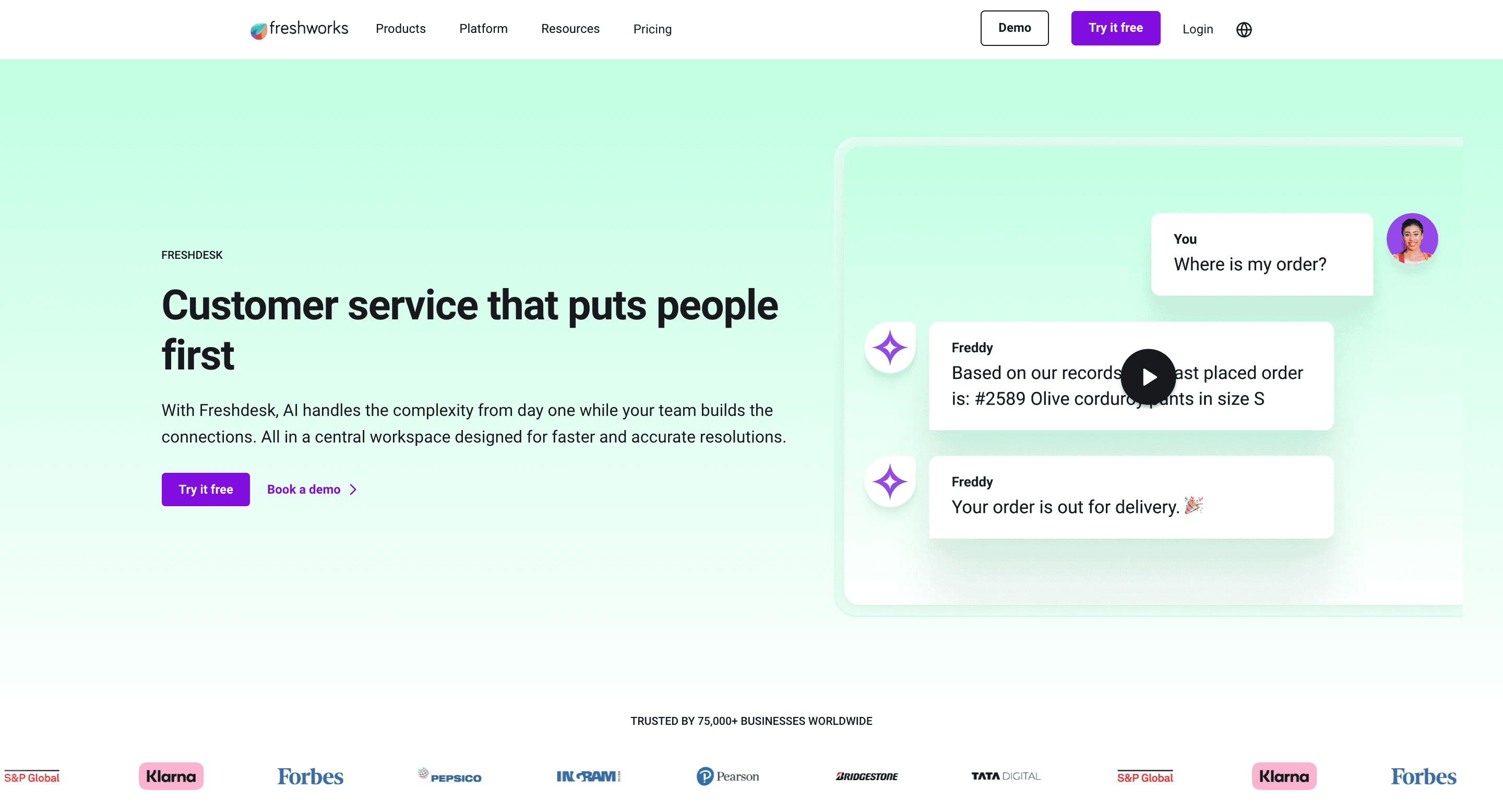
Freshdesk is a support platform that combines help desk, ITSM, and CRM in a single environment, with Freddy AI available across all pricing tiers.
Key features:
- Freddy AI for triage, assist, and auto-resolution
- Unified help desk, ITSM, and CRM
- Omnichannel inbox
- Automated ticket routing and prioritization
- 650+ marketplace integrations
- Custom SLA policies and escalation rules
Pricing:
| Plan | Price | What’s included |
|---|---|---|
| Growth | $19/agent/month | Ticketing, shared inbox, customer portal |
| Pro | $55/agent/month | + Multichannel help desk, email AI agent |
| Enterprise | $89/agent/month | + Proactive and conversational insights |
| Freddy AI add-ons | From $29/month | AI-powered triage and auto-resolution on lower tiers |
Best for: Enterprises consolidating fragmented support stacks into a single platform.
Pros:
- Best value-for-money in the category
- Freddy AI included across all tiers
- Reduces vendor complexity significantly
Cons:
- Customization ceiling on complex deployments
- Top-tier features trail enterprise-focused competitors
6. Genesys Cloud CX
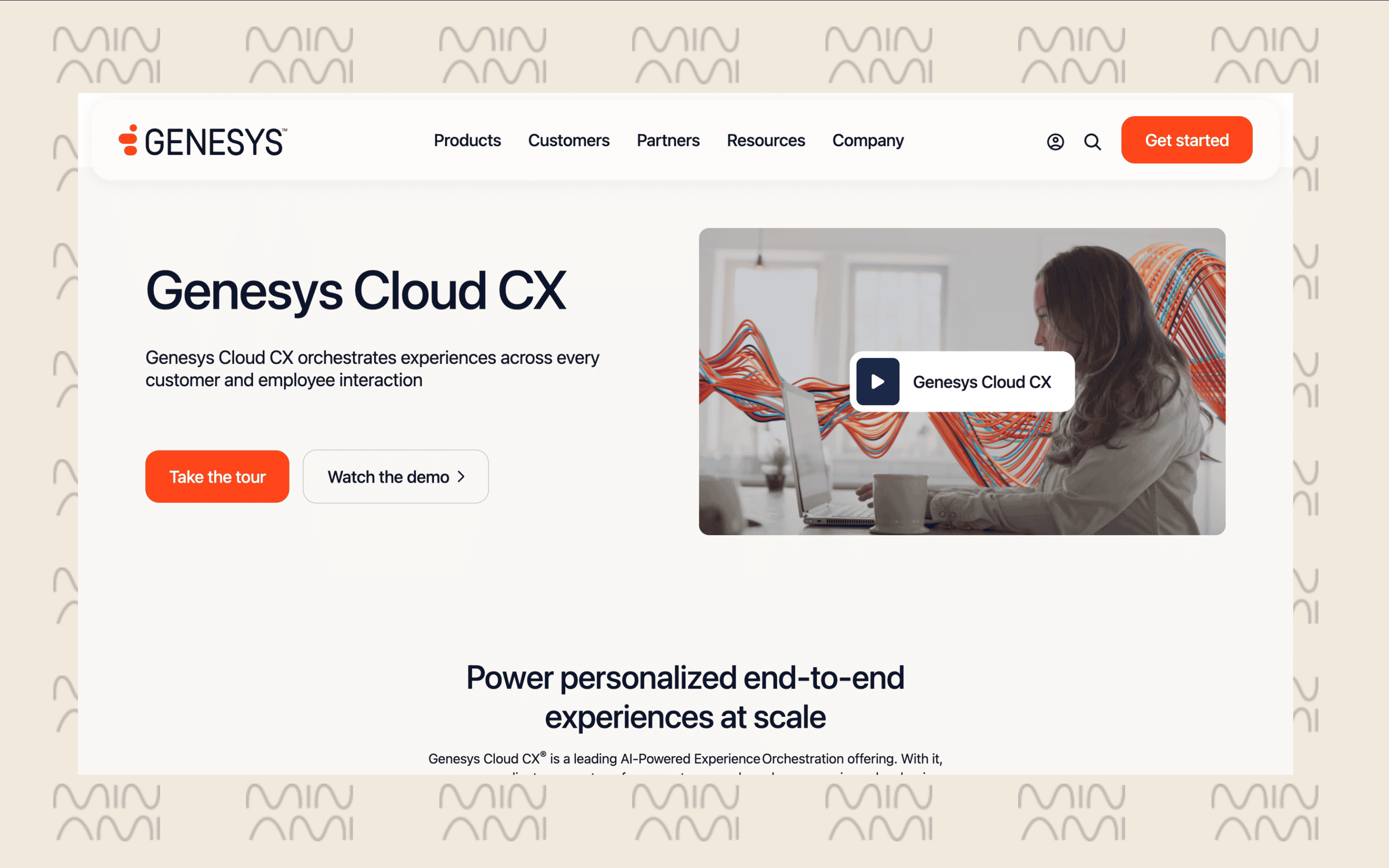
Genesys Cloud CX is a contact center platform built around voice operations, combining predictive routing, voicebot automation, real-time agent coaching, and workforce management in a single native environment.
Key features:
- Predictive voice and digital routing
- Native voicebot automation
- Real-time agent coaching and assist
- Workforce management (scheduling, forecasting, adherence)
- Omnichannel support including voice, chat, and email
- AI-powered performance analytics
Pricing:
| Plan | Price | What’s included |
|---|---|---|
| CX 1 | $75/agent/month | Voice, call routing, analytics, outbound dialing, unified communications |
| CX 2 | $115/agent/month | + Digital channels, workforce engagement, quality management |
| CX 3 | $155/agent/month | + Employee performance analytics, workforce management |
| CX 4 | $240/agent/month | + Agent copilot and other IA tools |
Best for: Contact-center-heavy enterprises with high inbound voice volume.
Pros:
- Native workforce management at enterprise scale
- Real-time agent coaching built in
- Proven at massive contact center deployments
Cons:
- Heavy implementation requires significant IT resources
- Narrower scope outside voice operations
7. Kustomer
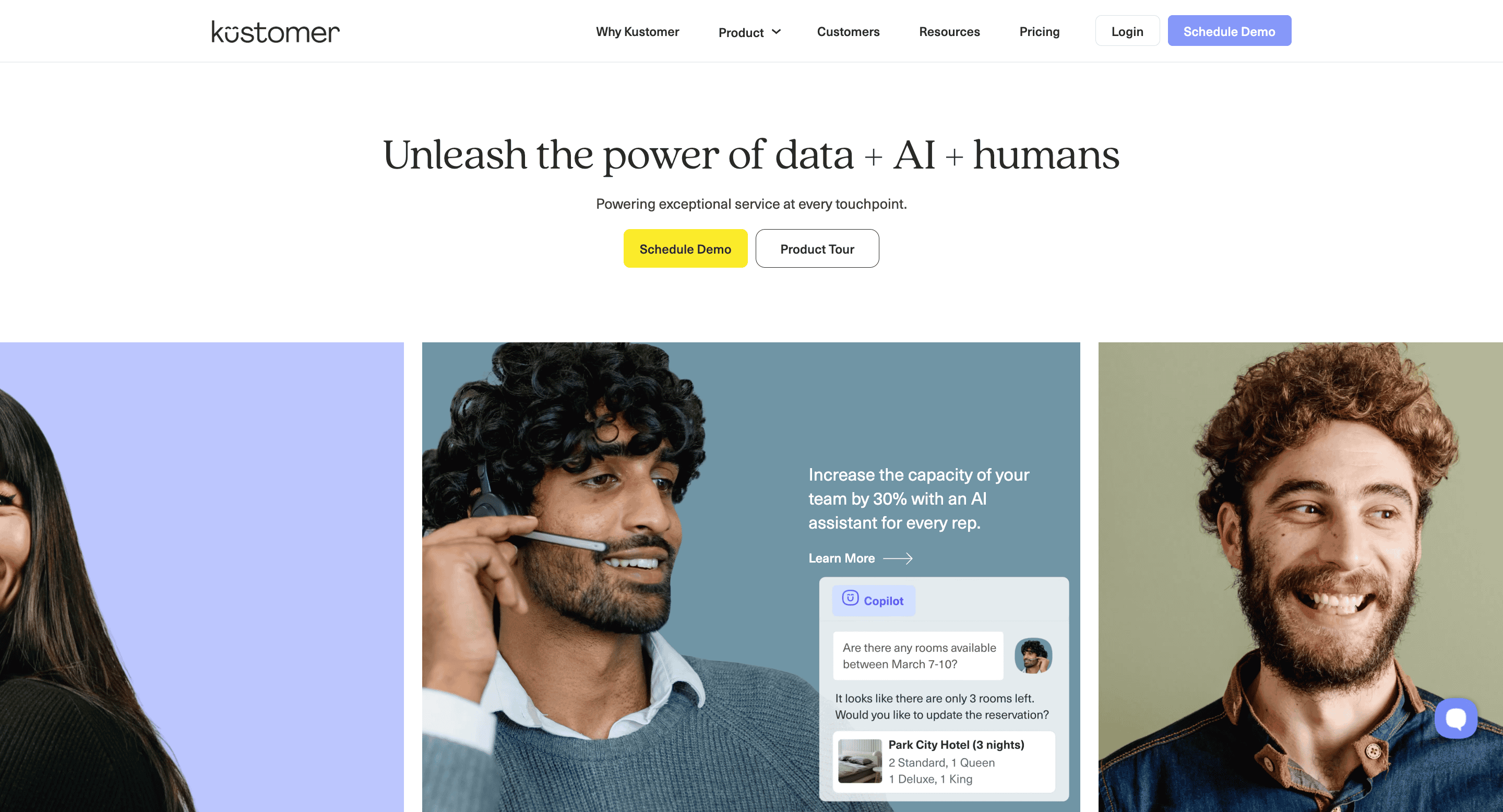
Kustomer is a support platform that organizes every interaction around a unified customer timeline, giving agents full order history, conversation history, and customer attributes before they respond.
Key features:
- Unified customer timeline across all touchpoints
- AI-powered response suggestions and intent detection
- Conversation-based pricing with no per-ticket fees
- Deep e-commerce data integrations (Shopify, Magento, etc.)
- Automated routing based on customer attributes
- Customizable data objects and workflows
Pricing: Custom
Best for: D2C and e-commerce enterprises with high order support volume.
Pros:
- Richest customer context layer in the category
- Conversation-based pricing removes per-ticket cost
- Strong native e-commerce integrations
Cons:
- Smaller integration ecosystem than market leaders
- Limited presence in EMEA and APAC
How to choose an AI-driven enterprise help desk
1. Map your current stack first
The best help desk integrates cleanly with your existing CRM, ERP, or e-commerce platform. Integration friction is one of the most underestimated costs in enterprise software projects.
A Salesforce shop has strong reasons to start with Service Cloud. An Atlassian-heavy team may lean toward Zendesk or Freshdesk. Don’t evaluate in a vacuum.
2. Define your AI ambitions
Are you looking to automate ticket deflection this quarter? Or do you need a platform that handles fully autonomous multi-step resolution in three years? Those are different products.
- AI-assisted workflows: AI surfaces suggestions, humans decide. Lower risk, faster adoption, well-suited for regulated industries.
- Hybrid escalation model: AI resolves simple cases, escalates complex ones. The most common enterprise deployment pattern.
- Autonomous agent model: AI takes multi-step actions (lookups, updates, refunds) without human approval. High ROI potential, requires governance frameworks.
3. Calculate total cost of ownership
Enterprise help desk pricing rarely reflects the real cost of deployment. Add implementation services, customization, training, ongoing administration, and integration work.
A platform with higher per-seat fees but faster time-to-value often costs less over three years than a cheaper alternative requiring heavy professional services.
4. Run a focused pilot with measurable KPIs
Every major vendor offers a proof-of-concept or limited deployment option. Pick a high-volume, lower-complexity ticket category.
Measure deflection rate, first-contact resolution, average handle time, and agent satisfaction. 60 to 90 days of real data tells you more than any analyst report..
If you’re looking to automate order management, returns, and customer support under a single AI agent and reduce the operational costs that come with running those processes manually, get Minami.
Savings calculator
EstimateWhat could Minami save your support team?
Saved per month
$0
0 agent hours freed
0 tickets handled by AI
Estimate based on your inputs. Default automation rate reflects the "on average 90% less customer queries" figure on minami.ai; your results will vary. Excludes Minami subscription cost.