On this page (6)
Re:amaze does the basics of store support well. A shared inbox for email, chat, social and SMS, several brands under one login, Shopify order data beside each message. For small teams, it works.
The cracks appear as volume grows. The built-in AI can explain a returns policy, but it can’t change, cancel or reroute an order, so every one of those requests waits for a person. More orders means more manual work, not more automation. That’s the point where teams go looking for something else.
This guide walks through 8 Re:amaze alternatives that online stores turn to most. Each is built for a different type of team. Which one fits comes down to whether you want a better inbox for your agents, or AI that takes the action in your store so the ticket never reaches them.
Re:amaze alternatives in one view
| Tool | Best for | AI that acts vs AI that replies | How much logistics it automates | Recommends products / drives sales |
|---|---|---|---|---|
| Minami | Stores wanting post-purchase problems solved without an agent | Acts: makes the change in the store and with couriers | End to end: edits, cancellations, address updates, delivery incidents, claims, returns, exchanges | Yes, in conversations and exchanges, with checkout in chat |
| Gorgias | Shopify brands keeping humans on orders | AI runs set flows; agents act from the sidebar | Partial: returns and tracking via AI | Shopping Assistant add-on |
| Richpanel | DTC brands wanting AI order updates in a helpdesk | Acts on orders and subscriptions | Partial: order/subscription changes, self-service portal | Not a focus |
| eDesk | Sellers on Amazon, eBay and a webstore | Acts on returns and cancellations | Partial, marketplace-centred | Not a focus |
| Help Scout | Email-first teams that prefer people on tickets | Replies | Minimal, no native Shopify actions | No |
| Tidio | Very small stores starting with chat | Replies, plus no-code Flows | Minimal | Flows for cart nudges |
| Zendesk | Large orgs needing governance | Replies, with buildable actions | Low without custom work | Not a focus |
| Freshdesk | General ticketing teams | Replies | Low, Shopify via apps | Not a focus |
What is Re:amaze and when does a store outgrow it?
Re:amaze is a unified support inbox for online stores, now part of GoDaddy. It gathers email, live chat, social, SMS and voice in one place, handles multiple brands, and displays Shopify order details next to each conversation.
Its AI Agent is conversational. It reads your help content and answers questions like “what’s your returns window?” or “where’s my order?” What it doesn’t do is reach into the store and fix things. A customer who wants to add an item, change a size, correct an address or report a broken parcel still ends up waiting for an agent to open Shopify and the courier’s site.
That’s the real reason stores move on. They aren’t short of a place to reply. They’re short of hands. The alternatives below split into two camps: helpdesks that give agents better tools, and AI agents that carry out the logistics work themselves, some of which also recommend products and add revenue.
8 Re:amaze alternatives, from helpdesks to AI agents
1. Minami AI
Best for: Shopify and eCommerce stores that want AI to handle the whole post-purchase workload inside the store, and to sell while it does.
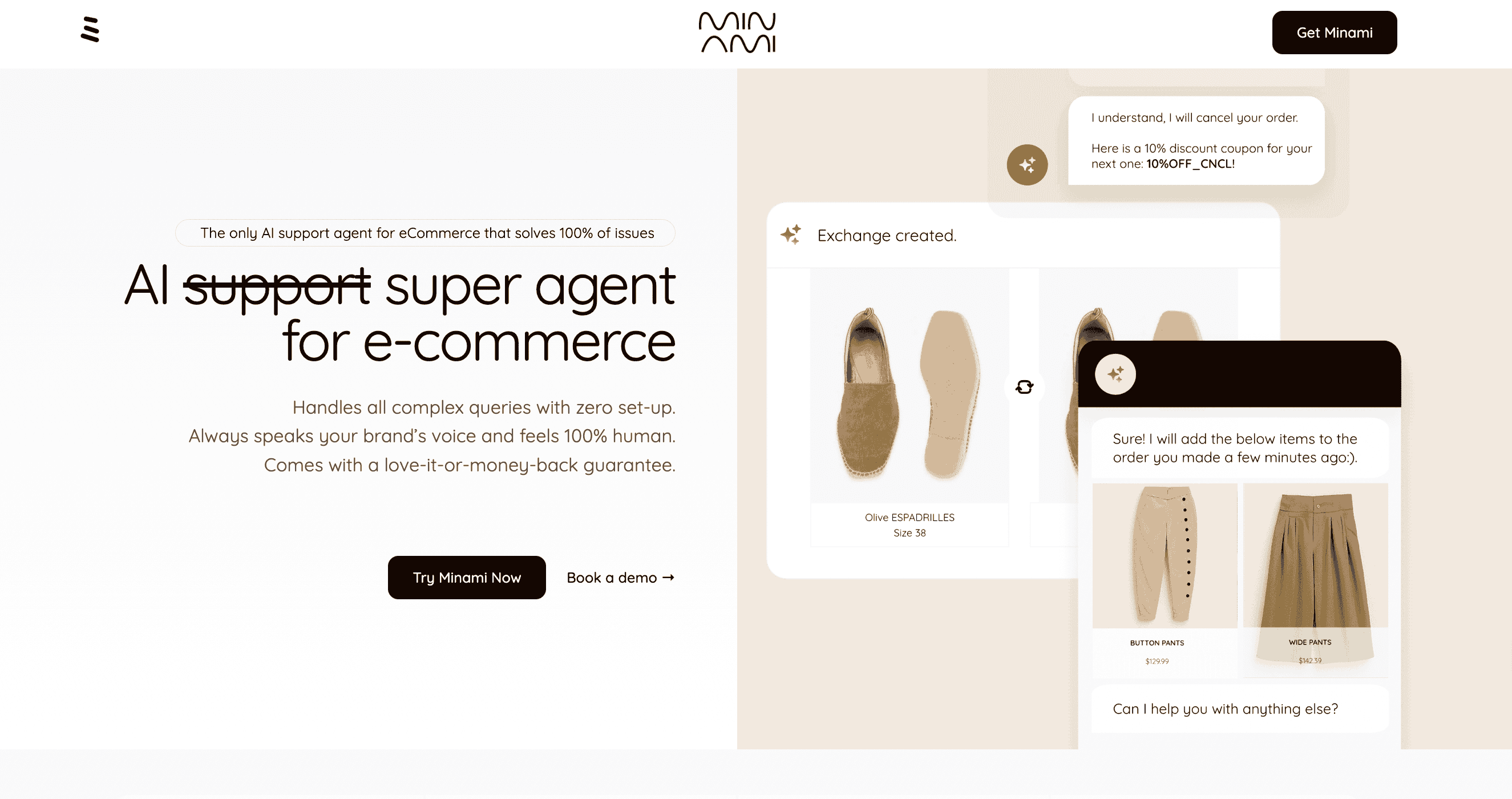
Where Re:amaze’s AI stops at the answer, Minami keeps going. It’s an AI agent that performs the task the customer asked for: it changes the paid order, cancels it, updates the shipping address, chases the carrier or sets up the exchange, then confirms it in chat or by email. Minami says it can resolve as much as 100% of support requests, and it’s built with the aim of automating every logistics problem a store faces.
Actions it carries out
- Paid-order changes: add a forgotten item or remove one before fulfilment.
- Cancellations: stop eligible orders pre-dispatch, with an alternative offered first.
- Shipping address fixes: correct delivery details before the parcel leaves.
- Parcel problems: lost, damaged or delayed shipments sorted; by Minami’s figures, 90% without a person.
- Carrier claims: over 80% of courier contact handled and claims negotiated (Minami’s number).
- Returns into exchanges: follows your policy and nudges customers toward a swap.
- Tracking: proactive status updates.
Selling, not just solving
Minami answers product questions and suggests items during conversations. Inside an exchange it can offer anything in your catalogue with checkout right in the chat, and adding an item to a paid order turns “I forgot this” into extra revenue. The Minami shopping experience page shows how it works.
Setup and pricing
You chat through your policies or upload them, then add the Shopify app or a script tag. No flows. Genuine exceptions go to your team with the context attached. There’s no set-up fee; pricing is custom, so contact sales.
Pros and cons
- Pros: acts in Shopify and with couriers instead of only replying; covers the full journey from checkout to delivery; recommends products and converts exchanges into sales; nothing to configure.
- Cons: focused on email and store chat, not voice or SMS; eCommerce-only by design.
Our take: for a store whose queue is orders, parcels and swaps, this is the alternative that actually shrinks the queue, and adds sales on the side.
- Talks directly with carriers to change addresses, reroute parcels and open delivery incidents, then executes the change in the store or CMS end to end.
2. Gorgias

Best for: Shopify brands that want people handling orders, with excellent tooling around them.
Gorgias is the best-known eCommerce helpdesk. Order data sits beside each ticket, and agents can refund, amend or check an order from inside the ticket. Its AI Agent covers returns, tracking and pre-sales chat, and a Shopping Assistant targets conversions. Read our Gorgias AI Agent pricing breakdown or our list of Gorgias AI alternatives.
What it automates
Set AI flows for common requests; most order edits are done by agents from the sidebar.
Pricing
Starter $40/mo (monthly only, 50 tickets and 30 automated interactions); Basic $90/mo, or $77/mo billed annually (300 tickets); Pro $550/mo, or $471/mo annually; Advanced $1,430/mo, or $1,227/mo annually. Beyond the included volume, extra tickets cost $0.36 to $0.40 each and AI Agent automated interactions $1.50 each.
Pros and cons
- Pros: the strongest Shopify inbox here, 254 integrations, pre-sales assistant.
- Cons: AI sits on top of an agent workflow, so complex changes still need a person.
Our take: the best upgrade if you want to keep humans in charge of orders.
3. Richpanel

Best for: DTC brands that want a helpdesk where the AI edits orders and subscriptions too.
Richpanel covers email, chat, social, SMS, WhatsApp and phone in one inbox, and its AI can make order and subscription updates. A self-service portal handles tracking, returns and cancellations.
What it automates
Order and subscription changes by AI, plus shopper self-service. Less depth on courier-side incidents.
Pricing
Helpdesk: Free ($0, 3 seats), Starter $29 per user/mo, Pro $99 per user/mo. AI and self-service plans are priced by order volume: Free (up to 50 orders/mo), Starter $50/mo, Pro $600/mo, with lower annual rates.
Pros and cons
- Pros: genuine AI order actions, every major channel, migration support.
- Cons: still a seat-based helpdesk at heart; light on carrier work and selling.
Our take: a solid step up from Re:amaze’s answer-only AI.
4. eDesk
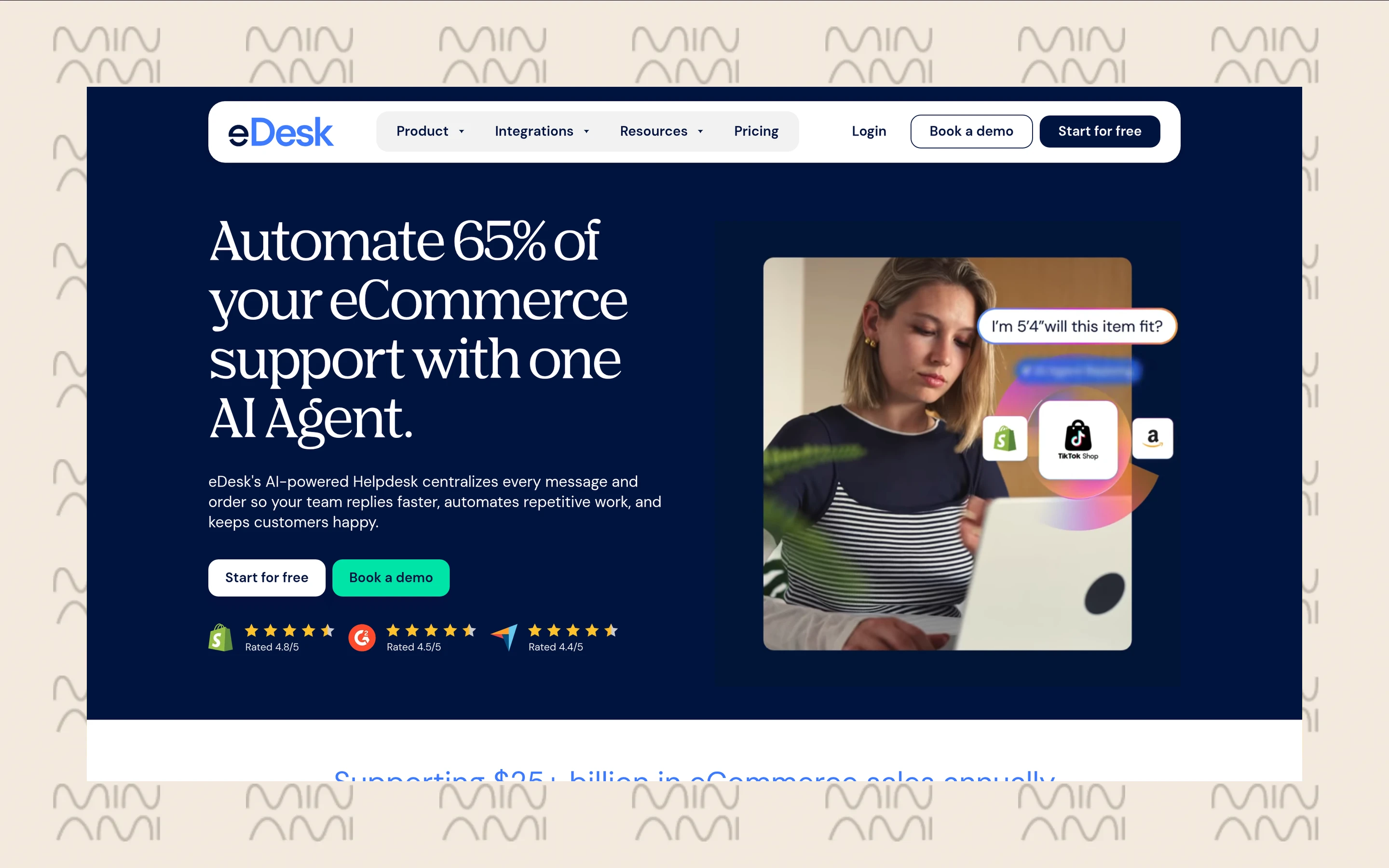
Best for: sellers running a webstore alongside Amazon, eBay or Walmart.
eDesk is built around marketplaces. It connects Shopify, BigCommerce, Magento, WooCommerce and more alongside Amazon, eBay, Walmart and others, pulling order and delivery data into each ticket. Its AI Agent can reply and take actions such as returns or cancellations.
What it automates
Replies and selected order actions across marketplaces and stores.
Pricing
Essential $49 per agent/mo ($39 billed annually), Growth $115 ($89), Professional $149 ($119), Enterprise on request. Every plan includes the AI Agent, charged at $0.99 per outcome.
Pros and cons
- Pros: the best marketplace coverage on this list, AI that can act on some requests.
- Cons: marketplace plumbing you won’t need if you’re Shopify-only; little on sales.
Our take: start here if marketplaces are a big share of your tickets.
5. Help Scout
Best for: small, email-first teams happy to keep people on most conversations.
Help Scout is a clean shared inbox with a good knowledge base, live chat and messaging channels. Its AI drafts and answers questions. Shopify data comes in through integrations, not native order actions.
What it automates
Answers and drafts. No built-in store actions.
Pricing
Free plan (up to 5 users), then Standard $25 per user/mo, Plus $45 and Pro $75. AI Answers are billed at $0.75 per resolution.
Pros and cons
- Pros: polished inbox, real free plan, calm workflow.
- Cons: nothing that touches orders; not built for eCommerce.
Our take: pleasant for thoughtful email support, not for an order-heavy queue.
6. Tidio
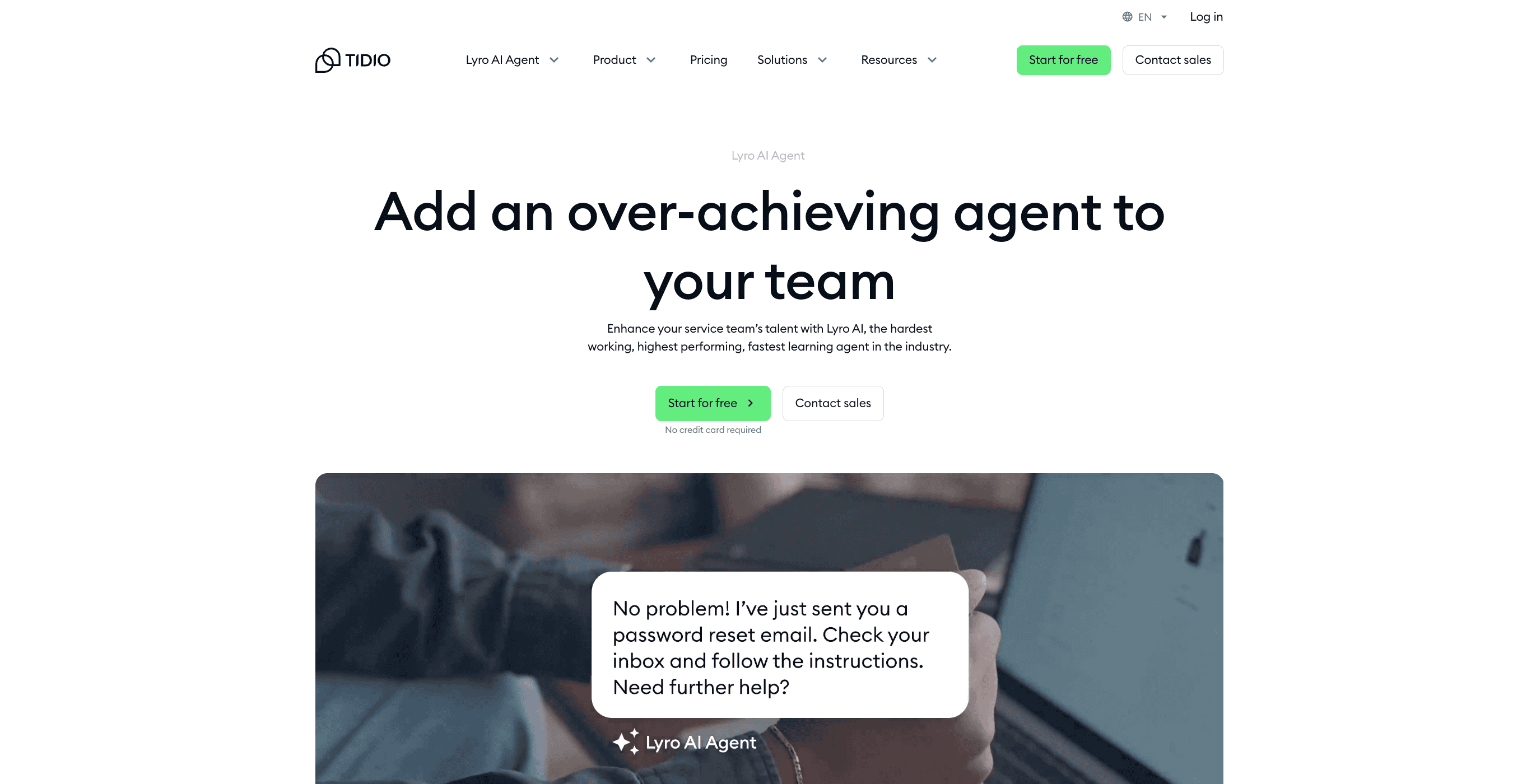
Best for: very small Shopify stores that mainly want live chat and a starter AI bot.
Tidio pairs live chat and a light ticketing inbox with Lyro, an AI agent that answers from your support content, and Flows for proactive messages and cart nudges.
What it automates
Conversational answers plus no-code marketing triggers. Order actions are limited.
Pricing
Free plan; Starter $24.17/mo, Growth from $49.17/mo and Plus from $300/mo. Lyro AI is also sold standalone from $32.50/mo for 50 Lyro conversations.
Pros and cons
- Pros: quick to launch, friendly widget, some sales nudges through Flows.
- Cons: conversational at its core; little logistics automation.
Our take: a fine first chat tool. You’ll outgrow it once orders, not questions, dominate the inbox.
7. Zendesk
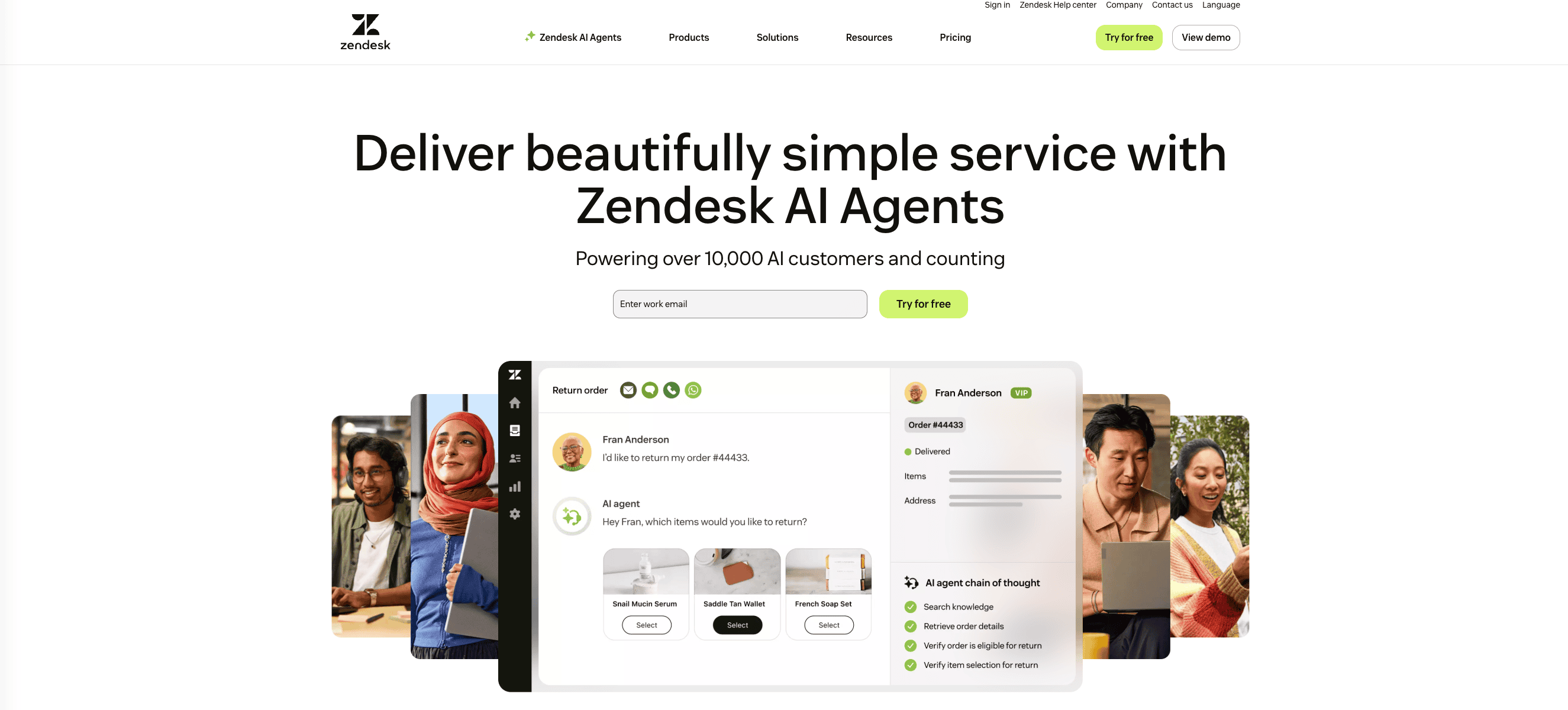
Best for: large support teams that need routing, SLAs, voice and reporting.
Zendesk is the enterprise heavyweight. Its AI agents handle conversations, and Action Builder lets you wire up actions to other systems. Shopify arrives through the app marketplace. Stores after something more commerce-native can compare our Zendesk AI alternatives.
What it automates
Conversations out of the box; store actions only with building and apps.
Pricing
Support Team $19 per agent/mo, Suite Team $55, Suite Professional $115 (billed annually; $25, $69 and $149 billed monthly). Automated AI agent resolutions beyond the included amount are $1.50 each, and Copilot is a $50 per agent/mo add-on.
Pros and cons
- Pros: the broadest feature set, native voice, huge ecosystem.
- Cons: eCommerce automation is a project, not a default.
Our take: worth it for governance at scale, not for automating store logistics.
8. Freshdesk
Best for: teams that want a full general-purpose ticketing system.
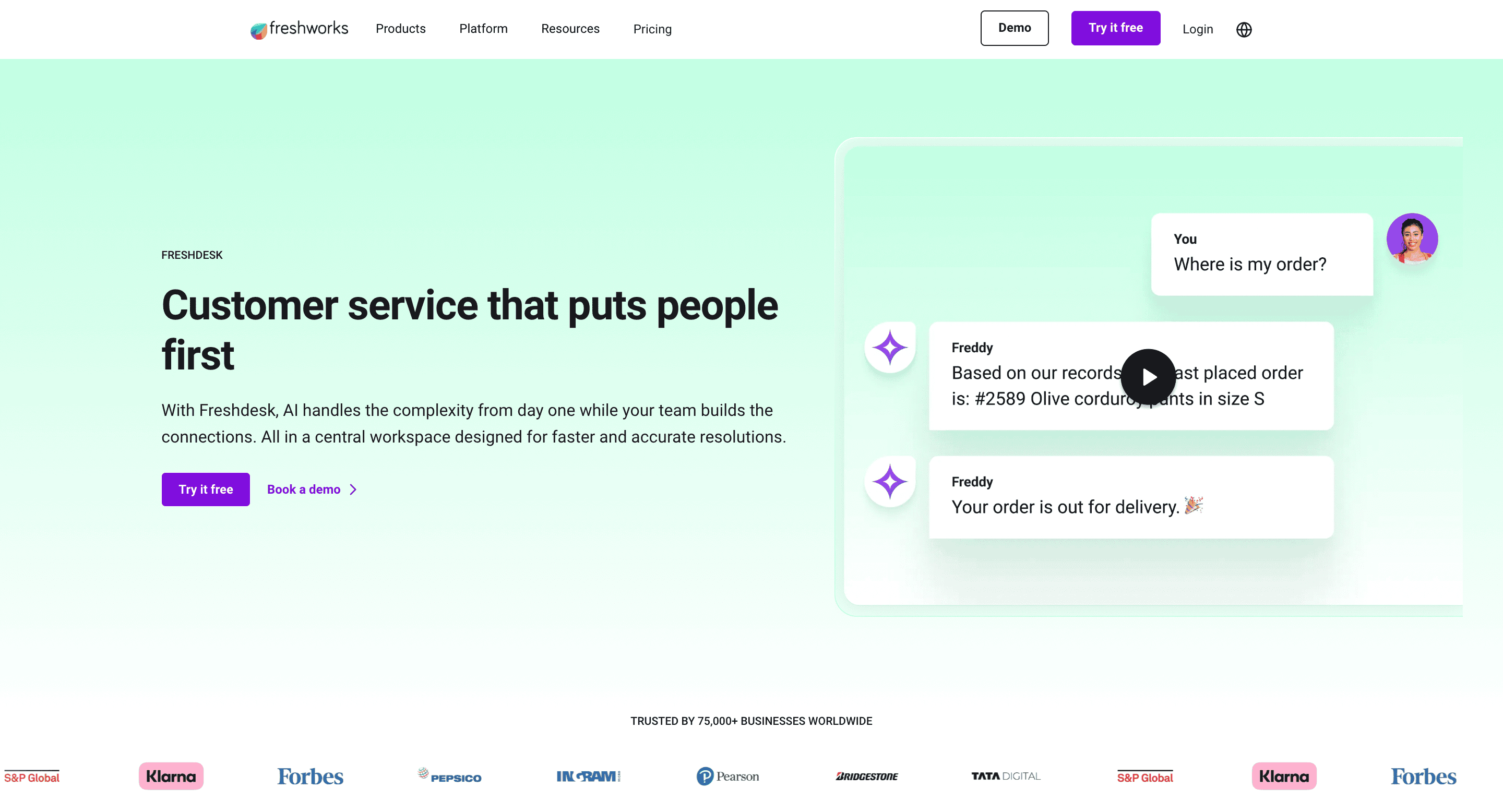
Freshdesk brings ticketing, a self-service portal, help articles and Freddy, its conversational AI. Store data arrives through marketplace add-ons.
What it automates
Replies and routing. No native order execution.
Pricing
Growth $19 per agent/mo, Pro $55, Enterprise $89 (billed annually). Freddy AI Agent sessions are $49 per 100 sessions, and Freddy AI Copilot is $29 per agent/mo.
Pros and cons
- Pros: dependable SLAs, easy start, day passes for busy periods.
- Cons: conversational AI only; order work stays manual.
Our take: a good general helpdesk that leaves the logistics to your team.
Re:amaze alternatives: 2026 price comparison
| Tool | Starting price | Pricing model | AI cost |
|---|---|---|---|
| Minami | Custom | Custom pricing, contact sales | Custom |
| Gorgias | $40/mo | Monthly plan by ticket volume | $1.50 per automated interaction beyond included |
| Richpanel | $29 per user/mo (free tier available) | Per user, plus order-based AI plans | AI plans from $50/mo by order volume |
| eDesk | $39 per agent/mo (annual) | Per agent, plus outcomes | $0.99 per AI outcome |
| Help Scout | Free; paid from $25 per user/mo | Per user | $0.75 per AI resolution |
| Tidio | Free; paid from $24.17/mo | By billable conversations | Lyro from $32.50/mo (50 conversations) |
| Zendesk | $19 per agent/mo | Per agent | $1.50 per automated resolution; Copilot $50/agent/mo |
| Freshdesk | $19 per agent/mo | Per agent | $49 per 100 AI Agent sessions; Copilot $29/agent/mo |
Figures come from each vendor’s official pricing page, checked on 29 October 2026, in USD. Vendors change plans often, so confirm before you buy.
Inbox upgrade or AI that acts?
Ask what you need the AI to do. If replies are enough, almost any tool here will improve on Re:amaze’s inbox. If you need the AI to change orders, fix addresses, settle delivery problems and run exchanges, and to recommend products as it goes, Minami is the alternative built for exactly that.
For humans handling orders with great tools, Gorgias. For a helpdesk whose AI updates orders and subscriptions, Richpanel. For marketplace sellers, eDesk. For calm email support, Help Scout. For a first chat widget, Tidio. For enterprise control, Zendesk or Freshdesk.
Try Minami on your store
If your team spends its day doing what Re:amaze’s AI can only describe, Minami does it instead. Install it as a Shopify app or a simple tag, share your policies, and it starts editing orders, cancelling, updating addresses, solving delivery incidents and processing exchanges in your brand voice, while suggesting products that grow basket size.
Set-up is free and there’s a money-back guarantee. Create an account at minami.ai, or set up a demo with your own orders. Still comparing? See our roundups of the best AI agents for Shopify and the best AI agents for eCommerce.
Minami AI agent
Automate 100% of your eCommerce support
Minami doesn't just chat. It takes the action inside your store and sells while it solves.
- Order edits and cancellations
- Address changes and delivery incidents
- Returns, exchanges and product recommendations