
On this page (7)
A customer support executive is not the best agent on the team. It is the person accountable for what customer support does to the business: who stays, who buys again, what they say publicly and how much it costs to keep them happy.
That is the difference most job descriptions miss. Real postings for senior support and customer experience roles talk about retention, lifetime value, NPS, cost to serve and cross-functional ownership, not about answering emails. A typical head of customer experience brief asks the person to own CSAT, NPS and churn, map the journey, and run a voice of customer program that turns feedback into fixes other teams deliver (ZeniaHR).
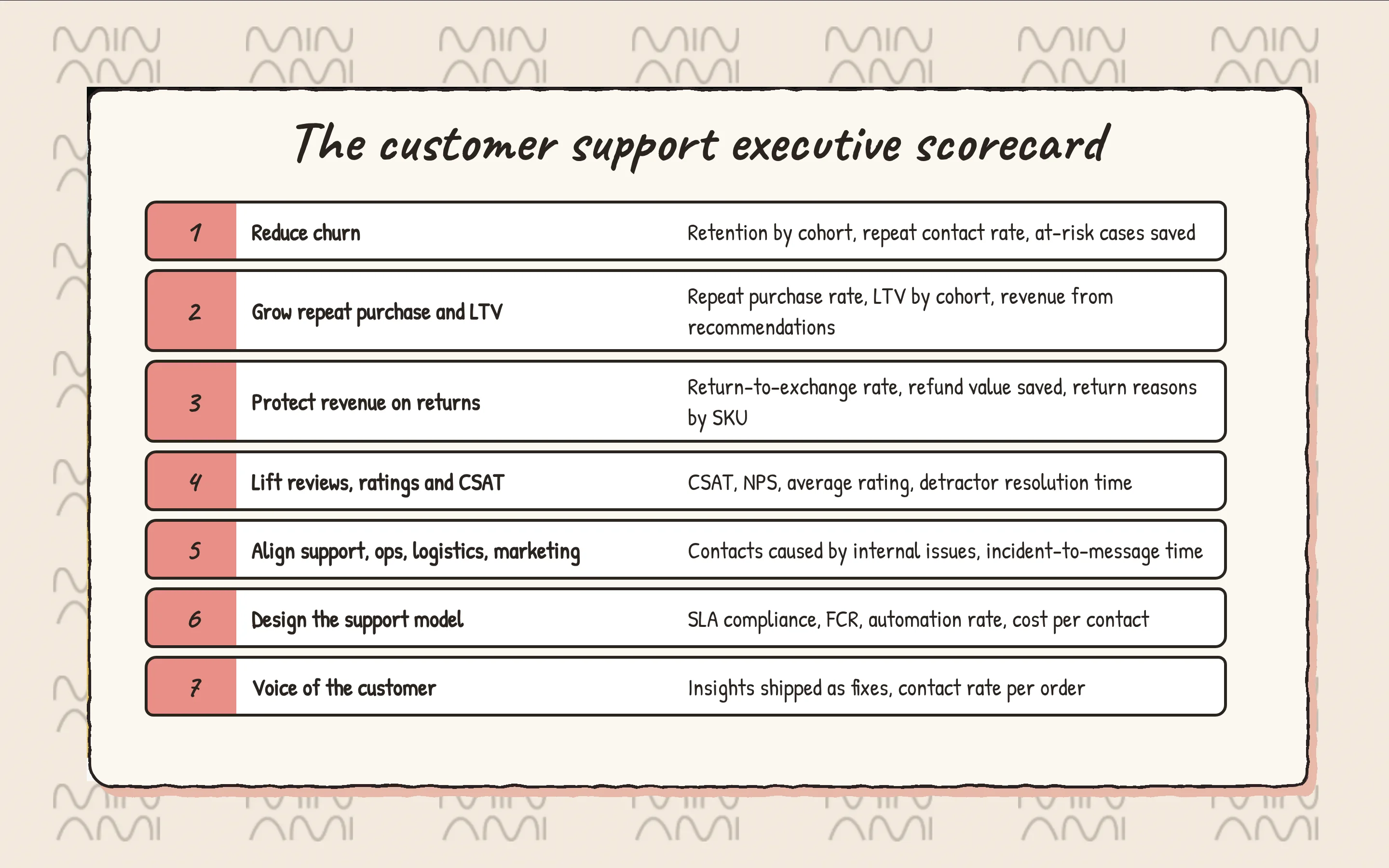
So here are the seven roles and responsibilities of a customer support executive written as outcomes, with how you actually get there and the line that proves it on a resume.
1. Reduce churn by fixing the moments that make customers leave
Customers rarely leave because of one slow reply. They leave after a pattern: a late parcel, a vague answer, a refund that took three emails. The executive’s job is to find those patterns and break them before they cost a second order.
The economics justify the focus. Research by Frederick Reichheld of Bain & Company found that a 5% increase in customer retention can lift profits by 25% to 95% (Harvard Business Review). Support is one of the few teams that talks to customers exactly when they are deciding whether to come back.
How you get there:
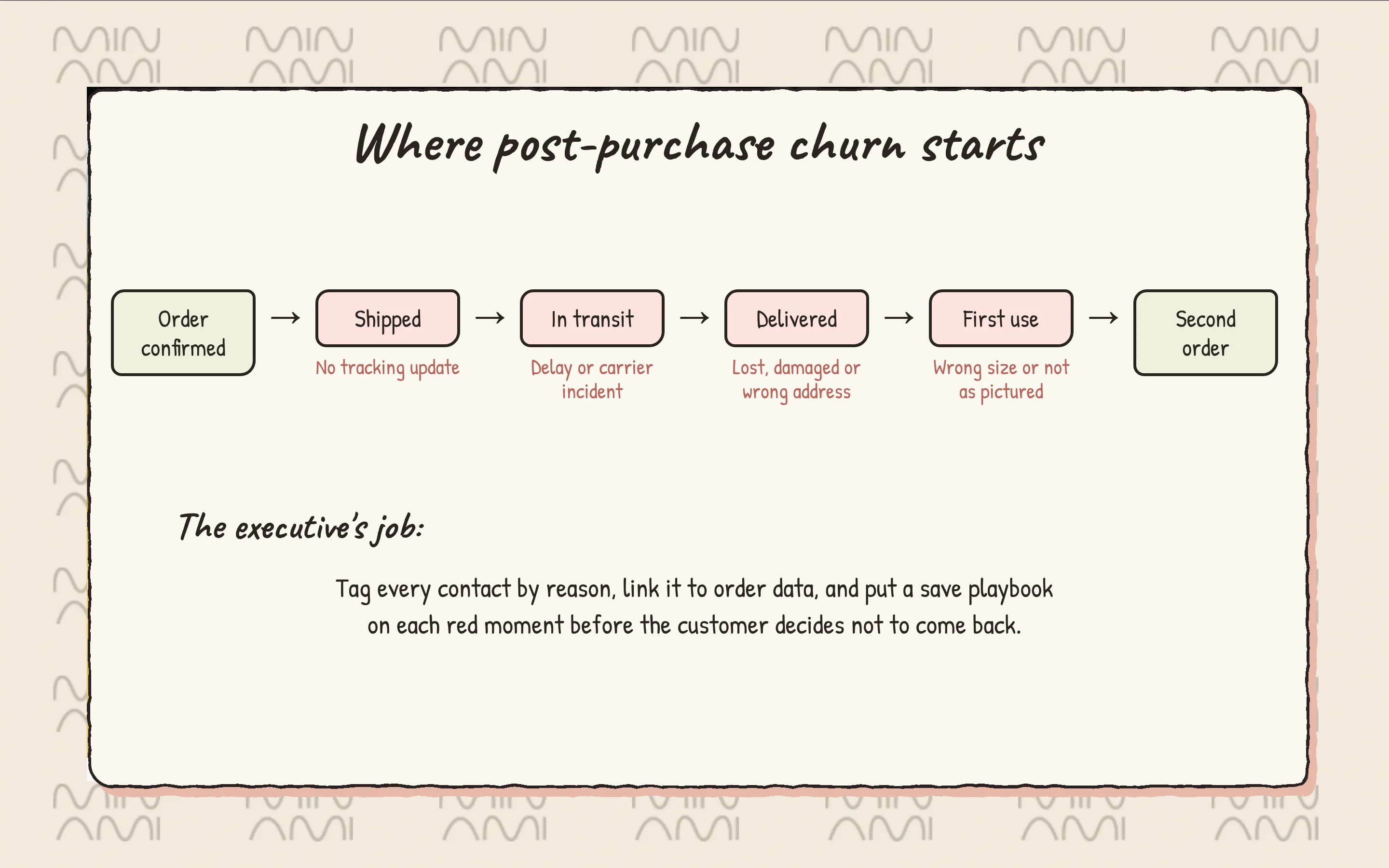
- Tag every contact by reason, then cross it with order data to see which reasons precede customers who never buy again
- Map the post-purchase journey (confirmation, shipping, delivery, first use, return) and mark where contact volume and negative sentiment spike
- Define a save playbook for the high-risk moments: a lost parcel gets a reship before the customer asks, a second delay gets a proactive message and a goodwill gesture
- Follow up on every detractor survey within a set window, by a person with authority to fix the issue
Track churn or retention rate by cohort, repeat contact rate and the share of at-risk cases saved. Good looks like knowing your top three churn drivers by name and having an owner and a date for each.
Many of those red moments are delivery problems, and they are the easiest to catch early. Minami AI picks up a stuck or failed delivery, solves it directly with the carrier and updates the order, often before the customer has noticed anything was wrong.
Resume line: “Cut post-purchase churn by mapping contact reasons to repeat-order data and launching proactive save flows for delayed and lost shipments.”
2. Grow repeat purchase and customer lifetime value after the first order
The first order is acquisition. The second is support. A customer support executive treats every service contact as a chance to make the next purchase more likely, and measures it that way.
The levers are practical. A sizing question is a moment to recommend the right fit, not just quote a chart. A delivery problem solved fast and openly builds more trust than a delivery that simply arrived. A customer who contacts support and leaves happy is someone marketing can reach again with confidence.
What the work looks like:
- Join support data with order history so agents see lifetime value, past issues and open orders in every conversation
- Train the team, and configure any AI, to recommend products in context when the customer’s problem is fit, compatibility or stock
- Agree with marketing on suppression rules, so nobody gets a promo email the day their order went missing
- Report repeat purchase rate for customers who contacted support versus those who did not, split by contact reason
Strong post-purchase communication is a big part of this. Order updates people actually read reduce anxiety and contact volume at the same time, which is why so many brands now invest in post-purchase tracking tools. Track repeat purchase rate, LTV by cohort and revenue influenced by support recommendations.
This is where an AI agent pulls its weight on revenue, not just cost. Minami AI recommends the right product inside the support conversation and keeps customers posted on WhatsApp while their order is on its way, so the next purchase starts from trust instead of a complaint.
Resume line: “Raised repeat purchase rate among customers who contacted support by adding order history and in-context product recommendations to every conversation.”
3. Protect revenue on returns by turning refunds into exchanges
Every refund is revenue walking out. Many returns are not “I don’t want this”, they are “I want this in another size or colour”. The executive’s responsibility is to make sure the business catches that difference.
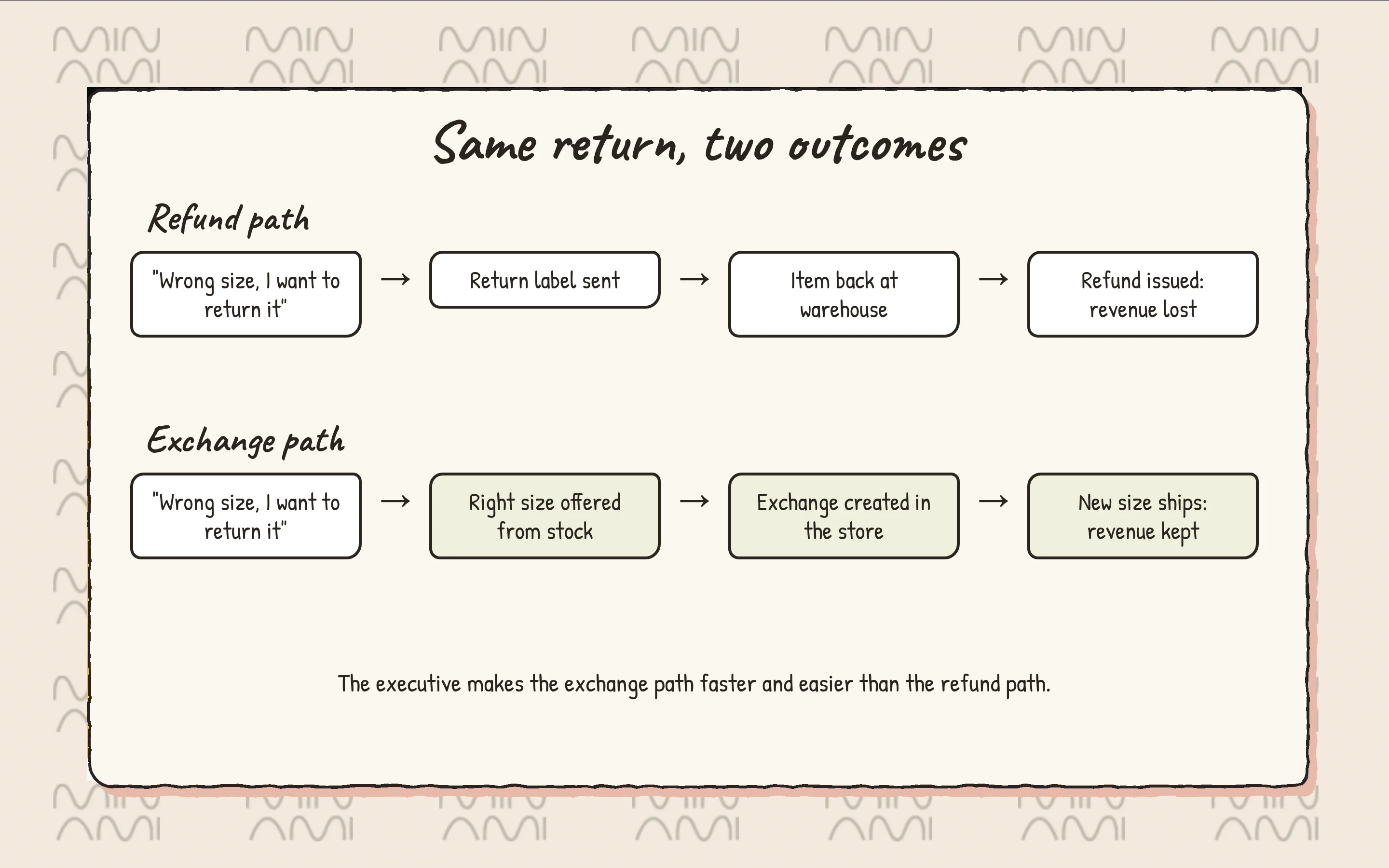
That starts with policy and process. If the exchange path is slower or harder than the refund path, customers take the refund. The executive works with operations and finance to make exchanges instant where possible, approve them before the original item arrives back for trusted customers, and give agents clear rules for when to offer store credit, a partial refund or a replacement.
Then the data. Return reasons need to be structured, not free text, so the executive can show merchandising which products, sizes and descriptions drive returns. Fixing a misleading product photo saves more money than any agent script. The approach is covered in detail in this guide on how to reduce returns with AI.
Track return rate, return-to-exchange rate, refund value saved and return reasons by SKU. Good looks like a monthly report that ends with decisions for other teams, not just numbers.
The fastest exchange path is one nobody on the team has to touch. Minami AI offers the exchange the moment a customer asks to return, checks stock and creates it in the store, so the refund never becomes the default. Talk to Minami about running it on your returns.
Resume line: “Increased the return-to-exchange rate by redesigning the exchange flow with operations and feeding structured return reasons back to merchandising.”
4. Lift reviews, ratings and CSAT by closing the loop on bad experiences
Public ratings are a support outcome. Most one-star reviews describe a service failure: late delivery, no answer, a hard return. The executive owns the system that stops those experiences from becoming permanent public text.
The commercial stakes are real. The Spiegel Research Center at Northwestern found that a product with five reviews has a purchase likelihood 270% higher than one with none, and that purchase likelihood tends to peak at ratings between 4.0 and 4.7 (Spiegel Research Center). Reviews sell, and support decides what many of them say.
How executives move this metric:
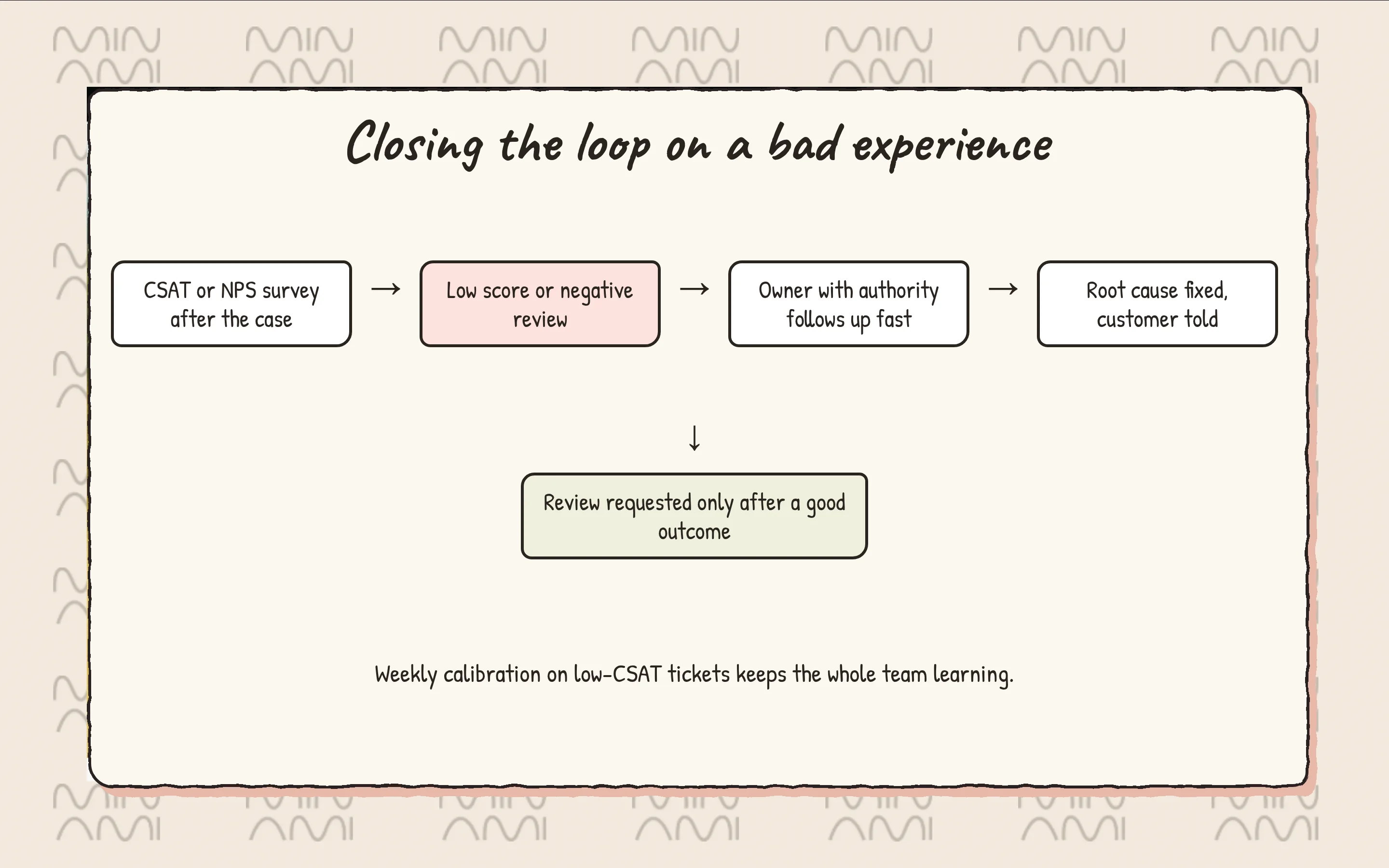
- Run CSAT on every resolved case and NPS on a regular cadence, with clear owners for follow-up on low scores
- Treat a negative review as an escalation: respond publicly, solve privately, then ask whether the outcome deserves an update
- Time review requests after a good support outcome or a smooth delivery, never after an open problem
- Review low-CSAT tickets weekly in a calibration session so the team learns what “good” sounds like
Track CSAT, NPS, average rating on your review platforms, response rate to negative reviews and time to resolution for detractors.
Resume line: “Improved CSAT and public review ratings by building a closed-loop detractor process and timing review requests after resolved cases.”
5. Keep support, operations, logistics and marketing working from the same information
Half of support volume is created somewhere else. A carrier strike nobody announced. A promo that went live before stock arrived. A warehouse delay the team learned about from angry customers. The customer support executive owns internal communication around the customer, because nobody else will.
This is less about meetings and more about plumbing:
- A shared incident channel where operations and logistics post delays before customers notice, with a ready customer message attached
- A launch checklist that marketing cannot skip: stock confirmed, FAQ updated, support briefed
- A weekly digest of top contact reasons sent to department heads, with one ask per team
- Clear escalation paths into finance, warehouse and carriers, with response times agreed in advance
Tools help. A good ecommerce help desk puts order, shipping and customer data in one view, so a conversation between teams starts from facts. Track contacts caused by internal issues, time from incident to customer communication, and how many cross-team asks get closed.
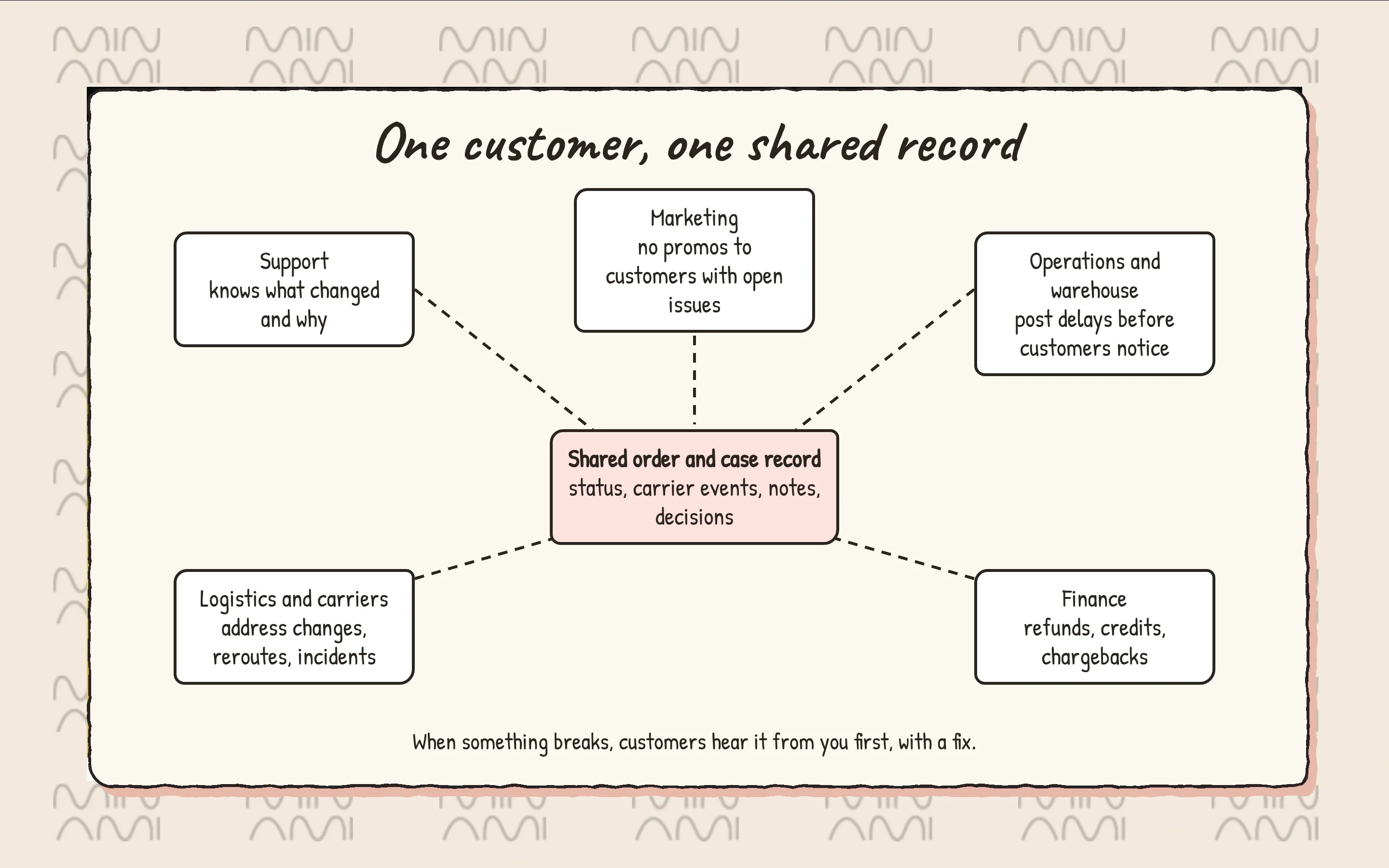
An AI agent can be part of that plumbing. When Minami AI changes an address with the carrier or edits an order, it executes the change in the store and records it on the same order, so support, operations and logistics all see one version of what happened instead of three.
Good looks like this: when something breaks, customers hear about it from you first, with a fix, and support volume barely moves.
Resume line: “Built a cross-team incident process with logistics and marketing that informed customers before delays hit, reducing incident-driven contact volume.”
6. Design the support model: SLAs, channels, automation and cost per contact
Someone has to decide how support works. Which channels to offer, what response time to promise, what gets automated, what stays human, how many people to hire for peak season. At executive level this is the core of the customer support executive job description.
The process starts with demand. Break contact volume down by reason and channel, then decide for each reason whether it should be prevented, self-served, automated or handled by a person. WISMO, address changes and cancellations look very different from a complaint about a damaged gift. Set SLAs by channel and priority, and staff to them with a forecast, not a guess. If you are building that model for the first time, a customer service manager certification gives you proven frameworks for staffing, SLAs and metrics to start from.
Cost per contact is the check on all of it. The goal is not the cheapest possible support, it is lower cost without losing the outcomes in roles one to four. This breakdown of AI tools that reduce customer support costs shows where automation removes cost and where it just moves it.
Track SLA compliance, first contact resolution, automation resolution rate, cost per contact and CSAT by channel.
Where an AI agent changes the model
Minami AI is an AI agent for ecommerce that resolves operational cases instead of just answering them. It talks directly with carriers to change delivery addresses, reroute parcels and solve delivery incidents, then executes the change in the store or CMS end to end. That moves an entire category of tickets from “handled by a person” to “resolved automatically” in the support model.
- Edits and cancels orders inside the store
- Corrects addresses in the order and with the carrier
- Resolves delivery incidents directly with the carrier
- Converts returns into exchanges
- Recommends products in the same conversation
- Sends proactive WhatsApp messages to keep customers informed before they ask
For the executive, this changes the planning math. Peak season no longer means hiring for WISMO and address changes, and order management after checkout stops being manual work. Proactive updates on WhatsApp prevent contacts instead of answering them, which is how a WhatsApp chatbot for ecommerce earns its place. The team’s time moves to escalations, VIP customers and the retention work in roles one to four. Get Minami to see it on your own store.
Resume line: “Redesigned the support model by contact reason, introducing an AI agent for order and delivery cases and lowering cost per contact while holding CSAT.”
7. Turn the voice of the customer into product and operations decisions
Support hears the truth first. The fabric that pills, the courier that leaves parcels at the wrong door, the checkout field that confuses everyone. The executive’s final responsibility is to make sure that knowledge changes something.
A working voice of customer program has four parts. Consistent tagging so themes can be counted. A regular report to leadership that ranks issues by volume and business impact. An owner and deadline for each fix in the team that can fix it. And closing the loop, telling customers and the support team what changed.
The hard part is influence. A customer support executive rarely owns product, warehouse or marketing. They win by bringing evidence: ticket counts, return cost, review excerpts, churn by contact reason. A clear business case gets a product page fixed faster than any complaint.
Track the number of insights shipped as fixes, contact rate per order over time and the drop in volume for each fixed issue. Good looks like a falling contact rate per order while the business grows.
Resume line: “Ran the voice of customer program, presenting monthly insight reports to leadership that led to product page, packaging and carrier changes.”
Customer support executive resume bullet points
When recruiters read customer support executive roles and responsibilities in a resume, they look for outcomes, levers and numbers. Use these as a base and add the figures from your own dashboards:
- Reduced churn by linking contact reasons to repeat-order data and launching proactive save flows
- Grew repeat purchase rate and customer lifetime value through order-aware service and in-context product recommendations
- Protected revenue by converting returns into exchanges and feeding return reasons back to merchandising
- Improved CSAT, NPS and public review ratings through a closed-loop detractor process
- Built cross-team incident and launch processes with operations, logistics and marketing
- Designed the support model, SLAs and channel mix, including AI automation for order and delivery cases
- Lowered cost per contact while holding or improving CSAT
- Ran the voice of customer program and turned insights into product and operations fixes
- Hired, coached and led a support team, setting quality standards and calibration routines
The structure that works every time: outcome first, then the lever, then the proof. That is what separates an executive resume from an agent one.
Minami AI agent
Automate 100% of your eCommerce support
Minami doesn't just chat. It takes the action inside your store and sells while it solves.
- Order edits and cancellations
- Address changes and delivery incidents
- Returns, exchanges and product recommendations