 Nobikage San
 Introducing
AI in Ecommerce Returns: Key Data, Metrics, and Statistics
Numbers that may surprise you: are AI agents in returns really worth it? See how leading brands quietly use them to automate most cases, cut costs, and turn refunds into new sales.
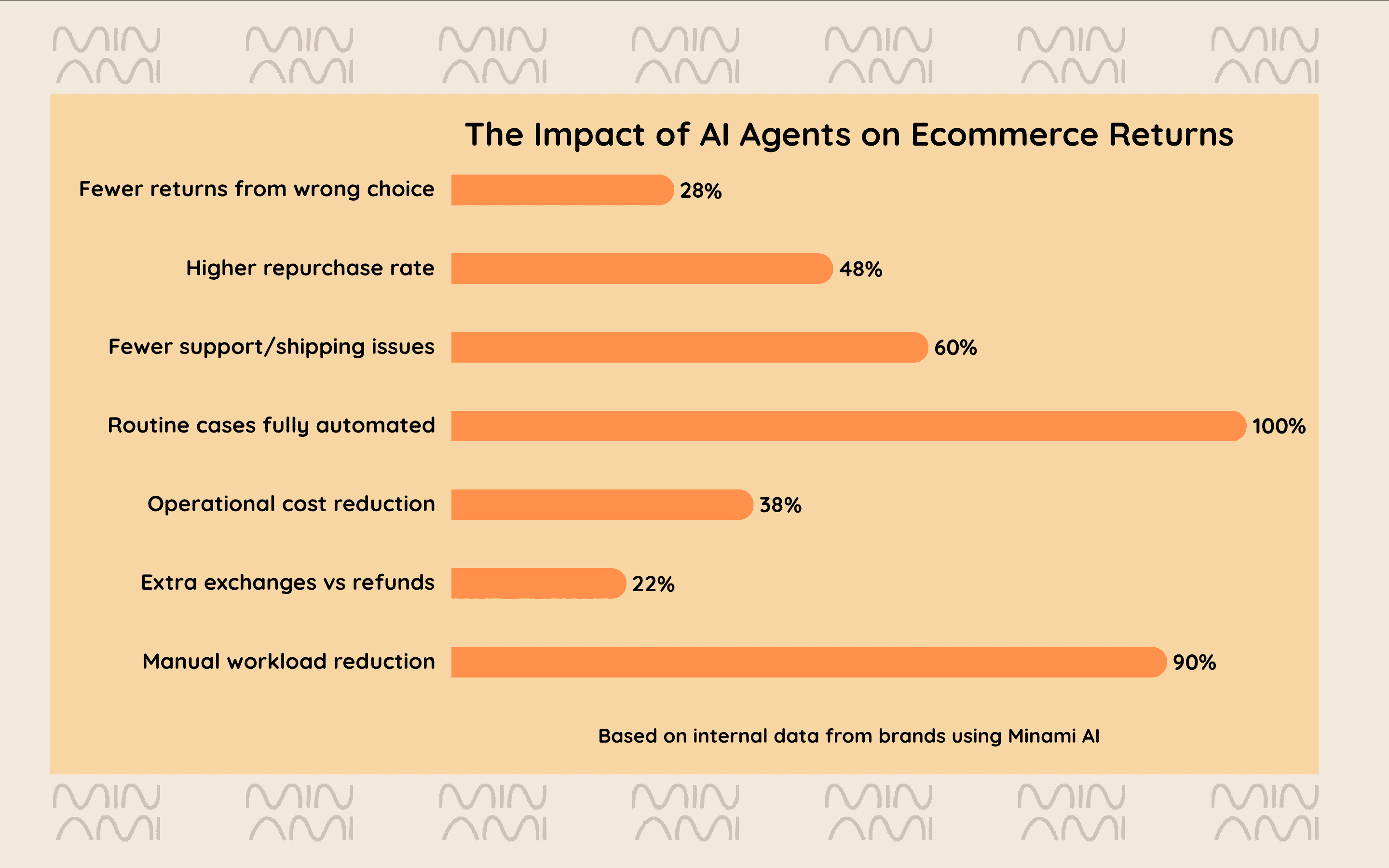
TL;DR based on internal data from brands using Minami AI
-
Manual workload on returns tasks drops by around 90%.
-
Product exchanges instead of refunds increase by around 28%.
-
Operational costs linked to returns and reverse logistics fall by about 38%.
-
100% of routine return cases can be handled without a human.
-
Support and shipping issues during the return process drop by around 60%.
-
Shoppers who use the AI return flow are about 48% more likely to buy again.
-
Returns caused by a wrong product choice decrease by around 28%.
AI agents and tools have quietly become one of the biggest forces shaping ecommerce today. Studies suggest that close to 80% of companies already use AI in at least one part of their business, and the number keeps growing. Besides, by 2030, AI is expected to manage nearly 90% of customer support interactions across multiple industries, including eCommerce.
But what about the use of AI in ecommerce returns management?
Returns have always been expensive, slow, and painfully manual. Most teams still review cases one by one, approve or deny requests, generate labels, update stock, and issue refunds by hand. That’s exactly why AI technology can be so decisive in the ecommerce returns landscape.
But what do the statistics and trends actually say? Do we have strong enough insights to show that investing in AI for returns is worth it? Let’s dive in
Adoption of AI in returns and reverse logistics
Most retailers are adopting AI in a broader sense, mainly through support-based platforms. However, in 2025 we’ve seen surveys showing that 76% of ecommerce AI adopters are investing in tools like Minami AI, focused on order tracking and returns use cases.
The reason for this trend is simple: AI in returns and reverse logistics is now present in almost every step of the flow. It starts with smart agents that collect the reason for the return, photos, and order details, then decide whether the case is valid or needs a human.
From there, risk models decide whether to approve, deny, or ask for extra proof, while optimization engines pick the best reverse route, carrier, or even whether it’s worth asking the customer to ship the item back.
That means that by using an AI agent like Minami, an ecommerce brand can automate nearly 100% of the process. And this isn’t just a theory; it’s an insight backed by our own internal data.
AI in ecommerce returns: Insights, trends and metrics
When you look at how ecommerce brands actually use Minami AI to manage returns, some clear patterns start to appear. In this section, we’ll walk through the signals we see every day in real operations: where automation has the biggest impact, how it changes customer behaviour, and which numbers keep repeating across different merchants. We won’t talk about AI in abstract terms. Instead, we’ll focus on concrete takeaways from brands already running their return flows with an AI agent like Minami.
Brands cut manual workload by 80–95%
When an AI agent takes over returns, most of the repetitive “copy and paste” work disappears. The agent asks for the order, understands why the shopper wants to return, checks the policy, decides if the case is valid or needs a human, creates the RMA, and triggers labels or QR codes. All the steps that used to pass through a human on every ticket become an automated workflow.
Across Minami AI clients, the reduction in manual workload sits closer to 90%. Support and operations teams move from processing every single return to focusing on exceptions, VIP customers, fraud risk, and edge cases. The day to day work becomes more about supervision and decision making, and less about mechanical tasks.
Personalized flows drive 10–35% more exchanges
AI changes the tone of a return from “I want my money back” to “let’s fix this.” Because the agent understands the context behind the return, it can offer smarter options in real time: a different size, another color, a similar product, a faster delivery method, or even a gift card when timing is critical.
The result is a smoother journey and less friction. Shoppers feel they are being guided, not blocked, so they are far more willing to switch to an exchange instead of asking for a refund. Across Minami AI clients, the data is consistent: brands see around 28% more exchanges compared to traditional flows.
This shift in return behavior has a direct impact on revenue and loyalty. Instead of losing the sale, ecommerce brands keep the order value, protect their margins, and create a better post purchase experience that makes repeat purchases more likely.
AI cuts operational costs by about 30–45%
Returns used to mean more people, more hours, and a lot more stress, especially during peak season. With an AI agent doing most of the repetitive work, that equation changes. The same team can handle a much higher volume because they’re no longer buried under simple, routine cases.
You need fewer temporary hires, fewer outsourced agents, and far less time spent chasing statuses or updating systems by hand. The cost per return handled drops sharply once the agent is doing the heavy lifting every day.
Across Minami AI clients, the impact is even clearer in the numbers: on average, brands see around a 38% reduction in operational costs linked to returns and reverse logistics. That shows up in lower support spend, leaner warehouse workflows, and a more predictable cost structure as return volumes grow.
100% of routine return cases can be resolved without a human
Most returns are not complex. Wrong size, wrong color, changed my mind, box damaged but product fine, product damaged within policy. These are patterns, not mysteries. An AI agent can recognise them in a few lines of text, check dates and conditions, apply the brand’s rules, and execute the next step without asking anyone for help.
The agent reads the shopper’s message, classifies the case, validates eligibility, and runs the decision logic in seconds. It approves or denies, creates the RMA, triggers labels or QR codes, and updates inventory and refunds in the background.
Minami AI managed returns generate 50–70% fewer issues during the process
Traditional returns create their own problems. Shoppers don’t know if the parcel has arrived, when they’ll get their refund, what happens if the carrier fails, or how long each step will take. Every one of those doubts turns into a support ticket or a “where is my order?” message.
When an AI agent manages the journey, the experience is much clearer. The agent sets expectations from the start, explains the rules in simple language, shows real time status updates, and sends proactive messages when something changes. Most potential issues are answered before the shopper feels the need to contact support.
In brands using Minami AI, the results are consistent. They report around 60% fewer support and shipping related issues during the return process
Shoppers who use an AI return agent are 40–55% more likely to buy again
When a return goes badly, the relationship usually ends there. The shopper waits too long, has to chase support, and leaves with the feeling that the brand made their life harder, not easier. They might get their money back, but they rarely come back as customers.
An AI return agent flips that experience. Instead of friction, the shopper gets instant answers, clear options, and a fast resolution. If the size is wrong, the agent offers the right one. If timing is the issue, it suggests a faster shipping method or a gift card. The journey feels controlled and fair, and the customer sees that “this brand knows what it’s doing when something goes wrong.”
In real projects with Minami AI, we see this play out in the numbers again and again. Shoppers who complete their return through the agent are almost 50% more likely to buy again than those who go through a manual flow, roughly a 48% lift. What they remember is how easy it was to fix the problem, not the fact that there was a problem in the first place.
AI reduces returns caused by wrong product choice by 20–35%
Another major shift comes from the impact of AI agents on reducing product returns. The AI learns from every return processed in your store, especially when the product choice was wrong, and starts to spot patterns like “this model runs small,” “this color doesn’t match expectations,” or “this product keeps getting returned by first time buyers.”
With those insights, the agent can warn shoppers at the right moment, improve recommendations, and guide them toward options that are less likely to be sent back. In real Minami AI setups, that change in return behaviour is clear: returns caused by a wrong product choice drop by around 28%, right in the middle of the range we see in the market.
Overall industry benchmark for AI-managed returns
If you look at ecommerce brands that have moved beyond simple chatbots and static rules, a clear pattern appears. Once AI is allowed to make decisions and execute actions, returns quickly become one of the most automated and efficient parts of the operation.
The insights, data and statistics in this section come from real merchants running AI-driven returns and post-purchase flows. The exact numbers depend on the vertical, average order value and how strict the returns policy is, but most mature AI setups land in similar ranges:
| Area | Typical range in mature AI setups |
|---|---|
| Manual workload per return | -80% to -95% |
| Routine return cases fully automated | Close to 100% |
| Extra exchanges vs. refunds | +10% to +35% |
| Operational costs per return | -30% to -45% |
| Support / shipping issues | -50% to -70% |
| Chance the shopper buys again | +40% to +55% |
| Returns from wrong product choice | -20% to -35% |
These numbers aren’t a promise, but they do give a realistic benchmark of what AI-driven returns operations are already achieving today.
Frequently Asked Questions
Have more questions? Fill this form and our team will be in touch to answer them!
-
How does AI turn refunds into exchanges and new sales?
- Because it understands context. If the size is wrong, it offers the right one. If the timing is a problem, propone un envío más rápido o una tarjeta regalo. Instead of a cold “refund approved,” shoppers get solutions that keep the order value inside your store.
-
Will using AI in returns hurt the customer experience?
- Done right, it usually does the opposite. Shoppers get instant answers, clear options and transparent status updates.
Get Started
Minami is available with zero setup
No integrations. No workflows. No dev time. Just power up Minami and let your AI agent cut refunds, manual labor, and losses