 Nobikage San
 Introducing
Siena AI pricing: Is it worth the cost in 2026?
Researching Siena AI pricing? Learn what it costs, how the pricing model works, and whether it is still worth it in 2026
Siena AI is a well-known AI Agent for ecommerce customer service, but its pricing is not fully visible upfront. That makes it harder to compare Siena AI with other AI agents before speaking with sales.
How much does Siena AI really cost? And what are you actually paying for? This guide breaks down Siena AI pricing based on public and third-party references.
Key takeaways:
-
Siena AI pricing is not shown as a fixed self-serve plan that brands can buy instantly.
-
Before receiving a final quote, Siena asks for details such as ecommerce size, monthly ticket volume, and team needs.
-
Public and third-party references point to a starting price of around $750/month plus around $0.90 per automated conversation.
-
Siena’s conversation-based model can be simple to estimate, but ecommerce brands should also measure how much support work the AI removes.
-
Minami AI is built for ecommerce teams that want to reduce the total cost of support by automating customer service, delivery issues, returns, exchanges, and post-purchase operations from one AI agent.
What does siena AI cost?
Siena AI does not show a fixed pricing table where ecommerce brands can choose a plan and start directly.
Instead, its pricing flow works more like a pre-evaluation. Brands are asked to share information such as their ecommerce size, monthly ticket volume, team structure, and automation needs. Siena can then assess the account before providing a more accurate price.
This gives brands some direction before speaking with sales, but it still means the final cost is not fully visible upfront.
👉 Best AI tools to reduce customer support costs
Estimated Siena AI pricing
Several public and third-party sources point to a starting structure of around $750 per month. Plus around $0.90 per automated conversation or ticket.
Here is what Siena AI pricing may look like based on those public references:
| Cost Component | Estimated / Reported Cost |
|---|---|
| Starting platform fee | Around $750/month |
| Annual platform baseline | Around $9,000/year |
| Automated conversation / ticket | Around $0.90 each |
| 1,000 automated conversations/month | Around $1,650/month |
| 3,000 automated conversations/month | Around $3,450/month |
| 5,000 automated conversations/month | Around $5,250/month |
| 10,000 automated conversations/month | Around $9,750/month |
| Final quote | Depends on volume, setup, contract terms, and business needs |
These figures should be treated as estimated starting points, not guaranteed final pricing.
The final cost can increase depending on how many tickets the AI automates, how complex the setup is, which integrations are required, what level of onboarding is needed, and the commercial terms agreed with Siena.
👉 Top AI tools for managing ecommerce operations
Siena AI pricing model: Pros and cons
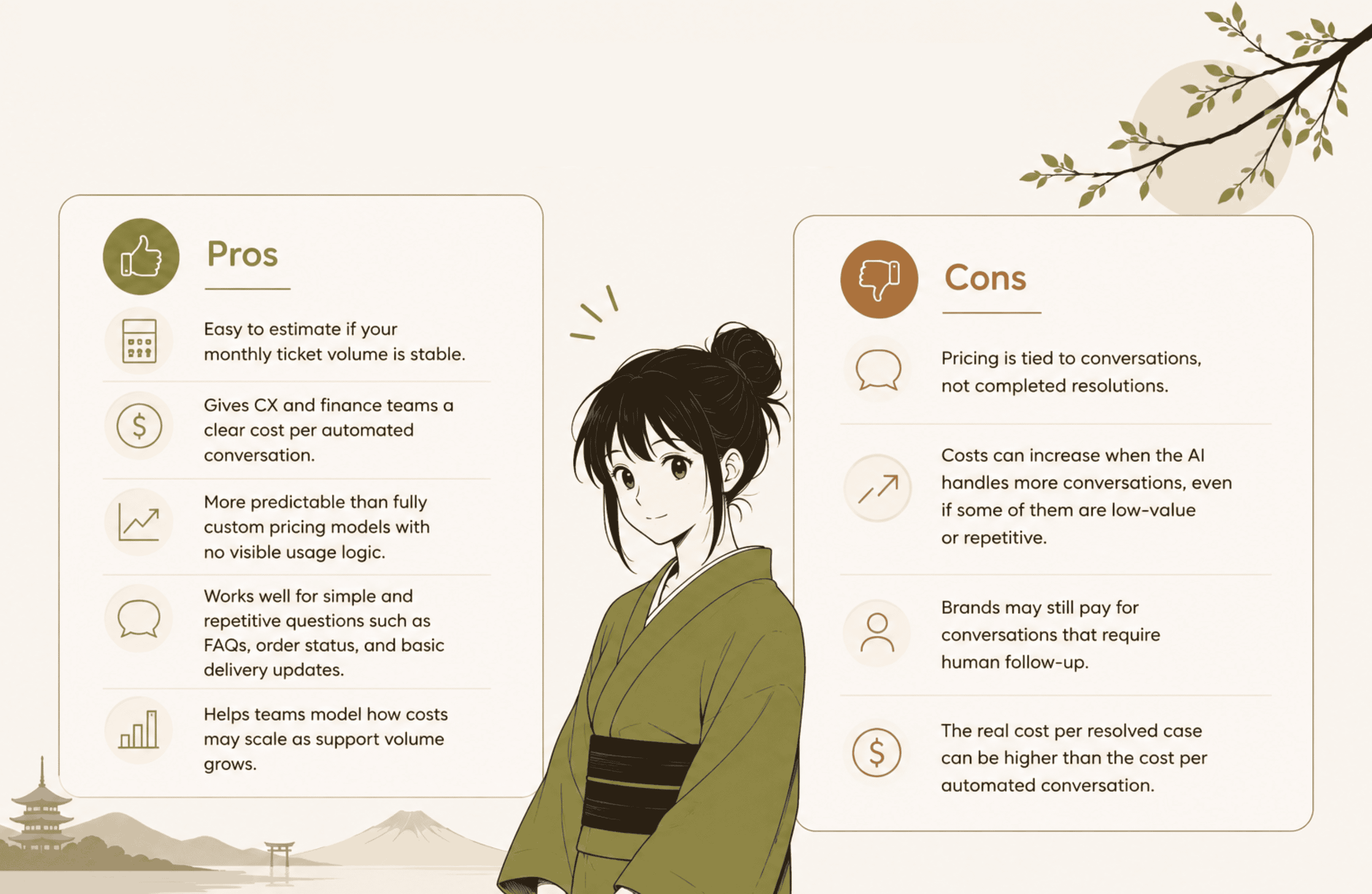
Siena AI is commonly associated with conversation-based pricing.
This means brands are charged based on the number of customer conversations or tickets handled by the AI, rather than the number of issues fully resolved from start to finish.
For ecommerce teams looking to leverage AI, this difference matters.
A conversation can be answered by AI and still require a human to complete the actual work behind it, such as checking an order, contacting a carrier, editing an address, approving a return, or processing an exchange.
Pros
- Easy to estimate if your monthly ticket volume is stable.
- Gives CX and finance teams a clear cost per automated conversation.
- More predictable than fully custom pricing models with no visible usage logic.
- Works well for simple and repetitive questions such as FAQs, order status, and basic delivery updates.
- Helps teams model how costs may scale as support volume grows.
Cons
- Pricing is tied to conversations, not completed resolutions.
- Costs can increase when the AI handles more conversations, even if some of them are low-value or repetitive.
- Brands may still pay for conversations that require human follow-up.
- The real cost per resolved case can be higher than the cost per automated conversation.
For ecommerce brands, the main question is not only how much Siena AI charges per conversation. The real question is how many of those conversations end with the issue fully solved.
Choose Minami AI
If you are checking Siena AI pricing, you are probably looking for more than a chatbot. You want to know if AI can actually reduce support costs.
That is what Minami AI is built for.
Minami helps ecommerce teams remove the manual work behind post-purchase tickets: delivery issues, order changes, returns, exchanges, refunds, store credit, and carrier follow-ups.
So your team does not just answer faster. It has fewer things to handle manually.
For brands with high ticket volume, rising support costs, or too many repetitive post-purchase tasks, Minami AI helps keep support lean without hurting the customer experience.
Frequently Asked Questions
Have more questions? Fill this form and our team will be in touch to answer them!
-
What should ecommerce brands ask before accepting a Siena AI quote?
- Brands should ask how Siena defines an automated conversation, when a conversation becomes billable, and whether escalated cases are still counted. It is also useful to ask for estimated monthly cost at different ticket volumes, so the team can see how pricing changes as support demand grows.
-
What metrics should brands use to evaluate Siena AI pricing?
- The most useful metrics are cost per resolved case, escalation rate, average handling time saved, ticket deflection quality, customer satisfaction, and support hours removed. Cost per conversation is useful, but it should not be the only metric.
-
Is Siena AI better for simple tickets or complex ecommerce workflows?
- Siena AI can be useful for simple and repetitive customer questions. For more complex ecommerce workflows, brands should check how much the AI can do beyond the first answer, especially when tickets involve carriers, returns, exchanges, refunds, or order changes.
-
When should brands consider Minami AI instead?
- Real autonomy means it can set its own steps, reason about decisions, act in real systems, remember past context, and adjust based on results.
Get Started
Minami is available with zero setup
No integrations. No workflows. No dev time. Just power up Minami and let your AI agent cut refunds, manual labor, and losses