On this page (4)
The ChatGPT Shopify shopping integration is the connection that lets products from Shopify stores appear in ChatGPT shopping results. Shoppers find and compare products in ChatGPT, then buy on the merchant’s own Shopify checkout.
The integration between Shopify and ChatGPT is on by default for eligible stores. There is no app to install, no application to file, and no fee from Shopify or OpenAI. You pay only your normal payment processing fees.
One thing changed in 2026. Buyers no longer pay inside the chat. ChatGPT is now a discovery channel that sends shoppers to your store.
How the Shopify and ChatGPT integration works today
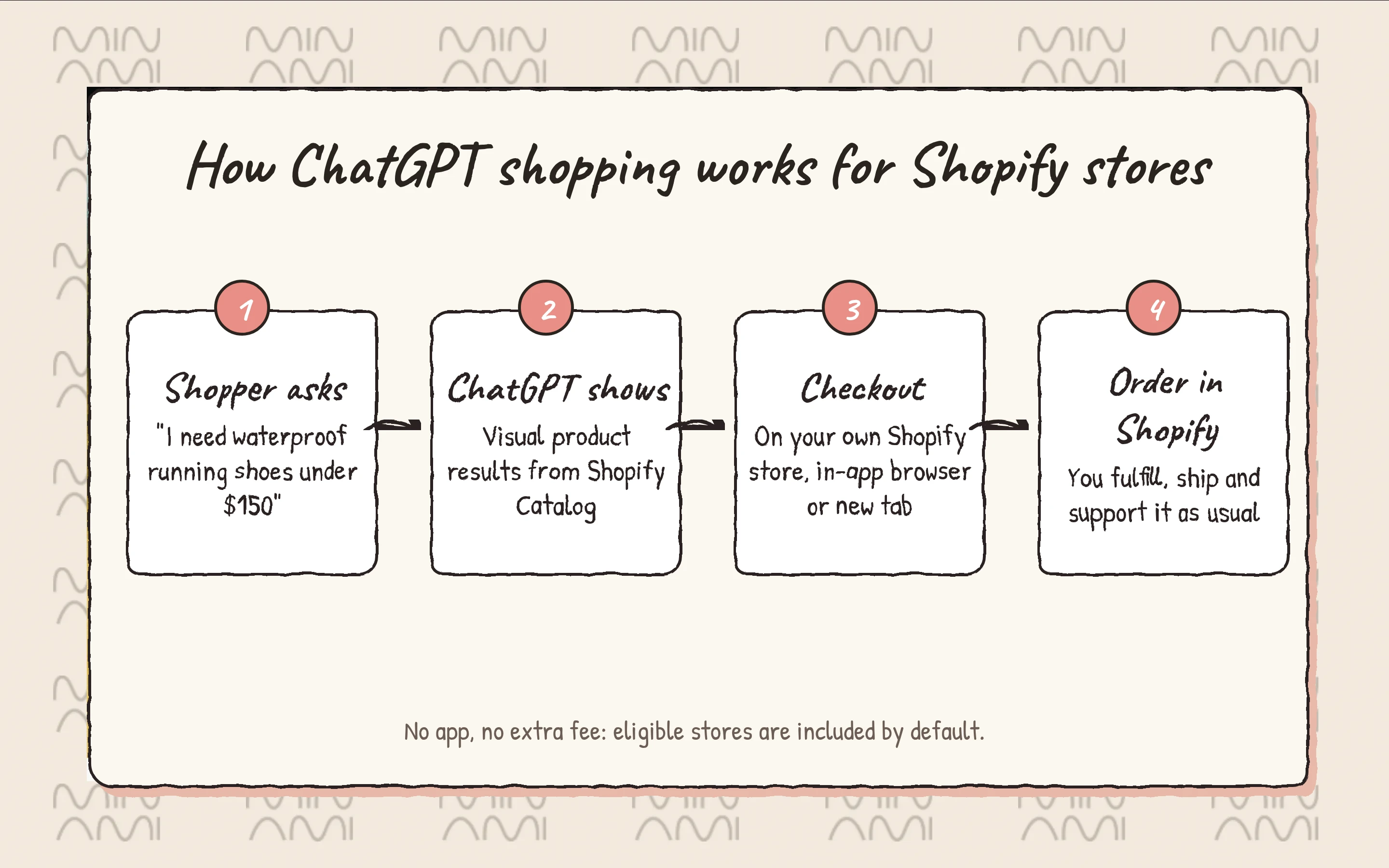
- Shopify shares your product data with ChatGPT through Shopify Catalog. This is part of Shopify agentic storefronts, the feature that lists your products in AI channels.
- Catalog sends titles, descriptions, images, options, prices and availability, and keeps them updated. So the Shopify inventory integration with ChatGPT works without a separate feed: shoppers see your latest stock and prices.
- A shopper describes what they want in ChatGPT, or uploads an image, and adds criteria like budget.
- ChatGPT shows visual product results that can be compared side by side.
- When the shopper picks a product, checkout opens on your online store. In the ChatGPT app it opens in an in-app browser. On ChatGPT web it opens in a new tab.
- The order lands in Shopify like any other order. You handle fulfillment, returns and support.
Benefits of the Shopify ChatGPT integration for merchants
- No setup and no application.
- No selling fees, only standard payment processing.
- Live prices and stock, pulled from Shopify.
- Your own checkout, with your branding, discounts, customizations and payment methods.
- Insights on how your products perform in agentic storefronts, in your Shopify admin.
ChatGPT shopping is live for users in the US. OpenAI rolled out the current visual shopping experience to Free, Go, Plus and Pro users in March 2026.
From Instant Checkout to merchant checkout: the timeline
- September 2025: OpenAI announced Instant Checkout in ChatGPT, built with Stripe. US users could buy from US Etsy sellers inside the chat. That ChatGPT Etsy and Shopify integration announcement listed Shopify merchants as coming soon.
- Same day: Stripe and OpenAI released the Agentic Commerce Protocol (ACP), an open standard for AI agents to share product data and process orders.
- March 2026: OpenAI said the first version of Instant Checkout did not offer enough flexibility. The planned Shopify ChatGPT Instant Checkout integration gave way to checkout on the merchant’s own store.
- March 24, 2026: OpenAI announced richer, visual shopping in ChatGPT and extended ACP to cover product discovery. In this OpenAI Shopify ChatGPT shopping integration, Shopify product data comes through Shopify Catalog with no extra work from merchants.
So OpenAI’s checkout integration with Shopify, first announced in 2025, now means one thing: ChatGPT finds the product, your store closes the sale. Merchants who want a native purchase flow inside ChatGPT can build a ChatGPT app. Shopify merchants do not need one.
Who can sell on ChatGPT through Shopify
Your store qualifies if it meets the requirements in Shopify’s Selling on ChatGPT guide:
- It sells to customers in the United States. The store itself can be based anywhere.
- Your products are eligible for Shopify Catalog.
- You agreed to the Shopify Agentic Storefronts Supplemental Terms of Service.
- Your Terms of service, Privacy policy and Return and refund policy are filled in under Settings > Policies.
Limits to know:
- B2B-only products are not supported.
- Products on OpenAI’s prohibited products list do not appear.
- Legal disclosures should be in the first 6,000 characters of the product description.
- You can turn off ChatGPT’s access under Sales channels > Agentic in your Shopify admin.
- There is no direct checkout setting for ChatGPT. Checkout always happens on your store.
How to show up better: Shopify notes that being in Catalog does not guarantee a product appears in a given AI answer. ChatGPT decides the ranking. What you control is your product data, so complete titles, clear descriptions, accurate variants, prices and inventory matter. Merchants outside Shopify or Etsy can apply to OpenAI to share a product feed through ACP.
How Minami handles support for your ChatGPT orders
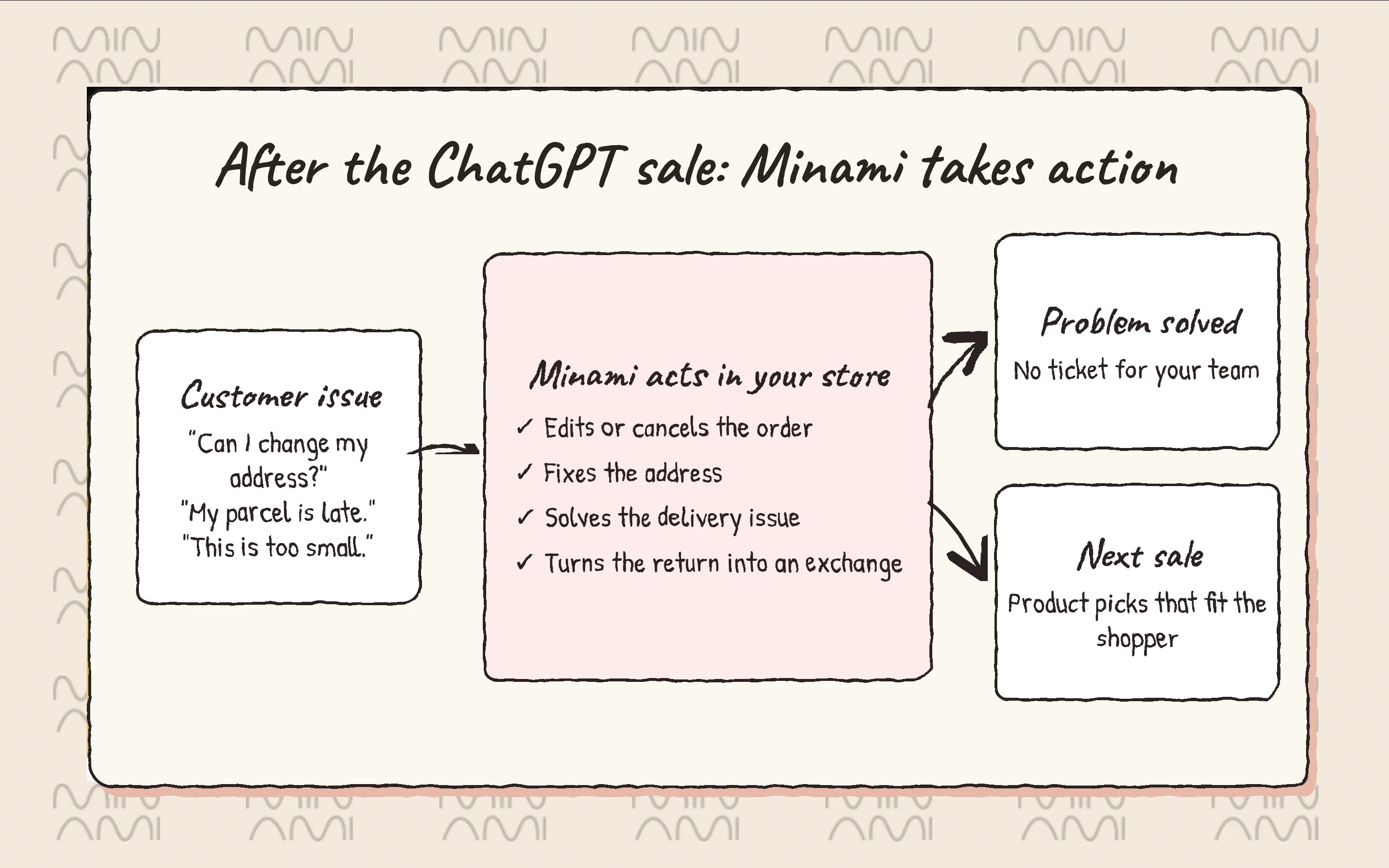
ChatGPT brings the sale, but the questions after it land on your support team. Minami is an AI agent that answers them by acting directly in your Shopify store. Most AI agents for Shopify reply to the customer and open a ticket for your team. Minami resolves the request itself:
- Edits or cancels the order before it ships.
- Corrects a wrong or incomplete shipping address.
- Checks where the parcel is and resolves late or stuck deliveries.
- Turns a return into an exchange and processes it.
Each action happens in Shopify, so the order, the shipment and the customer’s answer are updated in one step. That is what an AI agent for ecommerce logistics does differently, and returns are where it pays off most, with automated returns and exchanges that keep the revenue. In the same chat, Minami also recommends products from your catalog, so a support conversation can end in a second order.
Minami AI agent
Automate 100% of your eCommerce support
Minami doesn't just chat. It takes the action inside your store and sells while it solves.
- Order edits and cancellations
- Address changes and delivery incidents
- Returns, exchanges and product recommendations