Introducing
Is it really possible to manage returns in the Gorgias helpdesk? Everything you need to know
Learn what Gorgias can and can’t do when it comes to handling returns. Understand the limits, the workarounds, and the tools you may need if you want real automation
When you run an ecommerce store, returns are inevitable. Customers need them. You need systems to handle them. And if you’re using Gorgias to manage your helpdesk, you’ve probably wondered whether it can actually process returns.
The short answer is no. Gorgias is a support platform, not a returns processor.
But the longer answer explains exactly what you can do with Gorgias for returns, where you’ll hit walls, and what to consider when you need something more powerful.
Let’s take a look.
Does Gorgias platform offer returns management?
This is where a lot of people get confused.
Gorgias doesn’t create return labels, approve exchanges, issue refunds, or generate return portals. Instead, it connects to third-party returns platforms like Loop Returns, ReturnGO, ReturnLogic, RichReturns, and others. This way, your support agents can see return data and reply to customers without leaving the helpdesk.
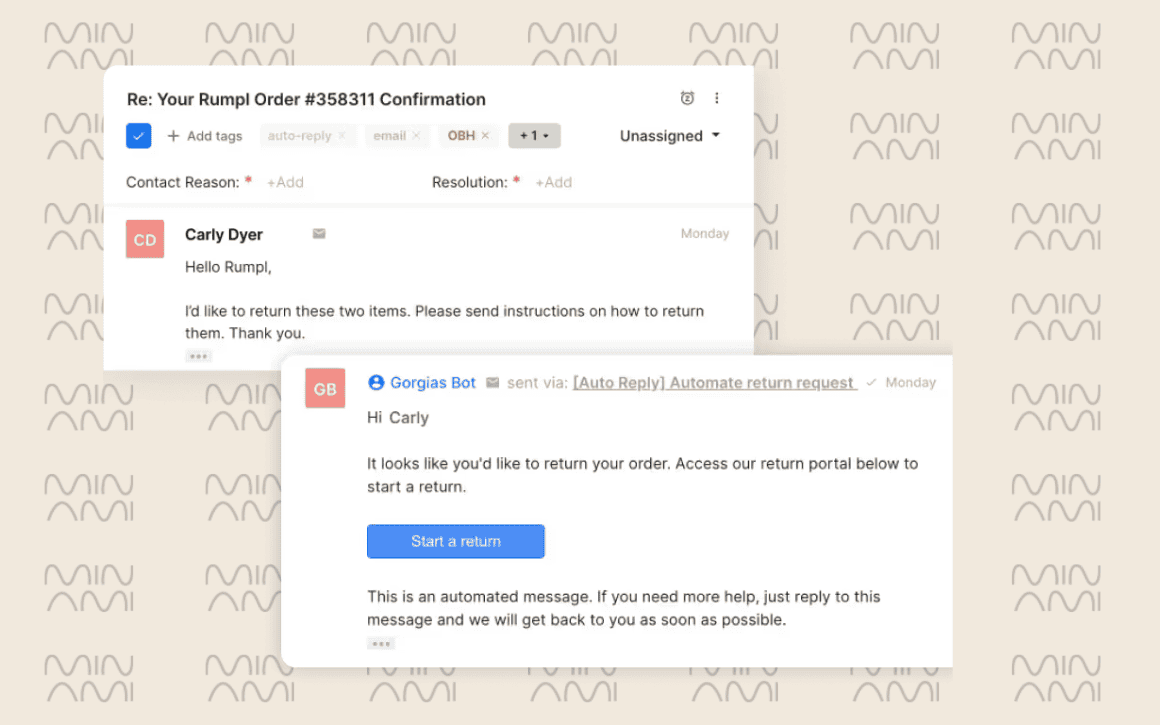
In reality, Gorgias acts more like a bridge than an engine. It connects your support channels with your returns software so the workflow feels smoother, but the heavy lifting still happens somewhere else.
Most of the automation Gorgias offers is sending shoppers to your return portal through a macro or an AI reply.
And there is another downside.
Splitting the workflow across two tools does not just complicate the process and your tech stack, it also forces you to pay for two separate platforms: Gorgias pricing on one side and your returns software on the other. More steps, more overhead, and higher monthly costs for the same outcome.
Gorgias, Loop Returns and other integrations
The most popular setup is the Gorgias and Loop Returns integration for Shopify. Loop runs the actual returns and exchanges flow in the background, while Gorgias is the place where the conversation with the customer happens.
In practice, it works like this. A customer asks for a return, Gorgias pulls the order information, and the customer is sent to your Loop portal. Loop applies your rules and policies in the background, decides if the order is eligible, offers a refund, store credit, or an exchange, and generates the return label or instructions.
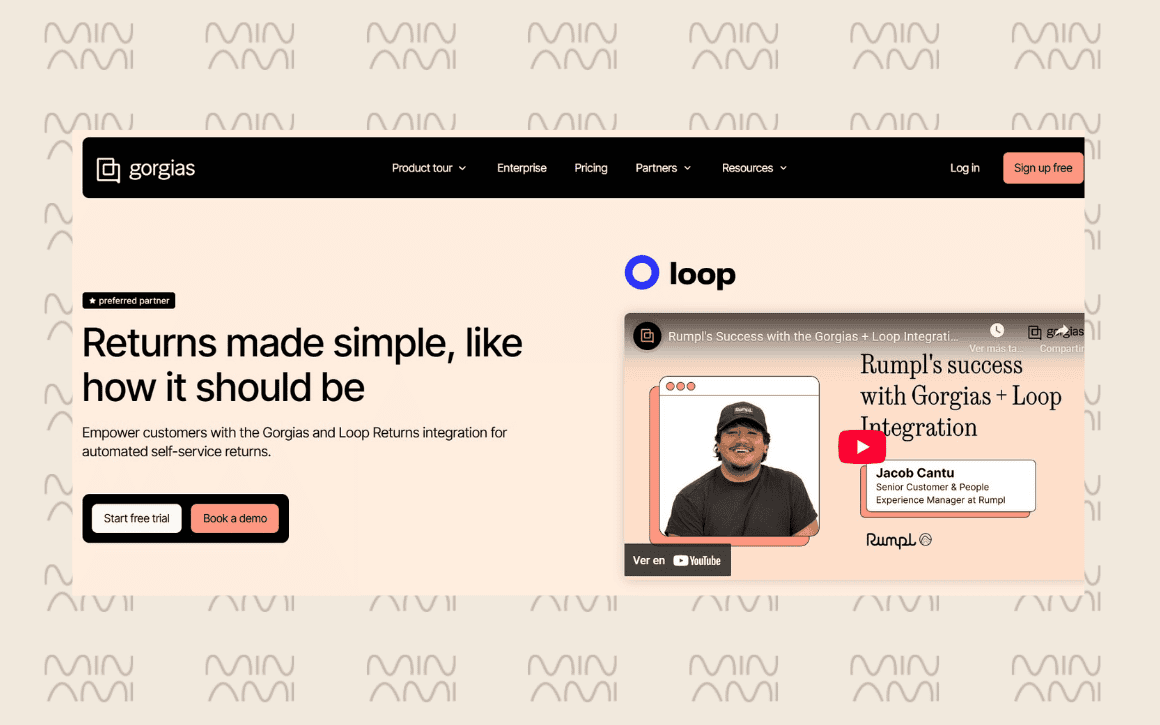
From that ticket view, your agents can:
-
See the return status at a glance, like requested, approved, in transit, or completed
-
Check which items are being returned or exchanged, and in what quantities
-
Understand whether the customer chose a refund, credit, or exchange
-
Open the Loop return directly if they need to dig deeper or make a manual change
Minami is the only AI agent that can process returns on its own, not just send customers to a portal. It approves, updates, verifies, and completes the full flow without adding more work to your team.
Common limitations of Gorgias Returns
| Limitation | What it means in practice |
|---|---|
| No return portal | You must use Loop, ReturnGO, etc. More tools, more cost, more risk |
| No automated approvals | Every return needs manual review, even simple ones |
| No exchange logic | Can’t auto-check inventory or approve size/variant exchanges |
| No refund automation | Refunds and store credit require agents or the returns app |
| Constant tab hopping | Agents move between Gorgias, Shopify, returns app, and payments |
| Data sync issues | Return status often mismatches across systems |
| Complex cases manual | High-value, damaged, or international returns need human handling |
| Peak season bottleneck | Volume spikes overwhelm agents; long waits and more disputes |
1. No native return portal
Gorgias doesn’t give you a branded return portal. You have to bring in a third-party tool (Loop, ReturnGO, ReturnLogic, etc.). That’s another platform to manage, another integration point where data can break, and another vendor to pay.
2. No automated approval rules
You can’t tell Gorgias, “If the order is within 30 days and the customer is not a known abuser, auto-approve the return.” Every return still requires an agent decision—even the straightforward ones. Your agent has to read the request, check the policy, and manually approve or deny it. This doesn’t scale.
3. No product exchange logic
If a customer asks for an exchange instead of a refund, Gorgias can’t automatically check your inventory, determine if the size they want is in stock, and approve an instant exchange. That’s handled by your returns app (if at all), but there’s still manual coordination.
4. No refund automation
Gorgias won’t automatically issue a refund to the customer’s original payment method, or offer store credit, or anything else. Your returns app might have this feature, but Gorgias doesn’t trigger it directly. There’s lag between what Gorgias knows and what actually happens in your payment system.
6. Agents have to tab-hop constantly
Agents end up bouncing between tabs for every return. They’re chatting in Gorgias, checking order details in Shopify, reviewing the return status in whatever app you use, jumping into the payment processor to issue the refund, and rereading the policy to be sure they’re allowed to do it.
7. Data sync issues
Depending on your stack, data doesn’t always sync smoothly. A return might be marked as “approved” in Loop but still show as “pending” in Gorgias. Your agent sees conflicting information. They have to dig into the returns app to figure out what’s real.
8. Complex cases require manual work
Complex returns still fall back on humans. If a shopper wants store credit instead of a refund, if the order comes from another country with a different policy, if the purchase is high value and needs verification, or if the item arrives too damaged to resell, Gorgias won’t automate any of it. An agent has to review the case and make the call.
9. Peak season creates bottlenecks
During Black Friday, Cyber Monday, or the holiday return rush, return volume spikes 10x. Your support team—even with Gorgias and a returns app—gets buried. They can’t approve all the returns fast enough. Customers wait days for a response. Some give up and dispute the charge, costing you even more.
Minami, the best alternative to Gorgias Returns
You already know how this works. Gorgias handles the conversation. Your returns app handles the return. But neither one actually does the work for you. They answer, they display data, they trigger small actions… and then the heavy stuff falls back on your team.
Minami steps in where both tools stop. Instead of bouncing between a helpdesk and a returns app, you get one AI agent that understands what the customer wants, checks the order, applies your policies, updates Shopify or Magento, processes the refund or exchange, fixes an address, or even contacts the carrier when there’s a delivery issue.
The customer doesn’t get sent to another portal. You don’t have to approve anything manually. Minami reads the request, makes the decision, and completes the entire workflow from start to finish.
That’s why Minami replaces your helpdesk plus your returns tool. It’s the first agent that actually finishes the job for you.
Frequently Asked QuestionsLearn what Gorgias can and can’t do when it comes to handling returns. Understand the limits, the workarounds, and the tools you may need if you want real automation
Have more questions? Fill this form and our team will be in touch to answer them!
-
Can Gorgias process returns on its own?
- Not really. Gorgias shows the info, but the real return workflow happens in your returns app. You still need Loop, ReturnGO, ReturnLogic, or another tool to actually generate labels, approve requests, or issue refunds.
-
Does Gorgias offer a branded return portal?
- No. Gorgias doesn’t have a native portal. You need a third-party app if you want customers to self-serve.
Get Started
Minami is available with zero setup
No integrations. No workflows. No dev time. Just power up Minami and let your AI agent cut refunds, manual labor, and losses