 Nobikage San
 Introducing
6 best AI tools and software for the cosmetics and beauty industry I have tested
Explore the best ai tools, agents and software for the cosmetics and beauty industry.
Are you looking for the best AI tools for the beauty and cosmetics industry?
The beauty industry has never had a shortage of tools promising to change the game.
However, a new generation of AI platforms is actually delivering on that promise, and the gap between brands leveraging these technologies and those that are not is growing fast.
This guide covers the six platforms worth your attention, exploring what they do, who they are for, and what makes each one worth considering.
The best AI tools for the cosmetics, beauty, and skincare industry in 2026
-
Minami AI — Best for reducing support costs by 90% while doubling customer lifetime value through autonomous product recommendations
-
Perfect Corp — Best for driving higher conversion rates with hyper-realistic AR virtual try-ons
-
PROVEN Skincare — Best for engineering custom skincare routines tailored to the user’s specific environment
-
Revieve — Best for boosting customer engagement through clinical-grade digital skin diagnostics
-
Osmo — Best for shaving years off fragrance R&D by predicting scents at a molecular level
-
Nightjar — Best for replacing expensive studio shoots with AI-generated, color-accurate lifestyle imagery
How AI improve marketing strategy in the cosmetics industry
The AI beauty market is valued at $4.9 billion, with 90% of marketers increasing their budgets to stay competitive.
By leveraging data-driven precision, brands are transforming how they acquire and retain customers:
-
Higher conversions: Personalization and virtual try-ons boost sales by up to 200% by reducing purchase hesitation.
-
Trend prediction: Leading brands now identify viral trends 6 months before they hit the mainstream, allowing for proactive campaigning.
-
Enhanced retention: AI tools like Minami AI cut support costs by 90% by turning returns into personalized exchanges based on purchase history.
-
Incremental revenue: Top retailers have already generated over $100 million in extra revenue through AI-powered shade matching.
Best AI tools, platforms, and agents for the beauty and cosmetics brands
1. Minami AI
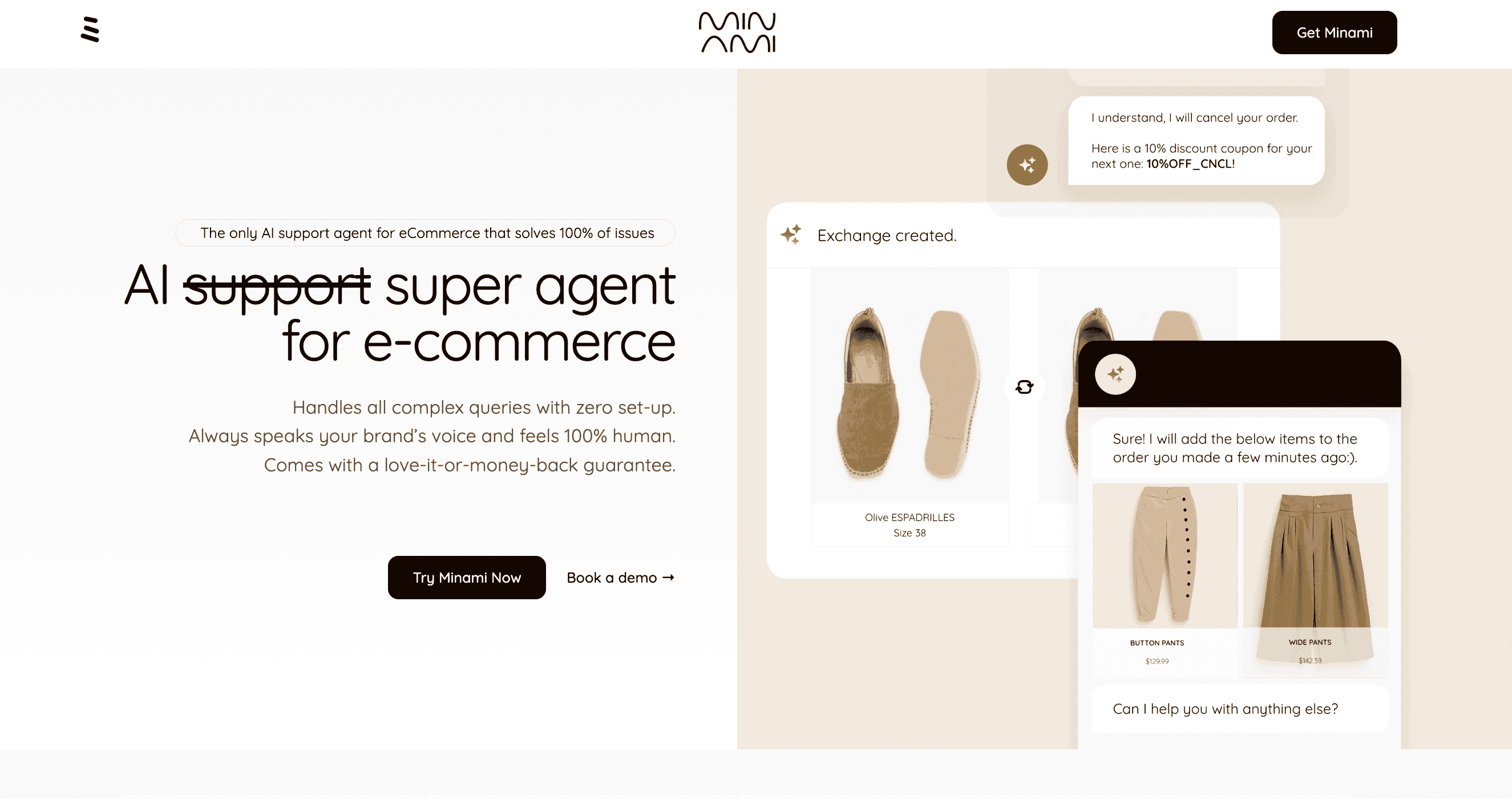
Minami AI is an autonomous agent for beauty and cosmetics eCommerce that manages customer experience, logistics, and support operations end to end.
Unlike traditional support tools, Minami does not just respond to tickets. It understands context, makes decisions, and executes actions across real workflows.
Whether it is resolving a damaged perfume delivery, coordinating a shade exchange, or proactively updating a customer about their order, Minami operates like a digital team member embedded in your post-purchase stack.
Best for:
-
High-growth beauty brands: DTC skincare, makeup, and fragrance companies scaling fast and looking to deliver premium post-purchase experiences without growing support teams.
-
Premium and experience-led brands: Brands where product fit, including shade, skin type, and routines, together with delivery experience, directly impacts retention and repeat purchase.
Key features
- Autonomous delivery issue resolution for fragile products: Beauty products often involve glass and liquids. Minami detects delivery issues, communicates with carriers, files claims, and triggers replacements automatically.
- Intelligent returns and shade exchanges: Instead of defaulting to refunds, Minami guides customers through product exchanges, such as wrong foundation shade or skincare mismatch, improving retention and recovery rates.
- Post-purchase order editing and upsells: Allows customers to modify or add products after checkout, capturing those last-minute purchase decisions common in beauty routines.
- Proactive WISMO elimination: Beauty customers expect constant visibility. Minami sends real-time updates, anticipates delays, and resolves “Where is my order?” queries before they happen.
- End-to-end post-purchase orchestration: From order monitoring to returns and carrier coordination, Minami connects and executes across the full post-purchase flow.
Pros:
- Built for beauty-specific workflows: Handles shade exchanges, fragile shipments, and experience-driven support scenarios from day one.
- Turns operations into a retention lever: Improves repeat purchase by resolving issues quickly and guiding customers toward better product outcomes.
Cons:
- Requires clear operational logic: Works best when aligned with defined policies for returns, exchanges, and shipping, since it executes them autonomously.
2. Perfect Corp
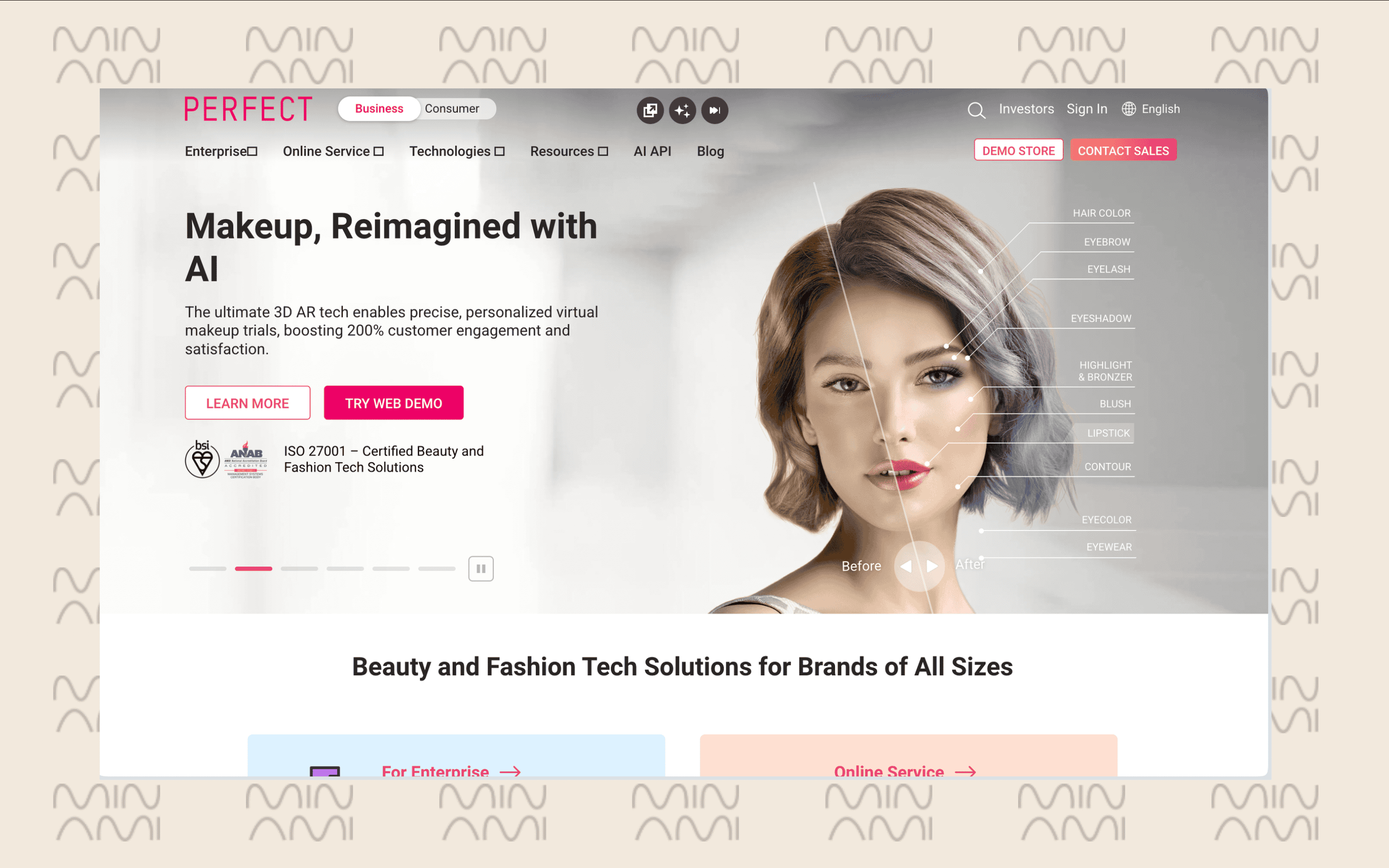
Perfect Corp is a platform that provides Augmented Reality (AR) and AI solutions.
Their core technology, AgileFace®, uses over 200 facial landmarks in real-time to ensure that when you blink, smile, or turn your head, the digital makeup moves perfectly with your skin.
It’s the difference between a cheap sticker and a professional digital application.
Best for: Companies that want the same “mirror” experience on their website, their mobile app, and on physical smart mirrors in their brick-and-mortar stores.
Key features:
-
Hyper-realistic textures: Most AI tools just change the color. Perfect Corp simulates the finish. You can distinguish between a matte liquid lipstick, a high-shine gloss, or a metallic eyeshadow.
-
AI skin diagnostic: Using the camera, it detects 14 different skin concerns (wrinkles, redness, oiliness, dark circles) in seconds and suggests a personalized routine.
-
VTO for hair and nails: It’s not just face paint. It can accurately “dye” hair (including ombré and highlights) and apply virtual 3D nail art that follows the curve of the fingernail.
-
AI face analyzer: It identifies the user’s face shape, eye shape, and skin tone to suggest “looks” that actually suit their specific anatomy.
Pros:
-
Drastic return reduction: The #1 reason for makeup returns is “the color didn’t look like the photo.” VTO solves this instantly.
-
Massive engagement: Users spend significantly more time on a website when they can “play” with their own face.
-
Social integration: They have official partnerships with Google, YouTube, and Instagram, allowing users to try on products directly from an ad or a video.
Cons:
-
Price barrier: Their enterprise-level “YouCam” technology is expensive. It is often out of reach for “indie” brands or small startups.
-
Hardware dependent: While very optimized, users with very old phones or poor lighting might experience “glitches” where the makeup looks misaligned.
-
Implementation curve: It requires a technical team to integrate their SDK/API into your existing eCommerce platform.
3. PROVEN Skincare
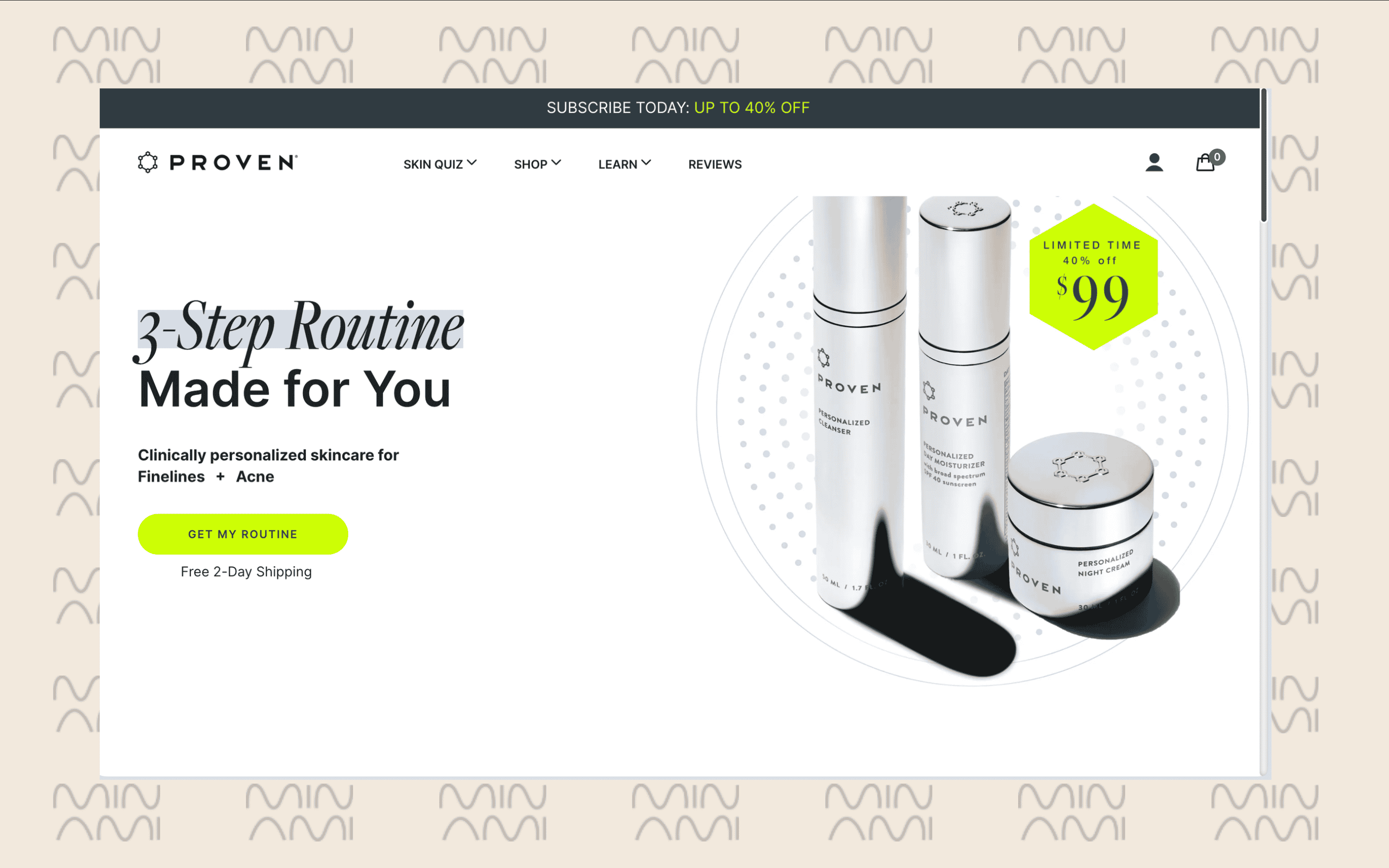
PROVEN is a database-driven formulation platform. At its core is the Skin Genome Project, the winner of MIT’s AI Technology of the Year award.
It is the largest analytical database of skincare ever created, featuring over 20,000 ingredients, 4,000 scientific publications, and 20 million consumer testimonials.
Best for: Companies that want to eliminate the “retail shelf” and ship custom bottles directly to the user.
Key features:
-
The 47-factor analysis: Their AI doesn’t just look at your skin type. It asks for your Zip Code. Why? To calculate the local water hardness, humidity, UV index, and pollution levels where you live.
-
Adaptive formulas: Your skin changes. PROVEN’s AI updates your formula every 8 weeks based on the changing seasons or if you move to a different city.
-
Ingredient synergizer: The AI ensures that the active ingredients (like Retinol or Vitamin C) are at the exact percentage your skin can handle without irritation.
-
Clean beauty filter: The system automatically cross-references formulas against banned or toxic ingredients globally to ensure 100% safety.
Pros:
-
Extreme personalization: It replaces a 10-step routine with just 3 “super-products” (Cleanser, Day Moisturizer, Night Cream) that do everything.
-
High retention: Once a customer finds a formula that actually works for their specific environment, they rarely switch back to generic brands.
-
Sustainability: By making only what is ordered, there is zero “dead stock” or wasted product sitting in warehouses.
Cons:
-
The “wait” factor: Because it is custom-made, shipping takes 1–2 weeks. There is no instant gratification like buying at a store.
-
Higher price point: Custom chemistry is more expensive than mass-produced drugstore brands.
-
Blind trust: You can’t “sample” it in a store before buying the full customized set.
4. Revieve
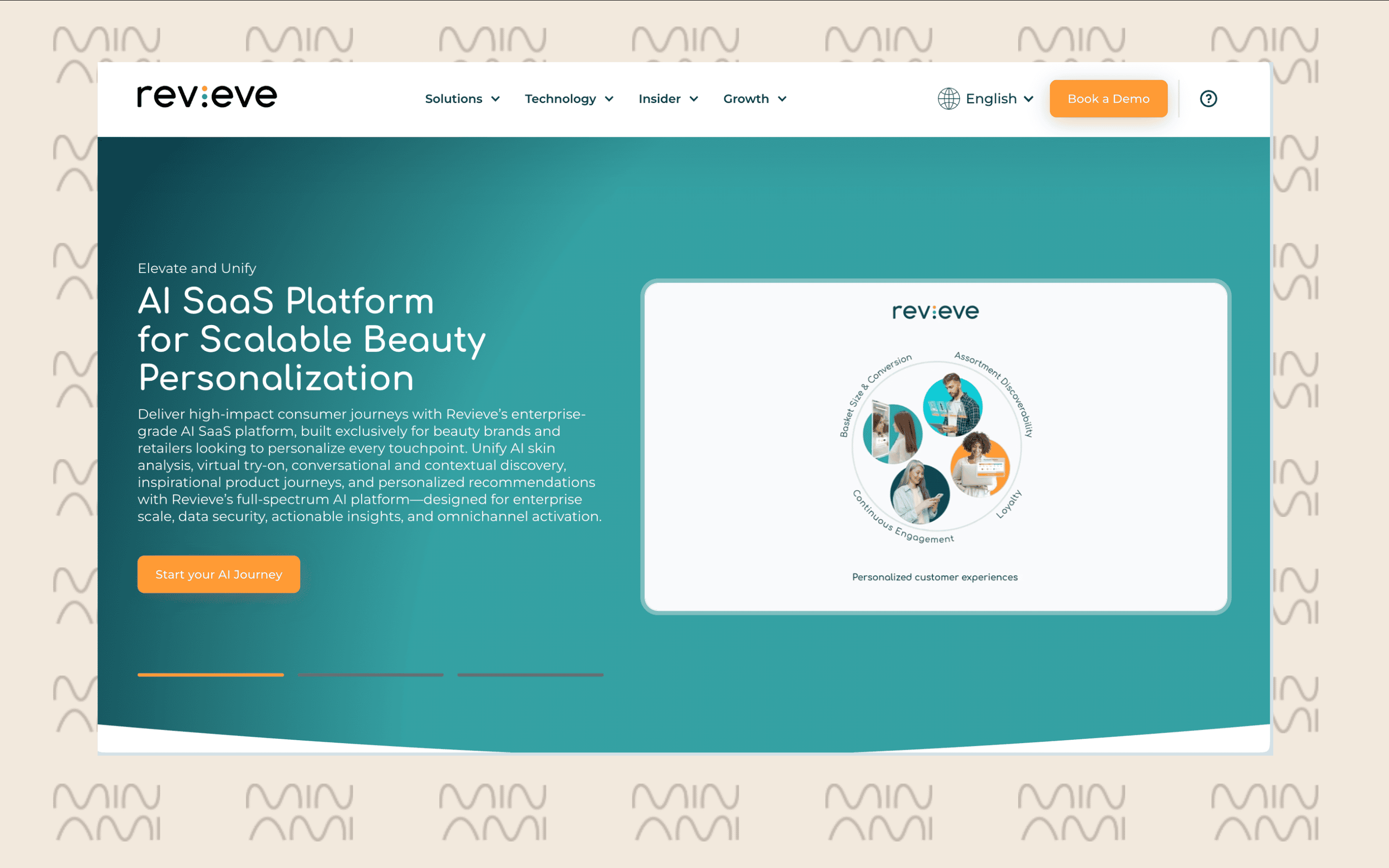
Revieve is a Digital Beauty Platform that combines visual AI (skin/face analysis) with a massive product recommendation engine.
Its standout feature is its ability to live anywhere: on a brand’s website, inside a mobile app, on a physical “Smart Mirror” in a store, and even as a white-labeled assistant inside ChatGPT.
Best for: Brands that want a customer to be able to start an analysis on their phone at home and finish the purchase at a physical kiosk in-store.
Key features:
-
Match my look & shop the look: This is their “viral” feature. A user uploads a photo of an influencer or a celebrity. The AI analyzes the specific shades of eyeshadow, lipstick, and blush in that photo and instantly creates a “bundle” of matching products from the store’s catalog.
-
AI-powered skin age diagnostics: A 2026 update that goes beyond just “spots” to provide a clinical-grade “Skin Age” benchmark, making results easier for consumers to understand and track.
-
LiveAR visualization: Unlike static filters, this shows real-time color-coded indicators (red for inflammation, blue for dehydration) directly over the user’s live video feed to explain why a product is being recommended.
-
Conversational AI advisor: An emotionally intelligent chatbot that handles complex routines (e.g., “I need a 5-step morning routine for sensitive skin that works under makeup”).
Pros:
-
Massive engagement: Brands using Revieve report up to 100%+ increases in time spent on-site and significantly higher average order values (AOV).
-
Cross-category mastery: It handles skincare, makeup, haircare, and even nutrition (suggesting supplements for skin health) in one unified interface.
-
Zero-party data: It collects incredibly valuable data on what customers actually want, allowing brands to stock the right products in the right regions.
Cons:
-
Implementation complexity: Because it is so robust, it takes more time to “train” the AI on a brand’s specific inventory and philosophy compared to simpler tools.
-
Standardized feel: Because so many big retailers use it, the UI can sometimes feel “corporate” unless the brand spends extra effort customizing the design.
5. Osmo
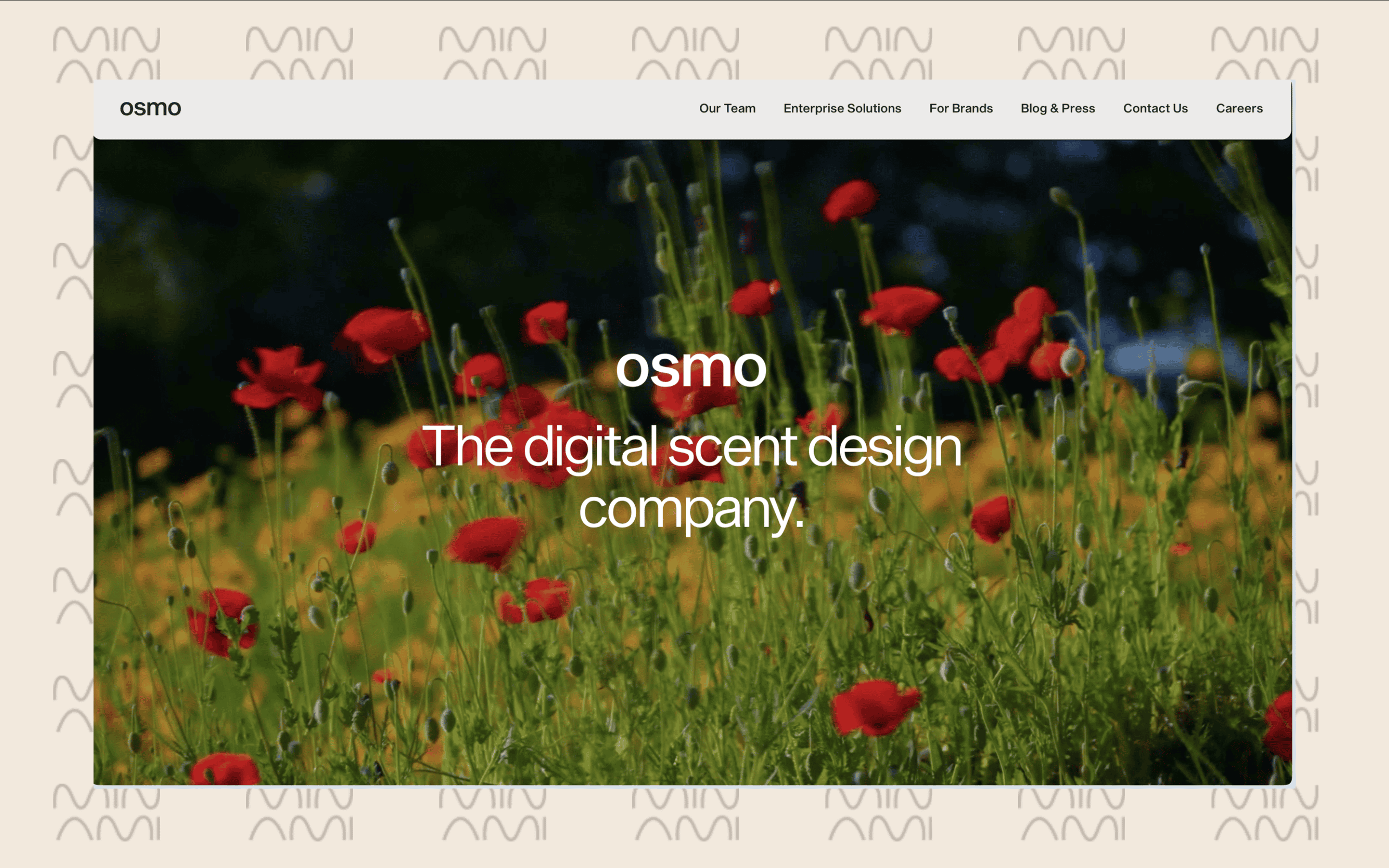
Osmo is an AI-powered fragrance house. They have created a “Principal Odor Map” (POM) that acts like an RGB map for smell.
By analyzing the molecular structure of an ingredient, their AI can predict exactly how it will smell to a human without anyone ever opening a bottle.
This allows them to “teleport” scents (digitize a smell in one place and recreate it in another) and design entirely new scent molecules that have never existed in nature.
Best for: Companies that want to create signature scents in weeks rather than years.
Key features:
-
Generation OI: A B2B platform where you can input a text description (e.g., “a rainy morning in a cedar forest”) or an image, and the AI generates a precise chemical formula for that scent.
-
Sustainable molecule design: Osmo’s AI identifies and creates “captives” (exclusive molecules like Glossine or Quasarine) that are biodegradable, non-toxic, and replace “forever chemicals” usually found in traditional perfumes.
-
Scent teleportation: The ability to capture the chemical signature of a rare flower in the wild and digitally transmit that data to a lab for identical reproduction.
-
Regulatory guardian: The AI automatically checks formulas against ever-changing international laws (like IFRA), ensuring your product is legal to sell in every country before you even blend it.
Pros:
-
Radical speed: Reduces the R&D cycle for a new fragrance from 18+ months to just a few weeks.
-
Limitless creativity: The AI can suggest molecular combinations that a human master perfumer might never have considered.
-
Safety & ethics: Eliminates the need for animal testing and reduces the carbon footprint of chemical R&D by simulating reactions in software first.
Cons:
-
The “Art” debate: Traditionalists argue that AI lacks the “soul” and emotional nuance of a human master perfumer (though Osmo uses AI as a co-pilot for perfumers).
-
High complexity: It is a B2B infrastructure tool, meaning it’s not something a consumer can play with on a website—it’s for the scientists and creators behind the brands.
6. Nightjar

Nightjar is a visual generation platform specifically tuned for the high standards of the beauty industry. Unlike generic AI image generators (which often struggle with skin texture or exact product colors), Nightjar allows brands to upload a “master bottle” 3D render and then generates thousands of different “lifestyle” scenes.
It can place your perfume bottle on a marble table in Paris or show your foundation on twenty different models with twenty different skin tones—all in seconds.
Best for: Brands that need a constant stream of high-quality content for Instagram, TikTok, and ads.
Key features:
-
Hex-code accuracy: This is crucial. Nightjar ensures the color of the lipstick in the AI image matches the real-world product’s Pantone or Hex code exactly, avoiding “false advertising.”
-
Diverse model generation: It can generate human models of any age, ethnicity, or skin type, ensuring every customer sees someone who looks like them.
-
Infinite scene swapping: You can take one product shot and instantly generate versions for “Summer in Ibiza,” “Winter in Tokyo,” or “Minimalist Spa.”
-
Shadow and reflection mapping: The AI calculates how the glass of a perfume bottle should reflect light based on the background, making the images indistinguishable from real photography.
Pros:
-
Speed to market: You can launch a campaign tomorrow that would have previously taken three months to organize and shoot.
-
Content scaling: Generate 100 variations of an ad to see which one performs best (A/B testing) without any extra effort.
Cons:
-
The “uncanny valley”: If not tuned perfectly, some AI models can look “too perfect,” losing the authentic human touch that some niche brands prefer.
-
Legal evolution: As of 2026, brands must often disclose that “Images are AI-generated” to comply with new consumer transparency laws.
How to choose the right AI tool for your beauty eCommerce business
The honest answer is that most brands don’t need all six. They need one tool that solves their most expensive problem right now.
If you’re still in the early stages, the smartest move is to start where the money is leaking: support costs, return rates, and the customers who never come back.
Those are the metrics that compound fastest, and fixing them creates the budget to invest in everything else, virtual try-ons, custom formulations, AI-generated content, later.
The pattern among the fastest-growing beauty brands is consistent. They don’t try to implement everything at once. They pick the tool with the clearest ROI, get it live, measure the impact, and expand from there. In an industry where customer loyalty is everything, the brands that win are the ones that make every post-purchase interaction feel effortless. Once that foundation is solid, the rest of the stack builds itself.
Frequently Asked Questions
Have more questions? Fill this form and our team will be in touch to answer them!
-
What is an AI tool for beauty, cosmetics, or skincare?
- It’s a smart platform that uses algorithms to automate expert tasks—like analyzing skin through a selfie, virtually applying makeup, or creating custom formulas based on your environment.
-
What are the main benefits for my brand?
- You’ll see a massive boost in sales and a drop in costs. AI removes shopping doubts with virtual trials and slashes return rates by ensuring customers get the right shade or product the first time.
-
Can AI reduce operational costs for a beauty brand?
- Yes, significantly. Tools like Minami AI automate up to 90% of customer support tickets and handle complex tasks like glass-breakage claims without human intervention. Additionally, Nightjar replaces the need for $20,000+ studio shoots by generating high-quality, color-accurate product imagery digitally.
Get Started
Minami is available with zero setup
No integrations. No workflows. No dev time. Just power up Minami and let your AI agent cut refunds, manual labor, and losses