On this page (6)
Yuma AI found a clever niche. Rather than replacing your helpdesk, it runs as a layer over Gorgias or Zendesk and starts answering tickets within days.
That architecture is also its ceiling. Everything it does passes through someone else’s integration, so when a connector misbehaves or a workflow needs custom logic, you’re back to tickets and developers. And plenty of what it handles is still replying, not fixing.
This guide covers 5 Yuma AI alternatives, from other AI layers to agents that connect to your store and carriers directly. Which one suits you depends on how much you’re willing to depend on the helpdesk in the middle.
Yuma AI vs alternatives: table
| Tool | Best for | Executes store actions or chat only | Logistics automation depth | Product recommendations / sales |
|---|---|---|---|---|
| Minami | Brands wanting AI to own post-purchase outcomes | Executes in the store and with carriers | Full: order changes, cancellations, addresses, incidents, claims, returns, exchanges | Yes, in chat and exchanges |
| Zowie | Mid-size eCommerce | Chat with recipes | Moderate | Some sales features |
| Ada | Enterprises | Chat, built actions | Custom | Limited |
| Tidio Lyro | Small stores | Chat | Minimal | Flows |
| Intercom Fin | Intercom teams | Mostly chat | Low | Limited |
Why the helpdesk layer holds Yuma back
Yuma AI is an AI agent for Shopify brands that sits on top of existing helpdesks. It answers tickets and can run certain order actions through its integrations. Our Yuma AI pricing guide covers its model, and our Yuma AI review walks through every feature.
Three things push teams to compare. Integrations aren’t always dependable, advanced set-up can need code, and much of the value is in replies rather than completed tasks. Delivery problems and complex edits still need staff.
So brands look for AI that executes logistics natively and adds sales.
The 5 Yuma alternatives
1. Minami AI
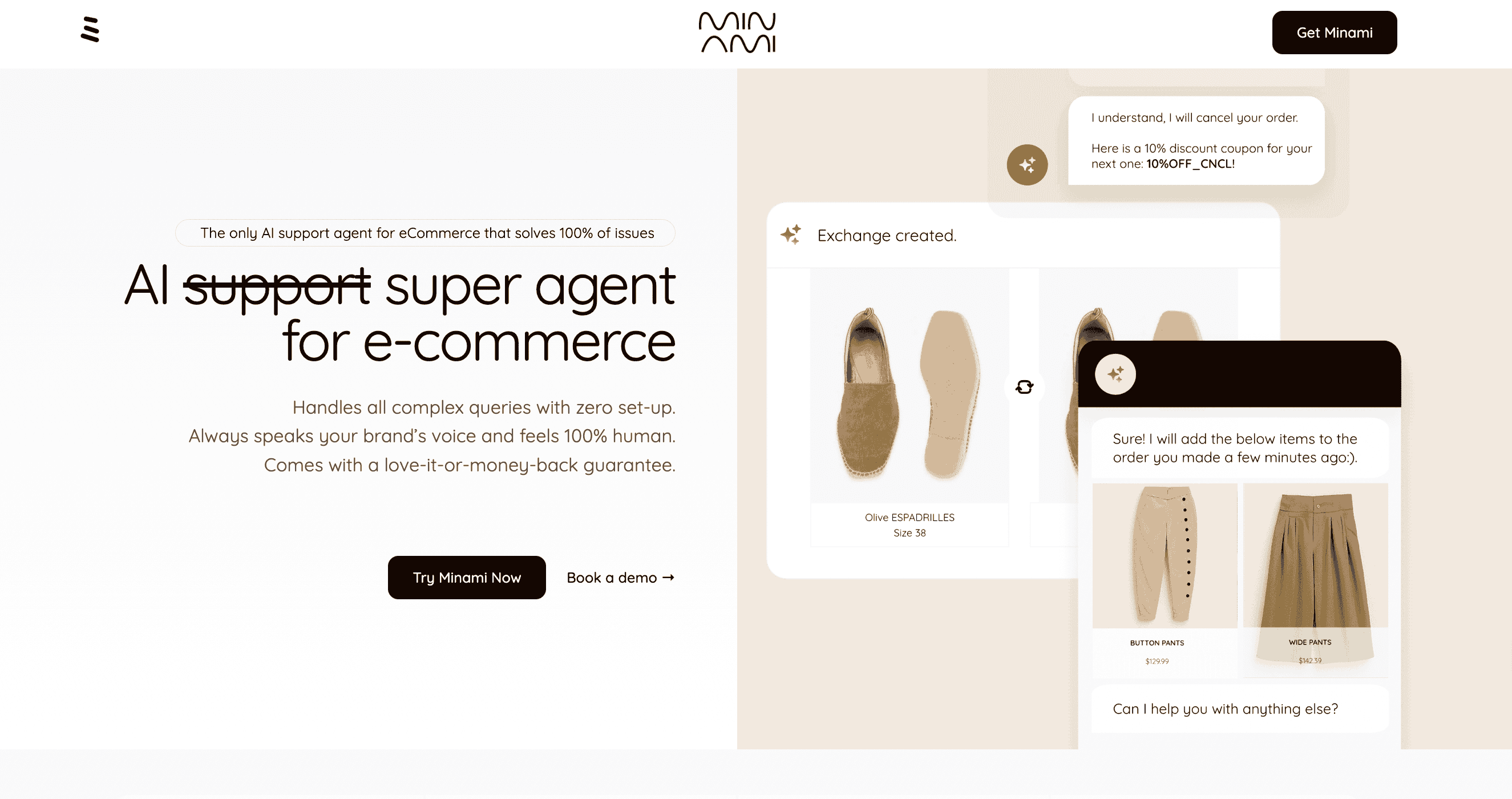
Best for: brands that want logistics resolved by AI without depending on a helpdesk layer.
Minami skips the middle layer. It connects straight to your store and couriers, so actions don’t depend on a helpdesk connector staying healthy. Ask it to change, cancel or redirect, and it does, then confirms. It’s built to automate each logistics headache your shop runs into, with recommendations that lift sales.
What it gets done
- Paid-order adjustments, add-ons and removals.
- Cancellations prior to shipping, with a save step.
- Shipping address changes in time.
- Late, lost or damaged parcels; Minami claims 90% fixed without people.
- Courier dialogue and claims, 80%+ per Minami.
- Exchanges proposed instead of refunds.
Upselling inside support
Shoppers get product ideas inside chats and swaps, and can buy instantly. See returns and exchanges.
Setup without code
Add the Shopify app or embed a tag, then explain your policies in plain words. Free set-up, custom pricing (contact sales).
Pros and cons
- Pros: native store and carrier actions; no code; sells.
- Cons: no voice; eCommerce only.
Our take: owns the outcome instead of sitting on top of another tool.
- Talks directly with carriers to change addresses, reroute parcels and open delivery incidents, then executes the change in the store or CMS end to end.
2. Zowie
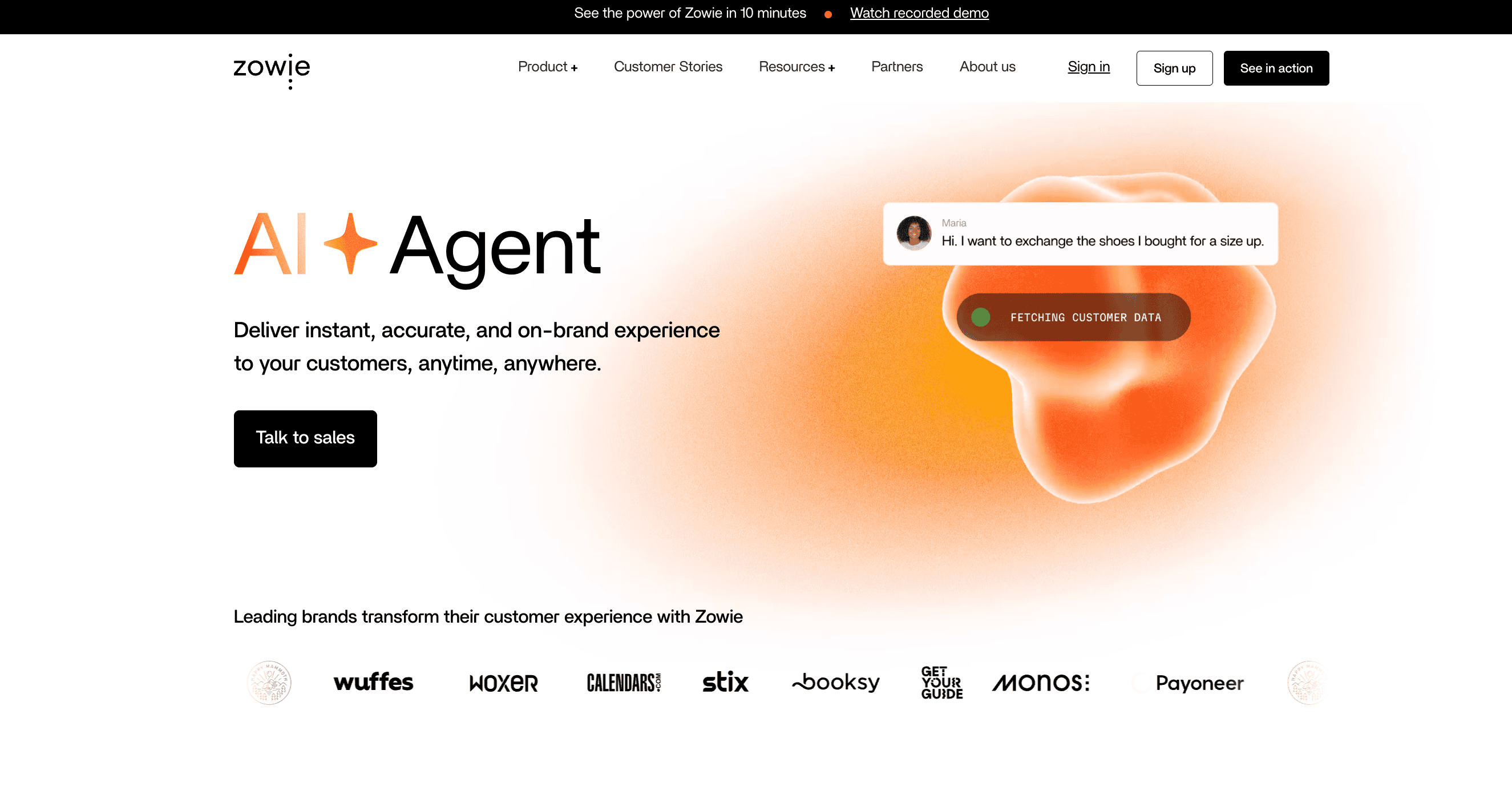
Best for: mid-size eCommerce brands.
Zowie automates frequent requests with recipes.
What it executes
Recipe actions.
Pricing
Custom / not published. Zowie has no public pricing page (its pricing URL returned 404 when checked).
Pros and cons
- Pros: commerce focus.
- Cons: configuration needed.
Our take: solid, set-up led.
3. Ada
Best for: enterprises.
Ada provides enterprise AI with built actions. Compare in our Ada CX alternatives.
What it executes
Configured tasks.
Pricing
Custom / not published. Ada’s pricing page leads to a demo request.
Pros and cons
- Pros: scale.
- Cons: long implementation.
Our take: enterprise route.
4. Tidio Lyro

Best for: small shops.
Lyro handles FAQ replies in Tidio.
What it executes
Answers.
Pricing
Free plan; Starter $24.17/mo, Growth from $49.17/mo and Plus from $300/mo. Lyro AI is also sold standalone from $32.50/mo for 50 Lyro conversations.
Pros and cons
- Pros: simple.
- Cons: no logistics.
Our take: a step down in capability.
5. Intercom Fin
Best for: Intercom users.
Fin writes answers from your content.
What it executes
Mostly replies.
Pricing
Essential $29 per seat/mo ($19 billed annually), Advanced $85 per seat/mo, Expert $132 per seat/mo. Fin AI Agent is billed at $0.99 per outcome on every plan, and Copilot is $29 per agent/mo.
Pros and cons
- Pros: fluent.
- Cons: not store-native.
Our take: good talk, little action.
Yuma AI alternatives compared on price
| Tool | Starting price | Pricing model | AI cost |
|---|---|---|---|
| Minami | Custom | Custom pricing, contact sales | Custom |
| Zowie | Custom / not published | Quote-based | Not published |
| Ada | Custom / not published | Enterprise contracts | Not published |
| Tidio Lyro | Free; paid from $24.17/mo | By billable conversations | Lyro from $32.50/mo (50 conversations) |
| Intercom Fin | $29 per seat/mo | Per seat, plus usage | $0.99 per Fin outcome |
All prices are in USD as published on the vendors’ own pricing pages on 29 October 2026; plans change frequently.
Layer or direct connection?
If you’re fine with a configurable layer, Zowie or Ada. If you want AI that directly handles orders, deliveries and exchanges, and suggests products as it goes, Minami.
Other guides: Zendesk AI alternatives, Siena AI alternatives, ChatGPT alternatives for eCommerce and Ada CX alternatives.
Connect Minami straight to your store
Get outcomes, not drafts. Minami edits and cancels orders, updates addresses, settles shipping incidents and books swaps, and recommends products to grow sales. Free set-up, money-back guarantee. Book a demo.
Minami AI agent
Automate 100% of your eCommerce support
Minami doesn't just chat. It takes the action inside your store and sells while it solves.
- Order edits and cancellations
- Address changes and delivery incidents
- Returns, exchanges and product recommendations